Last Updated: October 18, 2026
If you want a wireless webcam for a PC, you need to know one thing up front: there is almost no such thing as a true plug-and-play wireless webcam that works like a normal USB webcam, just without the cable. I have tested the workarounds for home office calls, and they all involve trade-offs.
Most office webcams are wired for a reason. USB gives you power, stable video, and no sync problems. Go wireless and you add battery anxiety, Wi-Fi delay, and software that can break after a Windows update. That does not mean wireless is useless. It means you should only buy it for the right job.
📄 In This Review
What “wireless” actually means for PC
When sellers say wireless webcam for PC, they usually mean one of four different things. A battery-powered Wi-Fi security-style camera repurposed for calls. Your phone acting as a webcam over Wi-Fi. An action camera or mirrorless camera sending video wirelessly to your PC. Or a normal USB webcam with a wireless receiver dongle for the microphone only, not the video.
For Zoom, Teams, and Meet, only the middle two options work reliably. True Wi-Fi webcams often show up as an IP camera feed, not as a standard webcam. Teams and Zoom may not see them at all without extra software like OBS Virtual Camera, and that adds 0.5 to 2 seconds of delay. Fine for watching a 3D printer in the corner. Terrible for a job interview.
When wireless makes sense, and when it does not
See also: Best Monitor for MacBook Air: Two USB-C 4K Screens and Six Adapter-Dependent Alternatives • Best Monitor for MacBook Pro: Eight Listings Sorted by Cable, Sharpness and Scaling
Wireless is worth it if you move around during calls: teaching a class, showing a workshop, doing physical therapy exercises, or using a second angle for demos. It is also useful if your PC is a desktop tower under a desk and you hate running a USB cable across the room to a tripod.
Wireless is not worth it if you just sit at a desk for meetings. A $40 to $70 wired 1080p webcam will look sharper, sound better, and never drop mid-sentence. It also wakes instantly when you join a call. Wireless options need charging, pairing, and checking the app before every meeting. That failure mode gets old fast if you take four calls a day.
If your main frustration is cable clutter on a laptop, fix that with a short USB-C cable and a monitor-mounted webcam. Do not buy a whole wireless system to solve a $12 cable problem.
The 3 workable options
1. Use your phone as a wireless webcam. This is the best option for most people. A modern iPhone or Android phone has a far better sensor, autofocus, and low-light performance than any sub-$150 webcam, wired or wireless. Apps like DroidCam, EpocCam, Camo, and Microsoft’s Phone Link let you connect over Wi-Fi and select the phone as your camera in Zoom or Teams.
The trade-off is stability and heat. Over Wi-Fi you will get 100 to 300ms of extra delay, which is noticeable but workable. If your Wi-Fi is congested, the image will stutter. Phones also get hot and drain fast after 45 to 60 minutes. Use a cheap tripod mount, plug the phone into power, and put both phone and PC on 5GHz Wi-Fi, not 2.4GHz. For most home offices, this beats buying a dedicated wireless webcam for PC because you already own the hardware.
2. Action camera with wireless streaming. If you need to walk around a room, a GoPro-style camera with its webcam utility or HDMI wireless transmitter is more robust than a phone. Image stabilization is excellent and the wide lens is good for demos. The failure modes are short battery life, often under an hour of streaming, fans kicking in, and soft focus on faces because these lenses are made for landscapes, not desks.
This suits teachers, makers, and fitness coaches who need a second camera angle. It does not suit daily desk calls. Expect to spend more on a media mod or extra battery, plus a tripod. Look at action camera webcam streaming kits only if you already use the camera for recording.
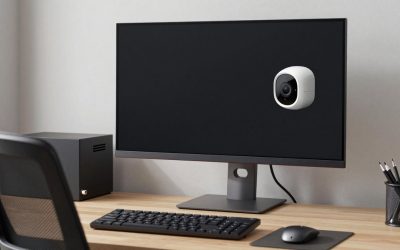
3. Wi-Fi / battery webcam for monitoring, not meetings. There is a small category of battery-powered 2K / 4K Wi-Fi cameras marketed as indoor wireless webcams. They are really security cameras. They are useful if you want to keep an eye on a kid’s playroom, a shop, or a second room while you work on your PC. They usually record to SD card or cloud and let you check in from an app.
Do not buy one as your main meeting camera. The problems I see repeatedly: no UVC support so Teams cannot select it directly, audio out of sync by a full second, night vision LEDs reflecting off windows, and a 10 to 20 second wake-up lag from sleep. If you need this use case, shop battery powered WiFi indoor cameras with PC viewing and treat it as a monitor, not a webcam.
Comparison: which wireless setup fits you
| Setup | Delay | Battery reality | Best for | Avoid if |
|---|---|---|---|---|
| Phone as Wi-Fi webcam | Low-moderate, 100-300ms | Drains in ~1 hour unless plugged in, runs hot | Desk workers who want better quality with no new camera | You do back-to-back calls all day |
| Action camera wireless | Moderate, 200-500ms over Wi-Fi | 45-75 min per battery | Moving demos, workshops, second angle | You want sharp face close-ups |
| Wi-Fi battery camera | High, 1-2 sec | Weeks on standby, hours when streaming | Room monitoring from PC | You need it for Zoom or Teams meetings |
| Wired 1080p USB webcam | Very low, under 100ms | Powered by USB, no charging | Daily meetings, laptops and desktops | You must walk around while presenting |
The table tells the real story. If low delay and reliability matter, wired still wins. Wireless only wins on freedom of movement.
How to make wireless actually work on PC
Put your PC on Ethernet if you can. That alone cuts most stutter when using a phone or action camera over Wi-Fi, because only one side of the connection is wireless. If you cannot run Ethernet, at least separate your networks. Put work video devices on 5GHz and leave smart home gear on 2.4GHz.
Lock exposure and focus. Wireless apps love to hunt for focus when you move, which looks amateurish. Set manual focus at arm’s length for desk use. Keep a small LED panel in front of you rather than relying on auto-brightness to compensate for a backlit window.
Always have a fallback. Keep a basic wired webcam plugged into your dock or monitor. When the wireless feed drops five minutes before a client call, and it will eventually, you can switch cameras in Zoom in two clicks instead of troubleshooting drivers while everyone waits.
FAQ
Can I get a truly wire-free webcam for Zoom on PC?
Not really. There is no mainstream battery-powered webcam that appears in Windows as a standard USB camera without extra software. Phone-as-webcam over Wi-Fi is the closest practical option, but keep it plugged into power during long calls.
Will a wireless webcam work with Teams and Meet?
Sometimes. If the camera needs an RTSP stream or proprietary app, Teams and Meet will not list it directly. You will need OBS Virtual Camera or the vendor’s PC utility, which adds delay and another point of failure. Check for UVC support before you buy.
Is audio worse on wireless setups?
Yes, usually. Phone mics pick up room echo when mounted three feet away, and Wi-Fi cameras compress audio heavily. For work calls, use a wired headset or a USB mic on your desk and set it as a separate audio input. Do not rely on the camera mic.
When is the cheaper option fine?
Most of the time. If you sit at a desk, a cheap wired 1080p webcam plus good lighting looks better than any wireless setup under $200. Spend the savings on a tripod mount for your phone if you occasionally need a wireless second angle.
Related Reviews & Guides

6 Best Laptop Notebook Stands 2026
Best 4K Webcam for Video Conferencing