Last Updated: October 18, 2026
- What noise cancelling actually does on a webcam
- What to look for for work calls
- The 4 types that make sense, compared
- If your room is quiet: save your money
- Best for most remote workers: mid-range 2K with software control
- If your house is loud: skip the webcam mic
- Setup mistakes that ruin noise cancelling
- FAQ
If you work from home, the microphone matters more than the camera. A sharp 4K image won’t save a call if your coworkers hear keyboard clatter, a barking dog, or room echo. A webcam with a decent noise-cancelling microphone fixes most of that without extra gear on your desk.
The catch: “noise cancelling” means very different things. Some webcams just have two microphones and basic echo removal. Others do real background suppression in firmware or with bundled software. For office work, Zoom, Teams, and Meet already do a lot of noise removal themselves, so you often don’t need the most expensive option.
📄 In This Review
- What noise cancelling actually does on a webcam
- What to look for for work calls
- The 4 types that make sense, compared
- If your room is quiet: save your money
- Best for most remote workers: mid-range 2K with software control
- If your house is loud: skip the webcam mic
- Setup mistakes that ruin noise cancelling
- FAQ
What noise cancelling actually does on a webcam
Most work webcams use two omnidirectional microphones spaced a few centimeters apart. The webcam compares the timing and volume between them to favor sound coming from directly in front — you — and turn down steady noise from the sides and behind.
That works well for constant sounds: fan hum, air conditioner, light typing, distant traffic. It works poorly for sudden, loud sounds close to the mic: a dog barking next to your desk, kids shouting in the same room, dishes in an open-plan kitchen. No dual-mic array can fully erase that, it can only soften it.
The other half is software. Zoom, Teams, Google Meet, and macOS Voice Isolation all add their own suppression. In practice, that software does more heavy lifting than the webcam hardware. If you are on calls all day in a noisy house, a dedicated noise cancelling USB headset for work calls will still beat any webcam mic, because the mic sits centimeters from your mouth.
What to look for for work calls
See also: Best Monitor for MacBook Air: Two USB-C 4K Screens and Six Adapter-Dependent Alternatives • Best Monitor for MacBook Pro: Eight Listings Sorted by Cable, Sharpness and Scaling
For home office use, prioritize these in order: pickup pattern, placement, and software control. Resolution comes last. A clean 1080p image with good exposure looks better than a grainy 4K sensor in a dim room.
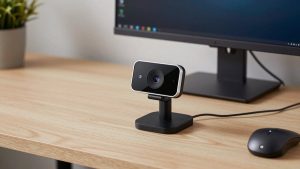
Look for dual stereo microphones with stated noise reduction, not a single mic hole. Check pickup range — most are tuned for 1 to 3 meters. Beyond that, echo gets worse fast. A physical privacy shutter and a decent clip matter more than they sound; if the webcam wobbles on a thin laptop lid, the mics pick up vibration.
On Macs, check that any background-removal or auto-framing app actually supports macOS. Some Windows-only utilities leave you with no way to adjust mic gain, focus, or noise level. On laptops, also check USB: USB-A webcams need an adapter or dock for newer MacBooks, and cheap adapters can cause dropouts. USB-C native or a good hub avoids that.
Failure mode to know: aggressive noise suppression clips the start of words and makes you sound underwater. If coworkers say you cut in and out, turn the webcam’s noise removal to medium or off and let Teams or Zoom handle it instead. Running two aggressive filters stacked is a common cause of robotic voice.
The 4 types that make sense, compared
Don’t shop by megapixels alone. Shop by your room and how you work. Here’s how the categories break down for call quality:
| Type | Video | Mic and noise handling | Best for | Trade-off |
|---|---|---|---|---|
| Budget 1080p with dual mics | 1080p/30, fixed focus | Basic beamforming, light fan/keyboard reduction | Quiet home office, laptop calls | Struggles in echoey rooms, no software tuning |
| Mid-range 2K/QHD with adjustable noise removal | 1440p, better low light | Dual mics + app with low/medium/high suppression | Most remote workers, shared apartments | Needs app setup, Mac support varies |
| Premium 4K with AI noise cancelling | 4K or downscaled 1080p, autofocus | Stronger voice isolation, often full-duplex echo cancel | Presenters, managers on calls all day | Price, can over-process voice if maxed out |
| Basic webcam + separate USB mic/headset | Use any 1080p cam | Best voice clarity, mic near mouth | Noisy homes, open offices, customer-facing roles | More gear, more cables |
If your room is quiet: save your money
If you have a door that closes and no constant background noise, a basic 1080p webcam with dual noise reduction microphone is fine. You will sound clear on Zoom and Teams because their own noise suppression will handle the rest.
Where cheap models fail: large bare rooms with echo, sitting more than an arm’s length away, and backlight from a window. No mic can fix a webcam placed on top of a 32-inch monitor three feet away in a tiled room. Move closer, add a rug or curtain, and face the light. That does more than spending an extra $100.
Who this suits: laptop workers who take 2-4 calls a day, students, anyone who mostly listens and talks briefly. Don’t buy 4K for this case. Your video gets compressed to 720p or 1080p by most meeting apps anyway.
Best for most remote workers: mid-range 2K with software control
This is the sweet spot. You get a larger sensor for dim home offices, autofocus that doesn’t hunt, and — most important — an app where you can set mic gain and noise removal level.
Set it up once: put noise removal on medium, mic gain at 70-80%, then do a test recording in Teams or QuickTime. Speak at normal volume while typing. If typing is loud, move the keyboard back 6 inches or lower mic gain a notch. If your voice pumps up and down, suppression is too high.
A 2K QHD webcam with noise cancelling microphone for Zoom and Teams also handles mixed lighting better — overhead lights plus a window — without blowing out your face. For Mac users, confirm the vendor app runs on Apple Silicon before you buy. Some only offer full controls on Windows, leaving Macs stuck on defaults.
Who this suits: people on camera 3-6 hours a day, shared apartments, anyone with a fan, HVAC vent, or street noise. It’s worth paying for if you lead meetings.
If your house is loud: skip the webcam mic
Kids, dogs, roommates on calls in the next room, kitchen noise — a webcam mic on top of your monitor will always pick that up because it’s three feet from you and three feet from everything else. Physics wins.
The reliable fix is a webcam for video plus audio from something close to your mouth. A cheap wired USB headset often sounds better than a $200 webcam’s mics in a noisy room. If you hate wearing a headset, a small desktop USB condenser mic with cardioid pickup placed 8-12 inches away is the next best step.
Failure mode here: Bluetooth earbuds. They are convenient, but their mic quality drops sharply in calls and they pick up more room noise than a wired headset. If you must use them, enable your meeting app’s noise removal on High and sit closer to your router to avoid stutter.
Who this suits: parents working with kids home, open living rooms, co-working spaces, support and sales roles where you talk for hours. Keep the webcam set to its camera only and select the headset as mic in Zoom/Teams settings.
Setup mistakes that ruin noise cancelling
First, stacking filters. If your webcam app, macOS Voice Isolation, and Zoom are all set to aggressive denoise, your voice will sound thin and clipped. Pick one — usually the meeting app — and turn the others down.
Second, wrong distance. Dual-mic arrays are tuned for 20 to 60 inches. Put the webcam at eye level on your monitor, not off to the side on a tripod or bookshelf. Side placement makes beamforming guess wrong and lets in more echo.
Third, speakers too loud. Even good echo cancellation fails if your speakers blast your coworker’s voice back into the mic. Use moderate speaker volume or wear earbuds for audio while using the webcam mic for talk. On MacBooks, check Sound settings to make sure input is the external webcam, not the internal MacBook mic, after every macOS update — it often resets.
FAQ
Do I need a 4K webcam for better microphone quality?
No. Video resolution and mic quality are unrelated. Many premium 4K models do have better mics, but you’re paying for the sensor and autofocus. If calls are your only need, a mid-range 1080p or 2K model with dual mics plus Zoom noise removal sounds just as good.
Why do I sound robotic with noise cancelling on?
Suppression is set too high, or two filters are running at once. Turn the webcam’s noise removal to low or medium, set Zoom/Teams to Auto or Medium, and turn off macOS Voice Isolation for a test. Retest with normal typing in the background.
Will a noise cancelling webcam remove echo in a large room?
Only partly. It reduces steady hum and some reflections, but bare walls and high ceilings cause echo no mic can fully fix. Get closer to the cam, lower speaker volume, and add soft furnishings. For persistent echo, a headset is more effective than any webcam upgrade.
Are webcam mics good enough for MacBook work calls?
Yes for quiet rooms, especially paired with macOS Voice Isolation or Teams noise suppression. For noisy homes, use a USB headset instead and use the webcam for video only. Always verify the webcam’s control app supports your macOS version before buying.
Related Reviews & Guides
Thunderbolt USB Hub (2026 Guide)

Reddit Best Webcam for Work