Last Updated: October 18, 2026
📄 In This Review
What PC Magazine actually picks
PC Magazine updates its best webcams list regularly, but the pattern is consistent. For work use they tend to favor the Logitech Brio line for plug-and-play reliability, the Dell UltraSharp WB7022 for image quality, and Obsbot models like the Tiny 2 for auto-tracking. Budget picks usually rotate between Anker and basic 1080p Logitech models like the C920s family.
If you just want the takeaway for video calls: PC Magazine rewards sharp 4K sensors, good low-light handling, and usable software. That is useful, but it is not the same as rewarding what matters most on a 9am Teams call – stable exposure, clean audio handoff, and no driver fuss on locked-down work laptops. Keep that gap in mind when you read their winners.
How PC Magazine tests vs. office reality
See also: Best Monitor for MacBook Air: Two USB-C 4K Screens and Six Adapter-Dependent Alternatives • Best Monitor for MacBook Pro: Eight Listings Sorted by Cable, Sharpness and Scaling
PC Magazine tests in a controlled way: still-image detail, color accuracy, low-light noise, field of view, microphone samples, and companion app features. That is helpful for comparing sensors head to head.
Home office reality is messier. You are usually backlit by a window, on hotel Wi-Fi or VPN, using Zoom or Teams noise suppression anyway, and mounting to a thin laptop lid or an external monitor. A webcam that wins on resolution can still fail you if it hunts for focus every time you lean forward, or if its Windows-only app is required to turn off an aggressive beauty filter. For Mac users especially, check macOS support before you buy – some Windows-centric utilities do not expose the same controls on Mac.
The categories that matter for work
Instead of chasing a single overall winner, match the category to your setup:
1. Reliable 1080p workhorse: Best for most office workers. You get 1080p30 or 1080p60, dual mics that are fine as a backup, autofocus that does not breathe, and a physical shutter. Image will not wow anyone, but IT departments like them because they work without admin rights. If your calls are 90% internal standups and client check-ins, stop here.
2. 4K premium for client-facing roles: Best for sales, coaching, teaching, creators doing office livestreams. You get a larger sensor, better dynamic range, and digital zoom without falling apart. The tradeoff is price, more CPU load, and larger file sizes if you record locally. Many people buy 4K and run it at 1080p for smoother performance – which is fine, you are paying for the better lens and low-light processing.
3. Auto-tracking / PTZ: Best if you present standing up, pace, or teach at a whiteboard. Gimbal-based models follow you and respond to gestures. The tradeoff is noise from the motor in a quiet room, occasional lost tracking when someone walks behind you, and software you will need to keep updated. Do not buy this to sit still at a desk; you will pay extra for a feature you disable.
Shoppers comparing current options often start with a broad search for a 1080p webcam for work video calls to see pricing for the reliable tier before deciding if 4K is worth it.
Comparison: what PC Magazine types favor
| Type | Typical example | Strength on calls | Weakness / failure mode | Who should buy |
|---|---|---|---|---|
| 1080p workhorse | Logitech C920s / C925e class | Stable exposure, wide compatibility | Soft in low light, narrow dynamic range with windows behind you | Office workers, IT bulk buys, laptop users |
| 4K business flagship | Logitech Brio class, Dell UltraSharp WB7022 class | Sharp detail, better low light, good auto-framing | Costs 2-3x more, needs good lighting to show difference, some features Windows-only | Client-facing, home office upgrades, Mac mini / desktop setups |
| Tracking camera | Obsbot Tiny 2 class | Follows presenter, hands-free framing | Motor hum, app dependency, can over-correct | Teachers, trainers, standing presenters |
| Budget 1080p | Anker PowerConf C200 class | Cheap, decent daylight image | Inconsistent white balance, flimsy mounts, poor mics | Students, second desk, travel kit |
Use that table as a filter. If you sit at a desk in a spare bedroom with one overhead light, moving from budget to mid-range 1080p with better low-light will help more than jumping to 4K.
Mounting, lighting, and Macs
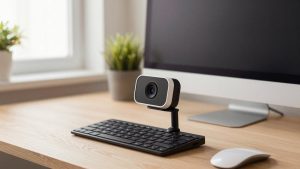
Most complaints I hear are not about sensors. They are about mounts and light. Thin laptop lids and curved gaming monitors make clamp-style webcams wobble. If you use a laptop on a stand with an external monitor, mount the camera at eye level on the monitor you actually look at, not perched high on the laptop. A $15 tripod or monitor shelf often improves perceived quality more than a $100 sensor upgrade.
Lighting is the same story. A window behind you will make even a PC Magazine Editors Choice pick look like a silhouette. Face the window if you can, or add a small key light. If you stay on late calls, look specifically for low-light samples, not daylight studio shots.
For Macs: Logitech and Anker are generally safe, but check whether features like background blur, firmware updates, or field-of-view adjustment require Windows. On Apple Silicon Macs, most modern webcams are UVC-compliant and work in FaceTime, Zoom and Teams without drivers, but companion apps may be Intel-only or limited. If you run a work-issued Mac with restricted installs, favor a camera that looks right with no app at all.
Those with external monitors and poor built-in laptop cameras often compare a 4K webcam for home office against a midrange 1080p model and pick based on low-light performance rather than resolution alone.
When the cheaper option is fine
Honestly, most workers should not buy the flagship. If your company compresses video to 720p anyway, if you use background blur, or if you wear a headset mic – and you should – a good 1080p camera in a lit room looks essentially the same to everyone else. Spend the savings on a headset or a light.
Pay more only if: you record training videos locally, you present to clients full-screen, your room is chronically dark, or you need a wider field of view for two people at one desk. Even then, test your current laptop camera first with better light. Recent MacBook and high-end Windows laptop cameras are surprisingly usable when they are not starved for light.
Travelers have a different calculus. A bulky 4K unit with a separate mount is annoying in a backpack. A compact 1080p model you will actually carry beats a flagship left at home. For that use case, browse a compact 1080p laptop webcam for travel and prioritize clip strength and a shutter cap over specs.
What to check before you buy
Before you checkout based on a PC Magazine badge, run this checklist: 1) Does it do 1080p30 minimum without requiring software? 2) Is there a physical privacy shutter? 3) Is the field of view adjustable – 78-90 degrees suits solo desk work, wider suits huddle rooms but distorts faces. 4) Are mics actually usable or will you use a headset? Do not pay for quad mics if you already own a headset. 5) Cable length and type – USB-C vs USB-A matters for MacBooks and docks. 6) Return policy, because focus hunting and color tint vary unit to unit.
Failure modes to expect: autofocus pulsing when you type and rock slightly, over-sharpened skin at default settings, auto white balance swinging orange under warm LEDs, and Teams/Zoom overriding your 4K setting back to 720p for bandwidth. None of those mean the camera is broken, but they explain why a top-rated camera can look average on a bad network.
FAQ
Is the PC Magazine No. 1 pick the best for Zoom and Teams?
Usually yes for image quality, but not always for work convenience. If their winner needs Windows software for key features or struggles without great light, a lower-ranked plug-and-play 1080p model may be better for daily calls, especially on a locked-down work laptop or Mac.
Do I need 4K for work video calls?
No, for most people. Live calls are heavily compressed, so others rarely see 4K. Buy 4K if you record locally, crop/zoom a lot, or work in low light where the larger sensor helps. Otherwise a good 1080p camera plus better lighting looks just as professional.
What webcam works best with MacBooks and Mac mini?
Look for UVC-compliant USB cameras from Logitech, Anker, or Dell that explicitly list macOS support. Avoid models where field-of-view, blur, or firmware updates are Windows-only unless you are fine with default settings. USB-C connection or an included adapter helps with modern Macs and docks.
Why does my new webcam still look bad?
Three common culprits: backlight from a window, too little light on your face, and the meeting app dropping resolution to save bandwidth. Face the light source, add a small lamp behind your monitor, mount at eye level, and test with a local recording app before blaming the camera.
Related Reviews & Guides

Best Computer Camera for Meetings
Web Camera for Desktop Computer