Last Updated: October 18, 2026
If you want to record videos with a webcam — YouTube talking-head videos, course lessons, demos for work — your priorities are different than for Zoom calls. For live calls, stability and low-light handling matter most. For recording, detail, focus behavior, exposure control, and audio matter more, because every mistake stays in the file.
Most people overbuy here. A sharp 1080p webcam with good light will beat a 4K webcam in a dim home office every time. Buy resolution last, after focus, exposure, audio, and mounting.
📄 In This Review
What matters for recording vs. live calls
Resolution is not image quality. Two webcams can both say 4K and look completely different. For recording, the sensor size, lens, and processing matter more. A larger sensor with clean 1080p will look better than a tiny sensor upscaled to 4K, especially indoors.
Autofocus behavior is the biggest failure mode. Many webcams pulse or hunt — sharp, soft, sharp again — when you move your hands or lean forward. That is distracting in a recorded video and hard to fix in editing. If you sit still and talk to camera, continuous autofocus is fine. If you hold products up to the lens, draw on a whiteboard, or move around, you want fast single autofocus with face tracking, or a manual focus lock.
Frame rate matters less than people think. 30 fps is fine for talking head, tutorials, and most course content. 60 fps helps only if you demo fast hand movements, unboxings, or do slow-motion B-roll. Do not pick 60 fps if it forces worse exposure or more noise in your room.
Exposure control is what separates usable from annoying. Webcams love to blow out windows and faces. For recording, you want exposure lock, white balance lock, and manual controls in the vendor app or in OBS / QuickTime / Photo Booth alternatives. Auto-everything looks okay for 10 seconds, then drifts when a cloud passes or you wear a white shirt.
Quick comparison by use case
See also: Best Monitor for MacBook Air: Two USB-C 4K Screens and Six Adapter-Dependent Alternatives • Best Monitor for MacBook Pro: Eight Listings Sorted by Cable, Sharpness and Scaling
There are really three webcam setups for recording. Pick by what you record, not by spec sheet.
| Setup | Best for | Strength | Weakness |
|---|---|---|---|
| Good 1080p webcam with autofocus | Talking head, coaching, course lessons, Loom-style updates | Reliable, small files, works on older laptops and Macs | Soft if you crop in, less detail for product texture |
| 4K webcam with large sensor | YouTube, product demos, detail work where you crop to vertical | More detail to crop, better digital zoom | Bigger files, needs good light and USB 3.0, can overheat on long takes |
| Webcam + separate mic and light | Anyone recording more than once a week | Audio and lighting upgrade matters more than camera upgrade | More setup, more cables |
When a basic 1080p webcam is enough
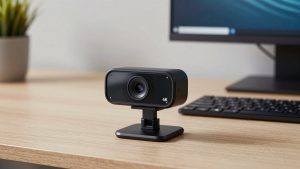
If you record yourself talking at a desk, 2-5 feet from camera, a basic 1080p webcam with autofocus and dual microphones is honestly fine. Put the savings into a $25-40 desk light and get close to a window.
Who it suits: managers recording async updates, teachers recording lessons, job seekers recording cover videos, anyone starting a channel and not sure they will stick with it.
Trade-offs: you cannot crop much. If you shoot wide 16:9 and then crop to 9:16 for Shorts or TikTok, 1080p gets soft fast. Fine detail like small text on packaging or fabric texture will smear. Low-light noise is also more visible after YouTube compression.
Failure modes to check in the first week: fixed-focus budget models that are sharp at 3 feet but soft at 18 inches; mics that pick up keyboard and fan noise; mounts that slowly droop on a laptop lid during a 20-minute take. Record a 5-minute test, watch it on a phone, and listen on earbuds. If focus holds and your voice is clear, keep it.
When 4K is worth it for recording
4K helps in two specific cases: you crop in post, or you want to show detail. If you demo crafts, electronics, makeup, or documents, and you punch in 150-200 percent, a good 4K webcam for video recording with autofocus keeps edges readable where 1080p falls apart.
Who it suits: YouTubers, Etsy sellers, course creators who record desk demos from above or at an angle.
Trade-offs: real 4K files are 3-4x larger, and many laptops stutter recording 4K while also running Chrome, Slack, and screen capture. On Macs especially, check that the vendor app supports Apple Silicon and that your recording app can actually capture 4K from that webcam — some only grab 1080p. Also plan on USB 3.0 directly into the laptop or a powered dock. Through an old USB 2.0 hub, many 4K webcams drop to 1080p or 15 fps.
Biggest recording complaint with 4K webcams is heat. After 30-45 minutes, some models get hot and soften focus or shut off. If you record long courses or webinars, do a full-length heat test before you commit. Leave it running for an hour pointed at yourself, then check the last 10 minutes.
Audio, light, and mounting matter more than the camera
Viewers forgive 1080p. They do not forgive echoey audio or a flickering face. The built-in mics on webcams are fine for calls, but for recording they pick up room echo and desk vibrations. If you record weekly, add a USB mic on a small stand or a wired lavalier. Record 10 seconds of silence in your room — if you hear hum, fan, or street noise, a mic closer to your mouth will help more than any camera upgrade.
For light, you do not need a studio. One soft light at 45 degrees, slightly above eye level, plus no bright window behind you, fixes 80 percent of webcam grain. Do not use auto-brightness plus a ceiling light directly overhead — that creates shiny foreheads and dark eyes.
For mounting, laptop lids are too low and wobble when you type. A small tripod or clamp mount at eye level makes you look more natural and reduces focus hunting. If you do overhead demos, get a boom arm or webcam tripod mount with overhead arm and lock focus before you start. Trying to hold a product steady with one hand while the webcam hunts is how good takes go bad.
When not to use a webcam
Be honest about limits. If you walk around, film outdoors, need blurry backgrounds, or shoot in very low light, a webcam is the wrong tool. A phone from the last 3-4 years on a tripod will record better video in those cases, with better stabilization and low-light handling. Use the webcam for desk-bound talking head and screen-plus-face, use the phone for everything else.
Also skip a new webcam if your current problem is software. Stuttering, out-of-sync audio, and dropped frames are often caused by recording to a full drive, recording 4K to an old laptop, or running Teams/Zoom in the background. Try 1080p at 30 fps, close other apps, and record to internal storage first.
FAQ
Is 4K necessary for YouTube with a webcam?
No. YouTube compresses heavily, and clean 1080p with good light and clear audio performs fine for talking head. Get 4K only if you crop to vertical or show small detail.
Why does my recorded webcam footage look worse than the preview?
Usually low light plus compression. The preview is uncompressed. The recording adds noise reduction and encoding. Add light, lock exposure, and record at the highest bitrate your app allows.
Can I record 60 fps with a webcam on Mac?
Sometimes. It depends on the webcam, the USB port/hub, and the app. Many Mac apps default to 30 fps. Test in QuickTime Player, OBS, or Photo Booth replacement first before assuming 60 fps will work.
Should I use the webcam mic or a separate mic for recording?
Use a separate mic if anyone will rewatch the video. A USB mic 6-12 inches from your mouth reduces echo and keyboard noise dramatically compared to a webcam mic 2-3 feet away.
Related Reviews & Guides

Best Webcam Compatible with Mac
Canon Imageformula R40II Review: Pros, Cons and Who It’s For