Last Updated: October 18, 2026
Your M1 Mac – whether it’s a MacBook Air, MacBook Pro, or Mac mini – handles Zoom, Teams, and Meet without breaking a sweat. The problem is the camera. M1 MacBooks still use a 720p FaceTime camera that looks soft and noisy, and the Mac mini doesn’t have one at all. An external webcam is the fastest upgrade you can make for work calls.
The good news: M1 Macs are easy to shop for if you stick to standards. The bad news: not every “Windows-ready” webcam behaves well on macOS. Software features often don’t carry over, and cheap 4K models can stutter if you plug them into the wrong hub.
📄 In This Review
What actually matters on an M1 Mac
Forget the spec sheet for a minute. On Apple Silicon, compatibility matters more than megapixels. Look for UVC compliance – USB Video Class. UVC webcams work with macOS natively, no driver needed. You plug it in, then select it in Zoom, Teams, FaceTime, or Photo Booth. Almost all mainstream webcams are UVC now, but some business models with Windows-only configuration tools lock white balance, zoom, or shutter behind an app you can’t install on a Mac.
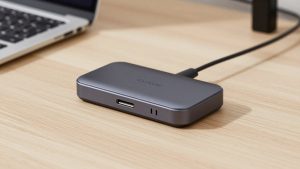
Second is connection and power. M1 MacBooks only have USB-C / Thunderbolt ports. Most webcams still ship with USB-A plugs. That means a dock or adapter in your chain. It usually works fine, but unpowered adapters are a common failure mode: the camera connects, then drops to low resolution or freezes when autofocus and the mic turn on. If you already have disconnects, a USB-C hub with powered USB-A ports solves more webcam problems than buying a more expensive camera.
Third is focus and field of view. For desk work at arm’s length, fixed focus is actually a plus. No hunting, no pulsing during a call. Autofocus is better if you move around, whiteboard, or demo products. For field of view, 65 to 78 degrees looks natural in a home office. Anything over 90 degrees makes you tiny and shows your whole room unless you plan to crop.
Picks by use case
See also: Best Monitor for MacBook Air: Two USB-C 4K Screens and Six Adapter-Dependent Alternatives • Best Monitor for MacBook Pro: Eight Listings Sorted by Cable, Sharpness and Scaling
Budget 1080p webcam: fine for most work calls
If you just want to look clear on daily standups, a basic 1080p webcam is enough. On an M1 Mac this is plug-and-play. Image quality in good light is dramatically better than the built-in 720p camera, especially for eyebrows, glasses, and text on a shirt.
Trade-offs: small sensor, so low light gets grainy fast. Auto-exposure will blow out a window behind you. Built-in mics pick up keyboard noise. Who it suits: laptop workers with a decent overhead light who want a set-and-forget upgrade. Be honest with yourself here – if your room is bright during work hours, don’t pay double for a better sensor you won’t notice. A budget 1080p webcam for Mac plus a $20 desk lamp will beat a premium webcam in a dark room.
Failure mode to know: many budget models default to 30 fps at 1080p but drop to 15 fps in dim light to gather more light. That looks laggy. Add light rather than returning the camera.
Mid-range 1080p with large sensor: best for home office regulars
This is the sweet spot for M1 Mac owners who are on camera 3-6 hours a day. You still get 1080p, but with a larger sensor, better low-light handling, and dual noise-reducing mics. Colors look less washed out, and backgrounds don’t go blocky when you move.
Trade-offs: physically larger, needs a solid clip if you use it on a thin MacBook lid. Some models add Windows-only background blur or auto-framing that won’t run on macOS – you’ll rely on Zoom or Teams effects instead. Who it suits: managers, teachers, therapists, and anyone who can’t control lighting perfectly.
Failure mode to know: auto-framing models can slowly drift during long calls on Mac because you can’t turn the sensitivity down without the Windows app. If that bothers you, choose a model with a physical focus or fixed framing.
4K webcam: only if you crop or record
4K sounds like future-proofing, but for live calls it’s mostly wasted. Zoom and Meet compress you to 720p or 1080p anyway. Where 4K helps on an M1 Mac is if you record training videos, want to crop in to a head-and-shoulders shot from a wider mount, or sit far from a Mac mini setup in a conference corner.
Trade-offs are real: 4K needs more light, more USB bandwidth, and more CPU to process. On an M1 Air through a cheap hub, 4K/30 can stutter while screen sharing. Many people end up running their 4K camera at 1080p for calls, which defeats the purpose. Who it suits: creators and anyone using the webcam as a recording camera. Everyone else should skip it. If you do buy, look for a 4K webcam for Mac that explicitly lists MJPEG or H.264 modes for Mac and includes a USB-C cable in the box.
Use your iPhone as the webcam: sharpest image, most hassle
Apple’s Continuity Camera lets a recent iPhone act as your M1 Mac’s webcam over USB or wireless. Image quality beats any sub-$200 webcam, especially in mixed light. Desk View and Center Stage are genuinely useful for demos.
Trade-offs: you need a mount, your phone is tied up during calls, and wireless mode can overheat the phone and add 0.5-1 second delay. Wired over USB is far more reliable for work. Who it suits: MacBook owners who already have an iPhone 11 or newer and do 1-2 important calls a week where they want to look excellent. It’s not ideal as a daily driver if you need your phone for two-factor logins during the call.
Quick comparison
| Option | Resolution for calls | Best for | Watch out for |
|---|---|---|---|
| Budget 1080p UVC webcam | 1080p / 30fps | Daily Zoom, tight budget | Noisy in low light, basic mic |
| Mid-range 1080p with large sensor | 1080p / 30-60fps | All-day home office use | Bulky clip, some features Windows-only |
| Premium 4K webcam | 1080p for calls, 4K for recording | Recording, cropping, mini setups | Needs light and bandwidth, can stutter via hub |
| iPhone Continuity Camera | 1080p to 4K depending on app | Best image with gear you own | Mount needed, phone unavailable, heat on wireless |
Making it work reliably on M1
Plug directly into the Mac or a powered dock first when testing. If the image freezes when you enable the mic, that’s almost always power, not a broken camera. Avoid stacking two adapters – USB-A webcam to USB-A to USB-C dongle to Thunderbolt dock is asking for dropouts.
Set expectations for software. On macOS Ventura and Sonoma, use Photo Booth or QuickTime Player > New Movie Recording to verify the camera before blaming Zoom. If Zoom sees it but Teams doesn’t, check System Settings > Privacy & Security > Camera. M1 Macs sometimes keep the old permission after you unplug and replug.
Light matters more than resolution. Face a window or put a diffuse lamp behind your monitor at eye level. Close blinds behind you. Set the webcam to 1080p, not 4K, for live calls unless you have a specific reason. Your M1 will run cooler, fans stay off, and you will actually look sharper because the exposure has headroom.
For audio, even good webcam mics sound hollow at 3 feet in an echoey room. If people ask you to repeat yourself, a wired earbud mic or a small USB mic 12 inches away will do more than upgrading the webcam again.
FAQ
Do I need drivers for a webcam on M1 Mac?
No, if it’s UVC-compliant. It should appear in FaceTime, Zoom, and Teams without installing anything. Avoid models that require a driver download for basic video – those are usually built for Windows conferencing systems.
Why does my webcam look worse on Mac than on Windows?
Often it’s the configuration app. Features like HDR, auto-focus speed, and noise reduction sometimes default to off and can only be toggled in a Windows app. Set it once on a PC if you can, as many cameras remember the setting, or just buy a simpler UVC model.
Will a 4K webcam slow down my M1 MacBook Air?
It can during screen share plus 4K capture plus background blur. The M1 Air has no fan, so it will throttle rather than get loud. Running the camera at 1080p for calls avoids this in most cases.
Is Continuity Camera better than buying a webcam?
For pure image quality, yes. For convenience, no. If you’re on camera all day, a dedicated webcam you can leave clipped to your monitor wins. Use Continuity Camera for interviews, sales calls, and recordings.
Related Reviews & Guides

Webcam for PC with Mic Price
Best Camera and Microphone for Zoom