Last Updated: October 18, 2026
If you are shopping for a webcam for PC with mic, price tells you a lot — but not what most listings claim. A $29 camera and a $129 camera can both say “1080p HD with built-in microphone.” In actual Zoom, Teams, and Meet calls, they look and sound very different.
For work use on a Windows desktop or laptop, you are paying for three things: low-light performance, autofocus reliability, and how the microphone handles room echo and keyboard noise. Resolution on the box matters less than those three.
📄 In This Review
What price actually buys you
PC webcams with mics fall into three real tiers in 2025-2026. Under $35 gets you basic 1080p, fixed focus, and dual holes for mics that pick up everything. From $50 to $100 you get autofocus, better sensors, and noise-reducing mics. Over $120 you are paying for larger sensors, 2K or 4K, and software for framing and background blur.
The jump from $30 to $70 is the one you will notice on calls. The jump from $70 to $150 is subtler and mostly matters if you present, teach, or record.
| Price range | Typical video | Typical mic | Best for |
|---|---|---|---|
| $25 – $40 | 1080p fixed-focus, soft in low light | Basic stereo, no noise removal | Occasional calls in a quiet, bright room |
| $50 – $90 | 1080p autofocus, usable in home office light | Dual mics with noise reduction | Daily Teams / Zoom / Meet for work |
| $110 – $180 | 2K to 4K, larger sensor, auto-framing | Beamforming mics, clearer voice at distance | Presenting, teaching, streaming from PC |
Under $40: when cheap is fine
See also: Best Monitor for MacBook Air: Two USB-C 4K Screens and Six Adapter-Dependent Alternatives • Best Monitor for MacBook Pro: Eight Listings Sorted by Cable, Sharpness and Scaling
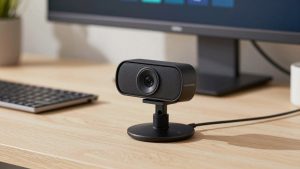
A basic 1080p webcam with microphone for PC is fine if you do two or three calls a week, sit close to the screen, and have decent daylight or a desk lamp in front of you. Plug it into USB-A, clip it to the monitor, select it in Windows sound settings, and you are done.
Trade-offs are concrete. Most budget models are fixed focus, usually sharp from about 2 to 6 feet. Sit too close and your face softens. Sit in a dim room and the image gets grainy and lags slightly because the sensor drops shutter speed to gather light. The mic will work, but it hears your keyboard, fan, and room echo almost as loudly as your voice.
Failure mode to expect: colleagues say you sound distant or hollow. That is not fixable with settings. If that matters, skip this tier or plan on a separate $20 USB headset for speaking.
$50 to $90: the work sweet spot
For most PC home offices, this is where to buy. You get true autofocus, a sensor that holds up under a single ceiling light, and mics that actively cut steady background noise like HVAC hum and typing.
Look for three specifics: autofocus (not fixed focus), dual omnidirectional microphones with noise reduction listed as DSP or noise-canceling, and a 78- to 90-degree field of view. Wider than 90 degrees looks impressive but makes you small and shows your whole room. A privacy shutter and tripod thread are useful if you use an external monitor arm or want the camera at eye level.
In testing, the practical difference is fewer “can you repeat that?” moments. Your face stays sharp if you lean in to share a screen, then lean back. Your voice stays forward while keyboard clicks drop back. You still need to be within 3-4 feet for best mic pickup. Beyond that, even good built-in mics pick up reflections from bare walls.
$110 to $180: who should pay more
A premium 2K autofocus webcam with dual microphone for Windows makes sense for three people: managers who present all day, teachers and coaches who move around, and anyone recording Loom-style videos on the same PC they meet on.
You get a larger sensor for cleaner evening image, 2K or 4K downscaled to 1080p for Teams/Zoom, and smarter auto-exposure that does not blow out your face when a window is behind you. Some add auto-framing that follows you slightly. Useful, but turn it off for formal presentations — the slow pan distracts people.
Honest limit: Teams and Zoom still compress you to 720p or 1080p most of the time. No one on the other end sees full 4K. You are paying for a cleaner, sharper 1080p feed and better low-light, not for them seeing four times the detail. The mics are better, but they are still 2 feet from you on top of a monitor. If you work in a noisy living room, a dedicated USB mic or headset will still beat any built-in webcam mic at any price.
What to check before you pay
Do not buy on megapixels. Check these instead. One, Windows compatibility: UVC plug-and-play over USB-A or USB-C is what you want. Avoid cameras that require a permanent driver app just to output 1080p. Two, focus type: fixed focus is only okay if you never move. For sit-stand desks or leaning, get autofocus.
Three, mic pickup pattern and controls. You want dual mics and a physical or Windows-level mute that actually works. Test in Windows Settings > System > Sound > Input. Speak at normal volume and watch the level bar. If it barely moves at 3 feet, return it. Four, mounting: a heavy clip slips on thin laptop lids and ultra-thin monitors. If you use a laptop docked to a monitor, get a model with a flat fold and tripod thread so you can put it on a small tripod at eye level.
Finally, lighting beats price. A $60 webcam with a $15 desk lamp aimed at your face will look and sound more professional than a $150 webcam in a dark room with a bright window behind you.
How not to overpay
If your PC already has a decent built-in mic array — many business laptops do — you can buy for video quality first and keep using the laptop mic. If you mostly listen and speak briefly, the cheaper option is fine.
If you speak for hours, put the extra $30 toward the mid-range tier, not 4K. And if you need to look good for clients, consider a webcam with ring light and microphone only if your room is truly dark. The built-in light helps in a pinch, but it is harsh up close and creates glasses glare. A separate small LED panel off to the side looks far better.
FAQ
How much should I spend for daily work calls on PC?
$50 to $90. That gets you reliable autofocus and noise-reducing mics, which matter more than 2K/4K for Teams and Zoom.
Is a webcam mic good enough for work?
Yes within 3-4 feet in a quiet room. For open rooms, loud typing, or long presenting, a USB headset or desktop mic will be clearer than any built-in webcam mic.
Do I need 4K for a PC office webcam?
No for most meetings. Meeting apps compress video anyway. Buy 4K only if you also record video and want cleaner downscaled 1080p and better low-light.
Why do I look dark even with an expensive webcam?
Backlight. If a window or bright lamp is behind you, the camera exposes for that. Face a light source, close blinds behind you, and set exposure to manual or +0.5 to +1.0 if your camera app allows it.
Related Reviews & Guides


Best Laptop for Webcam Modeling 2026

LG vs Samsung Monitor: How to Choose Between the Two Brands