Last Updated: October 9, 2026
- What Determines the Right Desk Height
- Ideal Seated Desk Height by Your Height
- Ideal Standing Desk Height by Your Height
- How to Measure Your Ideal Desk Height at Home
- What to Do If You Can’t Change the Desk
- Don’t Forget the Monitor
- Why the Wrong Desk Height Causes Real Problems
- Adjusting for Keyboard Thickness and Desk Slope
- Top-Rated Picks
- Frequently Asked Questions
- Conclusion
- Related Articles
- Related Guides
⚡ Key Takeaways
- The correct desk height is not about the desk in isolation.
- The table below gives recommended seated desk heights based on user height.
- If you stand to work, the same elbow rule applies, but the numbers are higher because you are upright.
- You do not need the tables if you are willing to measure yourself.
Figuring out the ideal desk height is one of the most overlooked steps in building a comfortable workspace, yet it has an outsized effect on your wrists, shoulders, neck, and lower back. Most desks sold today are built to a standard height of about 29 inches (73.7 cm), but that figure is an average designed for a person around 5 feet 10 inches tall. If you are shorter or taller than that, a “standard” desk almost guarantees you are reaching up or hunching down all day. This guide gives you exact desk heights based on your own height, explains how to measure correctly, and shows how to adjust your setup when changing the desk itself is not an option.
Related: best standing desks with storage.
🛒 Best Price Today on Amazon
Prime members get fast, free shipping on everything above, plus member-only deals. New members get a 30-day free trial — cancel anytime.
📄 In This Review
- What Determines the Right Desk Height
- Ideal Seated Desk Height by Your Height
- Ideal Standing Desk Height by Your Height
- How to Measure Your Ideal Desk Height at Home
- What to Do If You Can’t Change the Desk
- Don’t Forget the Monitor
- Why the Wrong Desk Height Causes Real Problems
- Adjusting for Keyboard Thickness and Desk Slope
- Top-Rated Picks
- Frequently Asked Questions
- Conclusion
- Related Articles
- Related Guides
What Determines the Right Desk Height
The correct desk height is not about the desk in isolation. It is about the relationship between your elbows, your keyboard, and your forearms. The guiding principle of seated ergonomics is simple: when your hands rest on the keyboard, your elbows should sit at roughly a 90-degree angle, and your forearms should be parallel to the floor or angled very slightly downward.
When that relationship is correct, your shoulders relax, your wrists stay neutral, and the small muscles of your forearms are not constantly fighting gravity. When the desk is too high, your shoulders creep up toward your ears. When it is too low, you slump forward and round your back. Either way, discomfort builds over hours.
Ideal Seated Desk Height by Your Height
See also: Best Monitor Under 300: Eight Listings Compared by Refresh Claims, Panel Type and Pixel Load • Best Adjustable Standing Desk Converters for Dual Monitors: Width, Weight and Fit Compared
The table below gives recommended seated desk heights based on user height. These assume a properly adjusted chair where your feet are flat and your thighs are roughly parallel to the floor. If your desk cannot be lowered to these numbers, adjust the chair up and add a footrest.
| Your Height | Seated Desk Height (inches) | Seated Desk Height (cm) |
|---|---|---|
| 5’0″ (152 cm) | 24.0″ | 61 cm |
| 5’3″ (160 cm) | 25.5″ | 65 cm |
| 5’6″ (168 cm) | 26.5″ | 67 cm |
| 5’9″ (175 cm) | 28.0″ | 71 cm |
| 6’0″ (183 cm) | 29.5″ | 75 cm |
| 6’3″ (190 cm) | 30.5″ | 77 cm |
| 6’6″ (198 cm) | 32.0″ | 81 cm |
Notice that the popular 29-inch desk only truly fits people around 6 feet tall. This is why so many shorter users feel like they are reaching upward and so many taller users feel cramped.
Ideal Standing Desk Height by Your Height
If you stand to work, the same elbow rule applies, but the numbers are higher because you are upright. Set the keyboard surface so your elbows stay near 90 degrees while standing tall.
| Your Height | Standing Desk Height (inches) | Standing Desk Height (cm) |
|---|---|---|
| 5’0″ (152 cm) | 35.5″ | 90 cm |
| 5’3″ (160 cm) | 37.5″ | 95 cm |
| 5’6″ (168 cm) | 39.5″ | 100 cm |
| 5’9″ (175 cm) | 41.5″ | 105 cm |
| 6’0″ (183 cm) | 43.5″ | 110 cm |
| 6’3″ (190 cm) | 45.5″ | 116 cm |
| 6’6″ (198 cm) | 47.5″ | 121 cm |
How to Measure Your Ideal Desk Height at Home
You do not need the tables if you are willing to measure yourself. Follow these steps:
- Sit in your work chair with your feet flat on the floor and your back supported.
- Relax your shoulders and let your upper arms hang straight down.
- Bend your elbows to 90 degrees so your forearms are parallel to the floor.
- Have someone measure the distance from the floor to the underside of your forearm or elbow.
- That measurement is your ideal keyboard surface height. Match your desk to it, or get as close as possible and adjust from there.
What to Do If You Can’t Change the Desk
Most people own a fixed-height desk, so the real skill is adapting the rest of the setup. Here are the most effective fixes:
- Desk too high: Raise your chair until your elbows reach desk level, then support your feet with a footrest so your thighs stay level. A dedicated footrest prevents the dangling-feet problem that causes thigh pressure and poor circulation.
- Desk too low: Lower your chair if possible, or raise the desk with sturdy risers. Avoid hunching to reach a low keyboard.
- Laptop too low: Laptops force a compromise because the screen and keyboard are attached. Raising the screen to eye level with a laptop stand and adding an external keyboard solves both problems at once.
Don’t Forget the Monitor
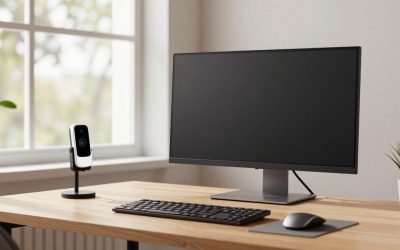
A perfect desk height still leaves your neck unsupported if the screen is too low. Once your keyboard and chair are dialed in, the top of your monitor should sit at or just below eye level, about an arm’s length away. Getting both right is the foundation of a comfortable workstation, and you can go deeper in our guide to standing desk converters if you want to adjust both sitting and standing heights without buying a new desk.
Why the Wrong Desk Height Causes Real Problems
It is tempting to treat desk height as a minor detail, but a surface that is even an inch or two off forces your body into compromises that compound over a full workday. When the desk sits too high, you unconsciously raise your shoulders to bring your hands up to the keyboard. Held for hours, that subtle shrug becomes chronic tension across the upper trapezius muscles, which is one of the most common sources of tension headaches and that nagging knot between the shoulder blades.
A desk that is too low creates the opposite problem. To reach the keyboard you lean forward and let your spine round, flattening the natural inward curve of your lower back. That posture increases pressure on the lumbar discs and puts the stabilizing muscles of your core to sleep. The discomfort often does not announce itself until the end of the day, which is exactly why people rarely connect their afternoon backache to a desk that is a couple of inches too low.
Wrist position suffers too. The ideal is a straight, neutral wrist while typing. A desk at the wrong height pushes your wrists into extension, bending them upward, which narrows the carpal tunnel and over time contributes to the tingling and numbness associated with repetitive strain. Getting the height right is therefore not about comfort alone; it is a genuine factor in preventing the cumulative injuries that affect so many desk workers.
Adjusting for Keyboard Thickness and Desk Slope
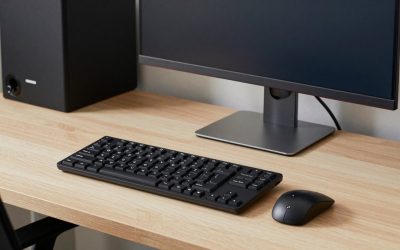
One detail that throws off otherwise careful measurements is the keyboard itself. The numbers in this guide refer to the height of the typing surface, meaning where your hands actually rest, not the bare desktop. A thick mechanical keyboard can add an inch or more, effectively raising your hands above the desk surface. If you use a tall keyboard, set the desk slightly lower so your hands still land at the correct elbow height. A low-profile keyboard needs no such adjustment. Small as this sounds, it is the difference between a setup that measures perfectly on paper and one that actually feels right in practice.
Top-Rated Picks


| Product | Brand | Rating | Reviews | Price |
|---|---|---|---|---|
| FLEXISPOT EN1 One-Piece Standing Desk, Electric Adjus… | — | ★ 4.5 | 12.5k | $109.99 |
| ErGear Height Adjustable Electric Standing Desk, 48 x… | ErGear | ★ 4.5 | 11.3k | $109.99 |
| Cubiker Standing Desk, 48×24 Inches Sit Stand Home Of… | CubikerHomeOfficeFurniture | ★ 4.7 | 4.3k | $86.01 |
| FEZIBO Standing Desk, 48 × 24 Inches Electric Height … | FEZIBO | ★ 4.6 | 4.6k | $99.99 |
| Desktronic HomeOne Standing Desk 48×24 — Ergonomic Si… | Desktronic | ★ 4.8 | 3k | $449.99 |
Frequently Asked Questions
What is the standard desk height?
The standard desk height is about 29 inches (73.7 cm). This was designed for an average person around 5 feet 10 inches tall, which is why it feels too high for shorter users and too low for taller ones.
How do I know if my desk is too high?
If you have to shrug or raise your shoulders to reach the keyboard, or if your wrists bend upward, the desk is too high. You may also notice tension across your upper shoulders and neck after an hour or two.
Is it better to have a desk slightly too high or too low?
Slightly too high is usually easier to fix because you can raise your chair and add a footrest. A desk that is too low forces you to hunch, which is harder to correct without raising the entire surface.
Does desk height change if I use a standing desk?
Yes. Standing desk heights are significantly higher than seated heights because you are upright. The elbow rule stays the same, but the keyboard surface needs to be roughly 10 to 18 inches higher than your seated height depending on your stature.
What if two people share the same desk?
A height-adjustable desk is the simplest solution because each person can set their own height in seconds. If the desk is fixed, set it for the taller person and have the shorter person raise their chair and use a footrest.
Conclusion
The ideal desk height is personal, not universal. Use your elbow position as the anchor: forearms parallel to the floor, shoulders relaxed, wrists neutral. Match your desk to your measured height when you can, and adapt with a footrest, chair adjustment, or laptop stand when you cannot. A few inches in either direction makes the difference between a workspace that supports you and one that quietly wears you down.
Related Reviews & Guides


How to Get the Assassin Class in 99 Nights in the Forest
How to Craft the Sanrei Glove in VV Ultimatum