Last Updated: October 18, 2026
If you stream for hours from a webcam — whether that’s client calls, teaching, live selling, or cam work — the computer matters more than the camera. A weak CPU will drop frames, overheat, and desync audio long before a good 1080p webcam hits its limit. I have tested this setup a lot: OBS + browser + chat + lights, all running at once.
You do not need a gaming monster. You need sustained CPU performance, enough RAM to keep 20 Chrome tabs open, quiet cooling, and the right ports. Here is what to buy without overpaying.
📄 In This Review
What actually matters for webcam streaming
Encoding is the bottleneck. Live streaming in OBS, Streamlabs, Zoom, or browser-based sites uses x264 or hardware encoding constantly. That is very different from office work, which is bursty. A laptop that feels fast for Word will still throttle after 45 minutes of 1080p30 encoding if the cooling is poor.
Prioritize this order: 1) modern 6-core+ CPU with hardware encoder, 2) 16GB RAM minimum, 3) good thermals and fan noise, 4) SSD 512GB or larger, 5) ports and network. GPU only matters if you add overlays, background blur, virtual camera effects, or stream and game from the same machine.
For encoders: Intel Quick Sync (12th-gen and newer), Apple Media Engine (M1 and newer), and NVIDIA NVENC (RTX 3050 and up) all handle 1080p streaming easily with low CPU load. Avoid relying on software x264 Very Fast on an old dual-core or Pentium/Celeron — that is the classic failure mode: fine for 10 minutes, then stutter.
Minimum specs I would buy in 2026
See also: Best Monitor for MacBook Air: Two USB-C 4K Screens and Six Adapter-Dependent Alternatives • Best Monitor for MacBook Pro: Eight Listings Sorted by Cable, Sharpness and Scaling
Do not buy less than this if streaming is income. If you only do 1-2 Zoom calls a day, you can go lower, but for 3+ hours live, stick to this baseline.
| Part | Minimum for camming/streaming | Sweet spot | Why |
|---|---|---|---|
| CPU | Intel Core i5-1240P / Ryzen 5 5600U / Apple M1 | Intel Core i7-13700H / Ryzen 7 7840U / Apple M3 | Holds 1080p encode without maxing fans |
| RAM | 16GB | 16-24GB | Browser + OBS + chat bots eat 10-12GB fast |
| Storage | 512GB SSD | 512GB-1TB SSD | 256GB fills up with recordings in weeks |
| Network | Wi-Fi 6 + Ethernet adapter | Built-in Ethernet or 2.5GbE dock | Wired cuts 90% of dropped-frame complaints |
| Ports | 2x USB-A + 1x USB-C, HDMI | 3x USB-A/C on separate buses + HDMI 2.0 | Webcam + mic + light + Ethernet need real ports |
| Webcam | Good 1080p external | 1080p60 or 4K downscaled to 1080p | Built-in laptop cams still look soft in low light |
One trade-off people miss: thin ultrabooks throttle. A thicker 3.5 lb creator laptop with two fans will outperform a 2.2 lb ultrabook with the same chip after an hour. If you stream daily, take the slightly heavier machine.
Best budget option: mid-range Windows laptop
For most people, a $650-$900 Windows laptop with a Ryzen 7 or Core i7-P/H chip and 16GB RAM is the value winner. It runs OBS, Chrome, Spotify, and a USB webcam and mic with headroom, and Quick Sync handles the encode so the CPU stays around 30-40%.
What to check before you buy: make sure RAM is 16GB soldered or upgradable (not 8GB), screen is IPS 300 nits or better for checking focus, and it has full-size USB-A ports. Many cheap laptops now have only USB-C, which means you live on a hub — hubs cause the second most common failure I see: webcam disconnects when mic + light share one underpowered hub.
Who it suits: beginners, part-time streamers, anyone who needs Windows-only apps. When the cheaper option is fine: if you stream 1080p30 with one camera and no gaming, you do not gain anything by spending $1,500. Put the difference into lighting and a budget laptop for streaming paired with wired Ethernet.
Best for Mac users: MacBook Air M3 / MacBook Pro M3
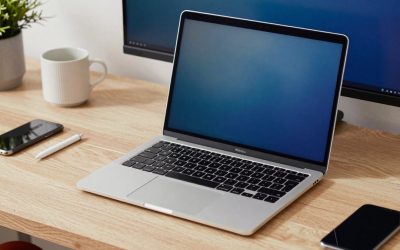
If you prefer macOS, the Air is genuinely enough now. The M1/M2/M3 chips encode 1080p with very low heat and the fanless Air stays silent, which matters a lot for mic noise. I have run 2-hour OBS streams on an M2 Air with CPU to spare.
Trade-offs: Macs are pickier about USB gear. Some older capture cards and DSLR-as-webcam utilities have flaky Mac drivers. Test your exact webcam, mic interface, and lighting control app first. Also, base 8GB models will swap heavily with Chrome + OBS + backgrounds — get 16GB, non-negotiable, and 512GB storage if you save recordings locally.
Pick Air if you want silent, portable, and long battery. Pick 14-inch Pro if you stream 4+ hours, use multiple cameras, or use background effects and multitrack recording. A current MacBook Air with 16GB is the model most solo webcam workers should shortlist.
Best for full-time: small desktop or mini PC
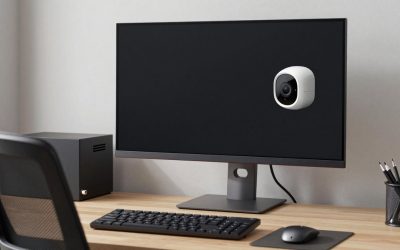
If you stream from the same desk every day, a desktop wins. Better cooling, no battery wear, more USB ports on separate controllers, and cheap upgrades. You do not need a tower — a Ryzen 7 mini PC or an Intel i5/i7 SFF desktop with 16-32GB RAM handles two webcams, OBS, and chat easily and stays quieter than any laptop at full load.
Failure mode desktops avoid: thermal throttling and port starvation. Laptops often put all USB ports on one internal hub. Plug in a 4K webcam, USB mic, Stream Deck, and Ethernet adapter and you get bandwidth dropouts. A desktop lets you spread devices across front/rear ports.
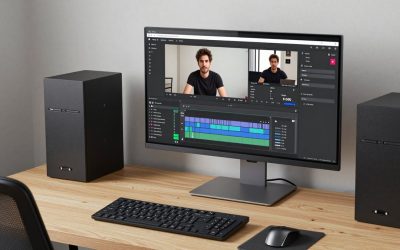
Downside is portability and upfront extras — you need monitor, keyboard, and ideally a UPS if your income depends on staying live through blips. A mini PC with Ryzen 7, 24GB RAM, and 1TB SSD is often $600-$800 and beats a $1,200 ultrabook for sustained streaming.
Setup mistakes that look like a slow computer
Half the lag complaints I hear are not the CPU. First, use wired Ethernet. Wi-Fi jitter causes frozen frames even on an M3 Max. Second, plug the webcam directly into the laptop, not through a $15 hub with the ring light and mic. Third, close Chrome hardware acceleration conflicts: run OBS as administrator on Windows, cap canvas to 1080p, and let the camera output 1080p30 instead of forcing 4K60 through USB 2.0.
Also watch lighting. A dim room forces the webcam to gain up, which looks noisy and makes autofocus hunt. A $40 key light lets you drop from ISO 2000 to ISO 400, which looks like a camera upgrade and lowers CPU denoising load. If fans scream, lift the laptop for airflow — a $20 stand drops temps 5-8C and cuts mic fan noise more than any software filter.
FAQ
Do I need a gaming laptop with RTX for camming?
No, unless you game and stream on one PC or use heavy AI background effects. For single-webcam 1080p, modern Intel, AMD, or Apple hardware encoding is enough. Buy better cooling and 16GB RAM before you pay for a GPU.
Is Mac or Windows better for webcam streaming?
Both work. Windows supports more capture cards, DSLR apps, and toys. Mac is quieter and more efficient for basic OBS + webcam. Choose based on the apps and gear you already own, not image quality — the encoder difference at 1080p is small.
How much upload speed do I need?
For stable 1080p30, aim for 12-15 Mbps upload minimum, 20+ Mbps ideal. More important than speed is stability: wired Ethernet, no roommates uploading 4K, and modem not overheating. Test with a 10-minute private stream before going live.
Should I use the built-in laptop camera?
Use it only as backup. Even good 1080p built-ins have tiny sensors and fixed exposure that looks washed out under ring lights. A dedicated $70-$130 external 1080p webcam with manual exposure will look sharper on any computer, new or old.
Related Reviews & Guides
Best Computer Camera with Ring Light
Best HD Webcam for Desktop