Last Updated: October 18, 2026
📄 In This Review
What actually matters for home office calls
For video conferencing, resolution is not the deciding factor. What makes you look and sound competent on Zoom, Teams, and Meet is autofocus stability, exposure control, microphone pickup pattern, and how the camera handles bad home office light. A solid 1080p webcam with good auto-exposure will beat a cheap 4K webcam in a dim spare bedroom every time.
Prioritize these three things. First, autofocus that does not hunt. Cheap lenses constantly pulse in and out when you lean forward or hold up a document, which is distracting. Second, a sensor that does not blow out your face when you sit near a window. Look for auto white balance and HDR or backlight correction, not just more pixels. Third, plug-and-play UVC compatibility. For work laptops and Macs, you want a camera that works without installing drivers, especially if your work machine locks down software installs.
Built-in microphones are fine for 1-on-1 calls in a quiet room, but they all fail the same way: they pick up keyboard clicks, fan noise, and room echo. If you are on calls four hours a day, plan to use earbuds or a separate USB mic. Judge a webcam mic as a backup, not a primary.
Quick comparison
See also: Best Monitor for MacBook Air: Two USB-C 4K Screens and Six Adapter-Dependent Alternatives • Best Monitor for MacBook Pro: Eight Listings Sorted by Cable, Sharpness and Scaling
Most home office buyers fall into one of three groups. This is where the trade-offs are clearest:
| Type | Best for | Strengths | Watch out for |
|---|---|---|---|
| Basic 1080p fixed-focus or autofocus | Daily Zoom/Teams on work laptop | Cheap, reliable, works with Mac and PC without drivers | Weak in low light; narrow mics pick up echo |
| Mid-range 1080p/1440p with good auto-exposure | Client-facing calls, managers, teachers | More natural skin tones, better backlight handling, wider field of view options | Autofocus can hunt; needs good USB port power |
| 4K with digital zoom and framing | Presenters, large monitor setups, recording | Sharper crop for whiteboards, AI framing keeps you centered | Costs more, needs good lighting and CPU; many conferencing apps compress it to 1080p anyway |
When a basic 1080p webcam is enough
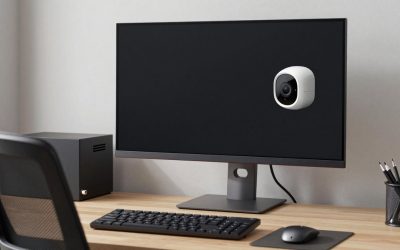
If your calls are internal check-ins and your room has decent daylight or a ceiling light, save your money. A simple 1080p webcam with autofocus and a privacy shutter is enough for most home office workers. You will look sharp at normal desk distance, and IT departments prefer these because there is nothing to install.
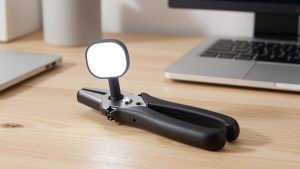
The failure mode here is low light. Small sensors go grainy and laggy below about 60 lux, which is a typical evening home office with one lamp on. Faces get waxy from noise reduction and motion smears when you move. If you regularly take calls after 5 p.m., add a $20 desk lamp bounced off a wall in front of you before you buy a more expensive camera. Light fixes more than pixels do.
Choose fixed-focus if you sit still and want zero focus hunting. Choose autofocus if you move, stand up to whiteboard, or show products to the camera. Fixed-focus is often sharper at 2-3 feet but blurry if you lean in close.
The sweet spot for client-facing work
If clients, students, or executives see you all day, step up to a mid-range 1080p or 1440p camera with a larger sensor and better exposure control. These handle mixed lighting — window on one side, warm lamp on the other — without turning you orange or silhouetting you. Field-of-view control, usually 65, 78, and 90 degrees, is also useful. Use 65-78 degrees for a home office so coworkers do not see your whole room.
This is also where microphones get usable. Dual mics with noise reduction can cut steady hum from a fan or HVAC, but they cannot cancel a dog barking next to you or a mechanical keyboard. Test where you sit: if the webcam is on top of a 32-inch monitor, you are 3 feet away and your voice will sound thin. In that case, wear earbuds and let the webcam do video only.
Common failure: plugging into a dock or unpowered hub. Many autofocus and 1440p cameras brown out on low-power USB ports, causing freezes in Teams. If the image drops mid-call, plug directly into the laptop first before you blame the camera.
When 4K is worth it — and when it is not
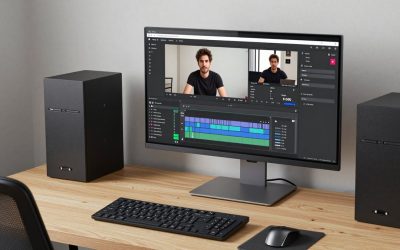
A 4K webcam for home office use makes sense in two cases: you present and need to crop in without going blurry, or you sit far from a large monitor and want digital zoom and auto-framing to keep you centered. The extra pixels help for recording training videos you will upload later.
For live conferencing, be honest about the limits. Zoom and Teams usually deliver 720p to 1080p to attendees anyway, and 4K needs a lot of light to actually look 4K. In a dim office it will pixel-bin down to 1080p and look no better than a good 1080p camera, while using more CPU. Mac users should also check compatibility — some auto-framing and background features require vendor software that is Windows-only, while basic UVC video still works on macOS.
If you buy 4K, you need decent upload bandwidth and a modern laptop. On a 4-year-old work laptop with 20 Chrome tabs open, 4K + background blur + screen share is a recipe for stutter.
Laptop, Mac, and mounting notes
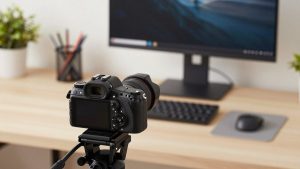
Clip shape matters more than people expect. Thin ultrabooks and MacBook Air lids do not hold heavy cameras well, and the camera points at your forehead if the mount is shallow. Look for an adjustable clip with a tripod thread. If you use a monitor arm or a large curved monitor, a mini tripod on the desk behind the monitor is often steadier.
For Macs, stick to UVC-compliant cameras with hardware privacy shutters and physical mic mute if you need it for compliance. Avoid cameras that require a Windows app to turn off beauty filters or set focus. For work laptops, same rule: if you cannot install drivers, all core controls should work in Teams/Zoom natively.
If your room is echoey, skip the search for a webcam with noise cancelling microphone as a cure-all and fix placement first. Move closer to the mic, add a rug or curtain, and turn off background blur if your fan spins up. Software blur looks clean but taxes the processor and can make cheap cameras overheat and throttle.
FAQ
Is 4K noticeably better than 1080p on Zoom?
Usually not for live calls. Conferencing apps compress video heavily, so lighting, lens quality, and stable exposure matter more than 4K. Buy 4K if you record video or need digital zoom, not just for sharper Zoom calls.
Why do I look washed out or dark?
That is backlight or auto-exposure struggling with a window behind you. Face a window or put a lamp in front of you, not behind. If you cannot move, turn on backlight compensation or HDR in the camera settings and narrow the field of view.
Do I need a separate mic?
Not for short internal calls in a quiet room. If you lead meetings, teach, or work in a noisy house, yes. Even basic wired earbuds will sound clearer than any webcam mic at 3 feet.
Will any webcam work with Mac and work laptops?
Almost any USB UVC webcam will show basic video on macOS, Windows, and ChromeOS without drivers. Advanced features like auto-framing, firmware updates, and custom background effects often need vendor software, which may be Windows-only or blocked by work IT.