Last Updated: October 18, 2026
If you are live on camera for 4-6 hours a day, small webcam flaws become big problems. Soft focus that drifts during a client call, a mic that picks up your keyboard more than your voice, a mount that slips off a laptop lid. I have tested work webcams in real home offices, not studios, with bad light, closed doors, and Teams, Zoom, and Meet all open at once. These five picks cover the setups that actually work for remote work.
📄 In This Review
How we rank a live work cam
For work, resolution is only fourth on the list. What matters first is stable autofocus that does not hunt when you move, exposure that handles a bright window behind you, a microphone that sounds clear at arm’s length, and plug-and-play support for Mac and Windows without a required app. Privacy shutter, tripod thread, and cable length matter more than they sound. A 4K sensor with bad auto-exposure will look worse than a good 1080p sensor in a dim spare bedroom.
Top 5 at a glance
See also: Best Monitor for MacBook Air: Two USB-C 4K Screens and Six Adapter-Dependent Alternatives • Best Monitor for MacBook Pro: Eight Listings Sorted by Cable, Sharpness and Scaling
| Pick | Resolution / Field of view | Strength | Watch out for |
|---|---|---|---|
| 1. Budget 1080p daily driver | 1080p / 78-90 degrees | Reliable focus, low price | Weak in low light, basic mic |
| 2. Sharp 1440p / 4K presenter cam | 1440p-4K / 75-90 degrees | Detail for demos, whiteboards | Needs good light, heavier CPU use |
| 3. All-in-one with mics and light correction | 1080p-1440p / 75 degrees | Better audio, fewer gadgets | Bigger housing, costs more |
| 4. Compact clip-on for laptops | 1080p / 70-80 degrees | Light, travel-friendly | Narrow mount can wobble |
| 5. USB-C native cam for MacBook setups | 1080p-4K / 80-90 degrees | Clean cable setup, modern Macs | Check Teams/Zoom compatibility |
1. Best budget 1080p for daily calls
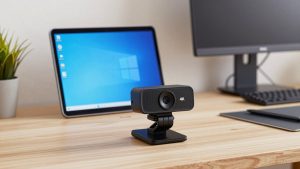
This is the right choice for most office workers. A basic fixed-focus or simple autofocus 1080p webcam at 30fps looks clean on Zoom and Meet, stays in focus from about 40cm to 2 meters, and does not tax an older laptop. Failure mode: cheap models over-sharpen and blow out faces when a window is behind you. Sit facing the window, not with it behind you, and turn off any beauty filter in the vendor app. Who suits: anyone doing standups, interviews, admin calls. Be honest here: if your laptop is from the last three years and you have decent front light, the cheaper option is fine. You do not need 4K to look professional. Look at a current 1080p webcam for laptop and prioritize dual mics and a physical shutter over extra pixels.
2. Best sharp cam for presenters and coaches
If you teach, coach, sell, or demo products live, extra resolution helps. A 1440p or 4K webcam holds detail when you crop in, share a whiteboard, or hold a document up to the lens. Trade-off: 4K needs light. In a dim room it will look noisy and dark, often worse than 1080p, because the smaller pixels gather less light. It also uses more CPU and USB bandwidth, which can stutter on an older MacBook Air with background blur on. Failure modes I see often: autofocus hunting during hand movements, and overheating on long 2-hour streams in small housings. Who suits: creators who stay live for 60+ minutes and need to look crisp full-screen. If you buy this category, get a model with fast autofocus and a tripod thread so you can raise it to eye level.
3. Best all-in-one for messy home offices
Some work webcams bundle better dual noise-canceling mics, auto-framing, and stronger backlight correction. That matters if you take calls from a kitchen, a shared room, or with kids in the next room. Good auto-framing keeps you centered when you lean to take notes. Good noise reduction cuts fan hum and typing without making you sound robotic. Trade-off: the housing is wider and heavier, which can tip a thin laptop screen backward. They also cost 2-3x a budget cam. Failure mode: auto-framing can be jumpy on group calls and aggressive noise reduction can clip the start of words. Turn framing to a slow setting and test mic range before a live client call. Who suits: managers, recruiters, and support staff who are live all day and do not want a separate mic.
4. Best compact clip-on for hybrid and travel
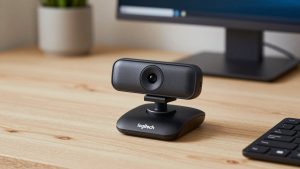
If you hot-desk or work from cafes and co-working spaces, size and mount matter. A small, light 1080p clip-on that fits in a laptop sleeve wins because you will actually carry it. Look for a fold-flat design, a 1.2m+ cable that reaches a dock, and a mount that grips both thick monitors and thin laptop lids. Trade-off: tiny lenses struggle in low light and tiny mics pick up room echo. Do not expect studio sound. Failure mode: narrow clip mounts slowly slide on MacBook lids when the laptop gets warm, leaving you filming the ceiling mid-call. A rubberized lip and a short USB cable with slack prevents this. Who suits: hybrid workers, students, consultants who join from different desks every week.
5. Best USB-C option for Mac and modern laptops
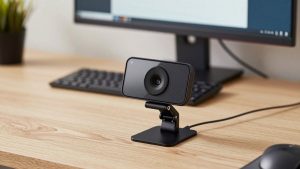
Most webcams still ship with USB-A, which means MacBook owners live on adapters. A native USB-C webcam or one with a detachable USB-C to USB-C cable keeps a dock setup clean and avoids loose dongles that drop the camera mid-call. Check that it is UVC-compliant, which means it works with macOS, FaceTime, Zoom, and Teams without drivers. Trade-off: some USB-C models draw more power and can be picky with cheap hubs. Plug directly into the Mac or a powered dock for all-day live use. Failure mode: background blur plus 4K plus screen sharing can spike fans on M1 / older Intel Macs. Drop to 1080p in the video app settings if frames drop. Browse a current USB-C webcam for MacBook if cable clutter is your main pain, and a low-light 4K webcam with autofocus and privacy shutter only if you present full-screen and have a window or key light in front of you.
Setup matters more than the cam
A $45 webcam with good light beats a $180 webcam in a dark corner. Put a lamp or window in front of you, raise the lens to eye level with a stack of books or a small tripod, sit 60-90cm back, and set your video app to 1080p max unless you have fiber and a new laptop. Test audio separately: laptop and webcam mics both fail in echoey rooms, and a $25 wired earbud mic will often sound clearer for live calls. Clean the lens monthly, close the privacy shutter when done, and unplug from hubs that also power hard drives if the image freezes.
FAQ
Is 4K worth it for work calls?
Usually no. Zoom, Meet, and Teams compress to 720p-1080p for most participants. 4K only pays off if you crop, record locally, or demo small details live. For normal meetings, spend on lighting and a stable mount instead.
Why do I look blurry when I move?
That is slow autofocus or low light forcing a slow shutter. Add front light, wipe the lens, turn off continuous autofocus hunting if your app allows it, and sit still for two seconds after moving so focus can lock.
Do I need a separate mic?
If you are live more than two hours a day or work in a noisy room, yes. Webcam mics are fine in a quiet, carpeted room at desk distance. In kitchens, open plans, or echoey rooms, a headset or USB mic is a bigger upgrade than a better camera.
Will any webcam work with Mac?
Almost all UVC webcams work plug-and-play on Mac for video, but special features like 4K modes, auto-framing, and noise removal sometimes need a Windows-only app to enable. Set those features once on another computer if needed, then move the cam back to your Mac.
Related Reviews & Guides
Best Resolution for Webcam
Best 4K Camera for Video Conferencing