Last Updated: October 18, 2026
- Why upgrade from the built-in camera
- What actually matters for laptop use
- The three types worth buying
- Best for most laptop users: mid-range 1080p business camera
- When the cheaper option is fine
- When 4K and auto-framing are worth it
- Mac and laptop-specific notes
- Setup that makes any camera look twice as good
- FAQ
If you take video calls from a laptop all day, an external camera is one of the fastest upgrades you can make. Built-in laptop cameras are still stuck at 720p on many models, with small sensors that fall apart in typical home office light. You look grainy, washed out, and slightly from below.
An external camera fixes the angle, the sharpness, and the low-light performance. You do not need to spend a lot to get there, but you do need to pick the right type for your laptop, your room, and how often you are on camera.
📄 In This Review
- Why upgrade from the built-in camera
- What actually matters for laptop use
- The three types worth buying
- Best for most laptop users: mid-range 1080p business camera
- When the cheaper option is fine
- When 4K and auto-framing are worth it
- Mac and laptop-specific notes
- Setup that makes any camera look twice as good
- FAQ
Why upgrade from the built-in camera
Laptop webcams have three basic problems. First, placement: they sit low and close to the keyboard, so they shoot up your nose and pick up more ceiling than face. Second, sensor size: tiny sensors need a lot of light to avoid noise. In an evening call with one lamp on, you get mushy detail and flicker. Third, fixed focus and narrow dynamic range: if you have a window behind you, your face goes dark while the background blows out.
An external camera lets you raise the lens to eye level, either clipped to an external monitor or on a small tripod. Even a basic 1080p external sensor will look cleaner than most built-ins because the lens and processing are better and the exposure is more stable. For managers, teachers, therapists, freelancers, and anyone job hunting over Zoom or Teams, that difference reads as more professional without any extra effort.
What actually matters for laptop use
See also: Best Monitor for MacBook Air: Two USB-C 4K Screens and Six Adapter-Dependent Alternatives • Best Monitor for MacBook Pro: Eight Listings Sorted by Cable, Sharpness and Scaling
Ignore most of the box specs. For work calls, prioritize these four things:
1. True 1080p at 30fps with good autofocus. That is enough for Zoom, Teams, Meet, and Webex. 4K sounds better but most meeting apps compress you to 720p or 1080p anyway. Autofocus matters more than extra pixels if you lean in and out or show documents.
2. Low-light handling. Look for a larger sensor, a wide aperture like f/2.0 to f/2.4, and honest low-light samples, not just marketing. If your office is a spare bedroom with one overhead light, this will affect you more than resolution.
3. Field of view and mounting. For one person at a desk, 65 to 78 degrees is ideal. Wider than 90 degrees pulls in your messy room and makes you small in frame. Check that the clip actually fits your laptop lid and external monitor. Thin MacBook lids and curved gaming monitors cause a lot of returns.
4. Plug-and-play UVC support. For Mac and work laptops with locked-down software, you want a camera that works over USB without drivers. USB-C or USB-A with an included adapter is best. Avoid cameras that require a Windows-only app to enable 1080p, noise removal, or autofocus.
Microphones, privacy shutters, and Windows Hello are bonuses. Built-in mics are usable for backup, but a $30 USB headset or earbuds will beat any webcam mic for echo and keyboard noise.
The three types worth buying
| Type | Best for | Strengths | Watch out for |
|---|---|---|---|
| Basic 1080p fixed or simple autofocus camera | Students, occasional calls, second laptop | Cheap, light, no setup, works on old laptops | Soft in low light, narrow dynamic range, weak mics |
| Mid-range 1080p/1440p business camera with dual mics | Daily Zoom/Teams, home office, Mac users | Better autofocus, cleaner low light, good clip mount | Needs decent USB port power, cable can be short |
| Premium 4K with auto-framing and noise reduction | Presenters, coaches, content + calls | Sharp crop/zoom, follows you, better backlight control | Costs more, auto-framing can hunt, needs good lighting to show benefit |
Best for most laptop users: mid-range 1080p business camera
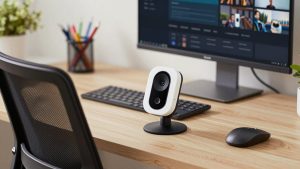
If you are on calls 2 to 6 hours a day, this is the sweet spot. You get reliable autofocus, a physical privacy shutter, dual noise-reducing microphones, and light correction that does not make skin look waxy. Mount it on top of your external monitor at eye level, plug directly into the laptop – not a cheap unpowered hub – and select it once in Zoom or Teams.
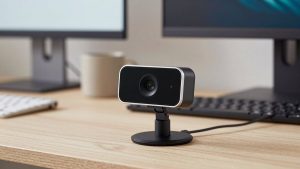
A good 1080p business webcam with autofocus is fine on both Windows and Mac because it uses standard USB video. It suits hybrid workers, recruiters, customer support, and grad students who need to look clear without fiddling with settings before every call.
Failure mode to know: low-light correction can smear motion if your room is very dark. If you wave your hand and it ghosts, add a $20 desk lamp bounced off a wall in front of you. No camera fixes a backlit window fully, so do not sit with blinds open directly behind your head.
When the cheaper option is fine
If you do one or two calls a week and your laptop is from the last three years, a basic 1080p camera is completely fine. Sharpness will be a clear step up from 720p built-ins, and the clip mount alone improves how you look. Do not pay extra for 4K, AI tracking, or studio mics you will not use.
Shop for a simple 1080p webcam for laptop with a privacy cover and a minimum 1.5m cable. Who it suits: kids’ school laptops, a travel kit, or a shared family machine. Who should skip it: anyone presenting to clients daily or working in a dim basement office. You will outgrow it fast.
Common failure: ultra-cheap no-name cameras claim 1080p but output upscaled 720p, with laggy 15fps in low light. If reviews mention stutter on Teams or the image freezing when the heater kicks on, pass. Stick to listings with hundreds of work-use reviews, not just streaming unboxings.
When 4K and auto-framing are worth it
Premium cameras make sense if you stand up, whiteboard, or move around during calls. Auto-framing keeps you centered when you pace, and the higher-resolution sensor lets you digitally zoom 2x and still look sharp. Backlight handling is also better if you cannot control your room.
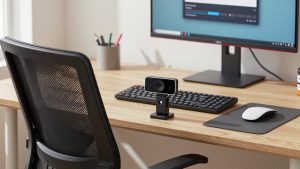
A 4K webcam with auto-framing for home office suits trainers, founders pitching, therapists who lean back in a chair, and anyone recording training videos as well as doing live calls. Pair it with a small tripod behind your monitor so you can raise it to true eye level.
Trade-offs: you will not look 4K on most calls because the app will downscale you. Auto-framing can be jumpy with pets or coworkers walking behind you, so turn it off for formal interviews. These cameras also run warmer and draw more USB power, which can cause disconnects on old hubs or MacBooks with dongle chains. Plug direct or use a powered hub.
Mac and laptop-specific notes
MacBooks are picky about mounts and USB. Check clip depth if you use a case, and prefer USB-C native cables to avoid flaky adapters. macOS will treat most UVC cameras as plug-and-play in FaceTime, Zoom, and Teams, but advanced features like background blur or manual exposure often need the vendor app, which is sometimes Windows-only. If you need background replacement, use the built-in effects in Zoom or Teams instead of relying on the camera.
For Windows work laptops, confirm your IT policy allows USB video devices. Most do, but some block installs. That is another reason to choose driverless UVC cameras. Also set your meeting app to 1080p or HD if available – Zoom and Teams default to lower resolutions to save bandwidth.
Setup that makes any camera look twice as good
Mount at eye level, about an arm’s length away. Put your key light in front of you, not behind. A window to the side with a sheer curtain is ideal; a window directly behind you is the worst. Close the laptop lid or turn off the laptop screen if you use an external monitor to avoid looking down the whole call.
In the app, turn off touch-up filters, auto low-light boost past medium, and mirrored video confusion. Do a 10-second test recording. Check for fan noise, echo, and flicker from LED bulbs. If you hear echo, switch the mic input to your headset while keeping the external camera for video – most apps let you split them.
FAQ
Is 4K worth it for Zoom and Teams?
Usually not for image sharpness alone, since calls are compressed to 1080p or less. 4K helps if you want to crop in, use digital zoom, or record locally while you stream. For daily meetings in a small room, a good 1080p camera with better low light will look the same or better.
Will an external camera work with my MacBook?
Yes, if it is USB plug-and-play. Look for UVC compatibility and USB-C support, and avoid models that need Windows software for basic focus or resolution. Mount fit is the bigger issue on thin lids, so check clip dimensions.
Why do I look worse on my new camera?
It is almost always lighting or placement. Too high resolution reveals bad light. Raise the camera to eye level, face a soft light source, kill strong backlight, and lower exposure slightly in your meeting app. Also plug directly into the laptop to avoid hub power issues that cause dark, laggy video.
Do I still need a separate microphone?
Not always, but it helps a lot. Webcam mics pick up room echo and typing. If people ask you to repeat yourself or you work in a noisy house, add wired earbuds or a basic USB headset and keep the camera just for video.
Related Reviews & Guides

Best Webcam with Depth of Field
TP-Link AX1800 WiFi 6 Router vs GL iNet GL-AX1800: Which Should You Buy?