Last Updated: October 18, 2026
If you just need to look clear on Zoom, Teams, and Meet, a cheap 1080p webcam is usually enough. Most sub-$40 cameras now do true 1920×1080 at 30fps, work plug-and-play with Windows and Mac, and beat a surprising number of built-in laptop cameras — especially on older laptops with grainy 720p sensors.
The catch is that “1080p” on the box doesn’t tell you much. A cheap sensor can be technically 1080p but still look soft, washed out, or laggy in a dim home office. After testing a lot of these for daily work calls, the difference between a usable cheap webcam and an annoying one is almost never resolution. It’s focus behavior, exposure control, and the microphone.
📄 In This Review
What a cheap 1080p webcam actually gets you
A good budget model gives you three things: a sharper image than most 3- to 5-year-old laptop cameras, a wider field of view that fits your shoulders without showing your whole room, and a clip that actually stays on a monitor. That alone solves 80% of work-call complaints.
What you don’t get at this price is real low-light performance, natural color, or background blur that looks clean. Most cheap webcams use tiny sensors and aggressive noise reduction. In good daylight or with a desk lamp in front of you, they look decent. In a dark room with a bright window behind you, they blow out your face, drop to visibly choppy frame rates, or hunt for focus.
The cheaper option is fine if your calls are mostly daytime, internal check-ins, and job interviews in a lit room. You don’t need autofocus, 60fps, or 2K for that. Save the money and spend five minutes on lighting and placement instead.
What to check before you buy
See also: Best Monitor for MacBook Air: Two USB-C 4K Screens and Six Adapter-Dependent Alternatives • Best Monitor for MacBook Pro: Eight Listings Sorted by Cable, Sharpness and Scaling
Ignore digital zoom, beauty modes, and inflated megapixel claims. Look for these four specs instead, because they predict failure modes:
1. True 1080p30, not interpolated. Listings that say “1080p / 2K / 4K supported” often mean the software upscales a lower-resolution sensor. Look for “1920×1080 @ 30fps” with MJPEG or YUY2 output and UVC plug-and-play. If a listing can’t state the sensor resolution clearly, skip it.
2. Fixed focus vs. autofocus. Fixed-focus cameras set around 2-3 feet are more reliable for desk work. Nothing to hunt, nothing to buzz. Autofocus helps if you lean in and out, hold up documents, or pace, but cheap autofocus is the number one complaint — slow pulsing in and out during calls. If you sit still, fixed focus is more stable.
3. Field of view around 70-90 degrees. Too narrow and you’re cropped at the chin. Too wide, over 100 degrees, and cheap lenses get soft at the edges and show your messy office. For one person at a desk, 75 to 85 degrees is the sweet spot.
4. Microphone and mount. Almost all budget webcams have dual noise-reduction mics that are fine for quiet rooms and terrible in echoey kitchens. Check for a standard tripod thread if you want to put it on a small stand. And check Mac compatibility explicitly — most are fine via USB-A with an adapter, but cheap software for zoom and exposure often only works on Windows.
The three types of cheap 1080p webcams compared
Almost every budget model falls into one of these buckets. Pick by how you sit and where you call from, not by the photo on the box:
| Type | Focus | Low light | Privacy / Extras | Best for |
|---|---|---|---|---|
| Basic fixed-focus 1080p | Fixed, ~60cm to 3m | Weak, needs daylight or lamp | Usually just a clip, sometimes no shutter | Desk workers who sit still and want zero fuss |
| Autofocus 1080p with dual mics | Autofocus, faster for movement | Slightly better, still noisy | Often includes privacy cover | Teachers, coaches, anyone who moves or shows objects |
| 1080p with ring light / shutter | Usually fixed focus | Better in dark rooms because of light | Built-in light + shutter | Night calls, dorms, shared apartments |
For most home-office workers, the basic fixed-focus type is the safest buy. You can find a solid budget 1080p webcam with fixed focus for under $30 that just works every time you open Teams. No drivers, no focus breathing on a client call.
If you teach, do a lot of whiteboard or product demos, or you can’t sit still, autofocus is worth it despite the risk. Look for a autofocus 1080p webcam with dual microphone and check reviews specifically for “focus hunting” and “microphone echo.” Those are the two failure modes that will ruin that use case.
The third type, with a small ring light around the lens, looks gimmicky but actually helps if you regularly take calls at 9pm in a dim room. It won’t match a real key light, but it evens out harsh shadows. A 1080p webcam with ring light and privacy shutter suits night-shift workers, students, and anyone whose office lighting you can’t control.
Laptop and Mac notes that matter
On Windows laptops, any UVC webcam is plug-and-play. Plug it in, select it in Zoom or Teams settings once, and you’re done. The main issue is USB ports: many cheap webcams still ship with USB-A only and a short 4- to 5-foot cable. If you have only USB-C, budget for an adapter and check cable length if your dock is under the desk.
On Macs, the camera itself will work in FaceTime, Zoom, and Chrome without drivers. What often doesn’t work is the vendor’s settings app for adjusting exposure, flicker (50Hz vs 60Hz), and zoom. That means you can get stuck with overexposed video under office fluorescents. The fix is to use a model that stores settings well out of the box, and control light physically — face a window, don’t sit with one behind you.
M1/M2/M3 MacBook users also often find the built-in camera is already quite good in daylight. A cheap external webcam only makes sense if you want a higher mounting position on an external monitor, a wider shot, or a physical privacy shutter. Otherwise, spend the money on a headset first — audio matters more.
Setup matters more than the model
I’ve made $25 webcams look better than $120 ones just by moving them. Put the camera at eye level or slightly above, about arm’s length away. Stack your monitor on books if you have to. Looking up at a laptop on a desk is unflattering on any sensor.
Next, get light on your face. Sit facing a window, or put a $15 desk lamp with a daylight bulb behind your monitor aimed at you. Do not rely on a ceiling light behind you — that is what causes the glowing halo and dark face that people blame on the webcam.
Finally, test before an important call. Record 20 seconds in Photo Booth, Camera app, or QuickTime and listen with earbuds. Cheap mics pick up keyboard clatter, fan noise, and room echo that you won’t hear on speakers. If you sound hollow, stay closer to the mic, close a door, or switch to earbuds. No budget webcam mic will beat even basic earbuds in a noisy house.
Common failure modes to watch for in the first week: focus pulsing when you lean back, audio dropping when you plug into a hub instead of directly into the laptop, and flicker under LED lights. If you see flicker lines, change the anti-flicker rate in the camera app to 60Hz in the US or 50Hz in the UK/EU, or try a different light.
FAQ
Is a cheap 1080p webcam better than my laptop camera?
Often yes for older Windows laptops with 720p cameras, and for desktop setups with no camera at all. For recent MacBooks and high-end Windows ultrabooks with good 1080p cameras, the difference in daylight is small — buy external mainly for positioning, field of view, or a privacy shutter.
Do I need 60fps for work calls?
No. Zoom, Teams, and Meet typically run at 30fps or lower anyway, and prioritize stability over smoothness. 1080p30 from a cheap webcam is fine. 60fps helps only if you move a lot and have strong lighting; in dim rooms it often looks noisier.
Why does my 1080p webcam look blurry?
Usually it’s low light, a dirty lens, or being too close for fixed focus. Add light to your face, wipe the lens, and sit 2 to 3 feet back. If it pulses in and out, that’s cheap autofocus hunting — lock focus if the app allows it, or switch to a fixed-focus model.
Will a cheap webcam work with Mac and Chromebook?
Yes, if it’s UVC-compliant, which almost all are. It will show up in Zoom, Meet, and Teams without drivers. Just know the extra settings software is often Windows-only, so you may not be able to adjust zoom or flicker on MacOS or ChromeOS.
Related Reviews & Guides
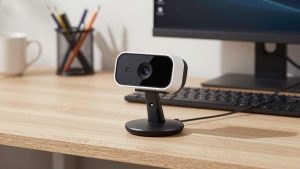
Best Webcam with Zoom Capability
Best Webcam for Ubuntu