Last Updated: October 18, 2026
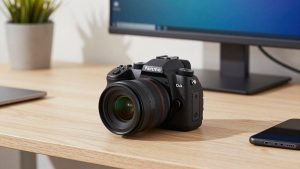
If you already own an Elgato Cam Link 4K, you do not need the most expensive camera. You need a camera that outputs clean HDMI, stays on for hours, and can run on wall power without overheating. For home office work, that matters more than sensor size or 4K specs, because Zoom, Teams, and Meet will compress your video anyway.
I have tested this setup on both Mac and Windows laptops for daily calls. When it works, it looks noticeably better than any plug-and-play webcam: cleaner background blur, better skin tones in a dim office, no watercolor noise. When it fails, it fails in annoying ways: camera shuts off after 30 minutes, autofocus breathes in and out, or the Cam Link runs hot and drops signal mid-meeting.
📄 In This Review
What Cam Link actually needs from a camera
Cam Link is just a capture dongle. It takes an HDMI signal and presents it to your computer as a webcam. It does not power your camera or fix a bad signal. Three features decide if a camera is usable for work.
First, clean HDMI out. That means no battery icon, focus box, or recording timer burned into the output. Most Sony, Canon, Panasonic, and Fujifilm mirrorless cameras from the last six years have a menu option for this, usually called HDMI Info Display Off. Older DSLRs often do not, avoid those.
Second, no auto-shutoff and no recording limit. Many stills cameras will turn off the live view after 30 minutes to save power, or overheat in video mode after 45 to 60 minutes. For a 25-minute standup that is fine. For back-to-back calls, it is a dealbreaker. Look for cameras marketed for vlogging or streaming, they are designed to stay on.
Third, continuous power. Internal batteries last 60 to 90 minutes and will die midday. You want USB-C power delivery that actually charges while streaming, or better, a dummy battery that plugs into the wall. Budget for this from the start, plus a good micro or mini-HDMI to full HDMI cable. Cheap thin HDMI cables are the number one cause of flicker I see.
Quick comparison for office use
See also: Best Monitor for MacBook Air: Two USB-C 4K Screens and Six Adapter-Dependent Alternatives • Best Monitor for MacBook Pro: Eight Listings Sorted by Cable, Sharpness and Scaling
| Type | Example class | Clean HDMI? | Stays on for workday? | Best for |
|---|---|---|---|---|
| 1-inch compact vlogging camera | Sony ZV-1 class | Yes | Yes with wall power, can get warm | Simplest desk setup, great autofocus |
| APS-C interchangeable lens | Sony ZV-E10 / A6400 class | Yes | Yes, best heat handling | Sharpest image, background blur |
| Budget mirrorless you own | Canon M50 II / Panasonic G7 class | Yes | Usually yes, check 30-min limit | Reusing gear, fixed desk |
| Action camera | GoPro with Media Mod class | Yes with adapter | Yes, but needs cooling/airflow | Overhead shots, tight desks |
Best simple pick for most home offices: 1-inch compact
If you are buying specifically for calls, get a 1-inch sensor compact made for video, like the Sony ZV-1 class. I recommend this type most for work because there is no lens to choose, autofocus face tracking just works, and clean HDMI is one menu toggle.
In a typical home office at 3 to 5 feet from the desk, you get sharp eyes, soft background, and much better low-light than a webcam without blasting your overhead lights. Set it to 1080p30 out, lock exposure, and leave it. Trade-off: the fixed 24-70mm equivalent lens means you cannot get that super-blurry f/1.4 podcast look, and the tiny body gets warm after two hours. Give it air, do not bury it behind a monitor, and use USB power plus a dummy battery if you run all-day calls.
Who it suits: laptop and Mac mini users who want one camera that is also usable for occasional family video. Who should skip it: if you already own an interchangeable-lens camera, do not buy this as a second camera just for Zoom.
Best image quality: APS-C mirrorless with kit lens
For a dedicated desk studio, an APS-C camera like a ZV-E10 or A6400-type body with a 15-45mm or 18-50mm kit lens is visibly better. Larger sensor, better heat dissipation, and you can stop down to f/4 for a forgiving focus zone so you do not drift in and out of focus when you lean back.
Failure modes to know: Sony bodies hunt less than Canon in mixed office light, but all of them will pulse if you have a bright window behind you. Face the window or close blinds. Also turn off in-body auto power off, turn off HDMI-CEC control, and set the HDMI output to 1080p, not Auto. Cam Link 4K handles 4K, but 1080p is more stable, cooler, and Teams will downgrade you to 1080p or 720p anyway.
This is overkill for audio-only workers, and the total cost with lens, tripod, dummy battery, and lighting adds up fast. It is worth it if you teach, coach, sell, or record Loom-style videos where you are on camera for hours.
If you want to spend less: reuse what you have
The cheaper option is often fine. A used Panasonic G7, Canon M50 Mark II, or Fujifilm X-series you already own will look 90 percent as good on a work call as a new camera. Check Elgato’s compatibility list for clean HDMI confirmation, then test two things before a real meeting: does it stay live for 90 minutes plugged in, and does autofocus stay locked when you type and move?
Panasonic contrast autofocus is slower and can wobble under LED desk lamps. Fix it by switching to single AF and half-press to lock, or manual focus on your chair. Canon colors look great out of the box but some older models need the auto power-off disabled in two separate menus. Do not forget wall power. A dummy battery costs far less than a new camera and solves most mid-call shutdowns.
Avoid action cameras as your main face camera unless space forces it. The wide-angle look makes a small office look cavernous and exaggerates nose and desk clutter. They are excellent as a second overhead camera for demos, paperwork, or keyboard work, but frustrating as a daily driver because audio sync and exposure need constant fiddling.
Setup mistakes that ruin Cam Link calls
Most problems are not the camera. Plug Cam Link directly into a USB 3.0 port on your Mac or laptop, not a cheap hub. On Macs especially, hubs cause black screens or 720p lock. Use the short USB extension Elgato includes if the dongle gets hot, heat-related dropouts are real in a warm office.
Lock your settings. Set camera to Movie mode, 1080p30, 1/60 shutter, auto ISO with a limit, white balance to 5600K or custom, not Auto. Turn off face touch-tracking boxes if they appear over HDMI. And turn off your laptop’s auto-switching between integrated and discrete GPU apps if you use OBS as a virtual camera, that introduces delay.
For work, skip 4K capture and beauty filters. They add lag and make you look waxy after compression. A clean 1080p signal with soft window light and a $30 LED panel behind your monitor will beat a $1,200 camera in a dark room every time.
FAQ
Do I still need Cam Link if my camera has USB webcam mode?
Often no. Most newer Sony, Canon, and Fujifilm cameras offer USB streaming without capture hardware. Quality is usually limited to 720p or compressed 1080p with more delay. Keep Cam Link if you want the sharpest HDMI feed, use a Mac where USB webcam drivers are flaky, or switch between multiple cameras.
Will Cam Link work with my MacBook?
Yes, Cam Link 4K works as a standard UVC device on macOS in Zoom, Teams, Meet, and QuickTime with no driver. Use a direct USB-A 3.0 port or a quality USB-C adapter, avoid daisy-chaining through a monitor dock. If you get no signal, change the camera HDMI output from Auto to 1080p.
Why does my camera turn off after 30 minutes?
That is usually auto power-off or a stills-mode overheating timer, not Cam Link. Disable Power Save, set to No Limit if available, switch to Movie mode, open the flip screen for heat, and use wall power. Some older DSLRs cannot be fixed and are bad picks for calls.
Is a Cam Link plus camera better than a high-end webcam for work?
Image quality yes, convenience no. A mirrorless camera gives better color, low light, and blur. A $200 to $300 webcam wins on simplicity, privacy shutter, built-in mic, and no extra cables or batteries. If you do two calls a day, buy the webcam. If you live on camera, the Cam Link setup pays off.
Related Reviews & Guides
6 Best Thunderbolt Docking Stations For Laptop 2026
Best Webcam for Vtube Studio