Last Updated: October 18, 2026
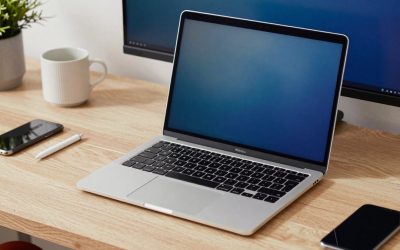
The MacBook Air camera got better in recent years, but it’s still a 1080p sensor squeezed into a thin lid. In good light it’s fine for quick check-ins. In a dim home office, on a backlit window call, or when you’re presenting to clients, it falls apart fast: soft detail, noisy shadows, and that slightly washed-out look.
That’s why most MacBook Air owners who live on Zoom, Teams, or Google Meet end up adding an external camera. You don’t need anything exotic. You need something that works the moment you plug it into USB-C, doesn’t fight macOS, and looks decent without fiddling with settings before every call.
📄 In This Review
What to check first on a MacBook Air
Mac compatibility is mostly about USB and software. The Air only has USB-C / Thunderbolt ports, so every USB-A webcam will need a small adapter or dock. That’s not a dealbreaker, but it’s one more failure point if you unplug daily to work from cafes.
Look for UVC compliance – that means plug-and-play with no driver. macOS handles exposure, mic, and speaker automatically in FaceTime, Zoom, and Teams. The cameras that cause trouble on Mac are usually the ones that require a Windows-only app to unlock 4K, background blur, or firmware updates. You can still use them in basic mode, but you’ll never get the features on the box.
Microphones matter more than resolution for work. The Air’s built-in mics are actually good. A lot of external webcam mics sound thinner by comparison, especially in echoey rooms. If you already use AirPods, a USB headset, or a desk mic, you can ignore mic quality and just disable the webcam mic in your meeting app.
Option 1: Use your iPhone as the camera
See also: Best Monitor for MacBook Air: Two USB-C 4K Screens and Six Adapter-Dependent Alternatives • Best Monitor for MacBook Pro: Eight Listings Sorted by Cable, Sharpness and Scaling
For many MacBook Air owners, the best camera is the one already in your pocket. Apple’s Continuity Camera lets you mount an iPhone on top of the Air and use its rear cameras as a wireless or USB webcam. Image quality beats almost every sub-$200 webcam, especially in low light.
Setup is simple: your iPhone and Mac need the same Apple ID, Wi-Fi and Bluetooth on, and macOS Ventura or newer. Then in FaceTime or Zoom you select iPhone as camera. You get Center Stage auto-framing, Portrait mode for background blur, and Desk View for showing paperwork.
The trade-offs are practical. You need a MagSafe mount, your phone gets warm and drains battery on long calls, and incoming calls or notifications can interrupt video. It’s also awkward if you need your phone during the meeting to check notes or 2FA codes. If you take 4-5 hours of calls a day, a dedicated webcam is less fiddly.
Who it suits: occasional callers, travelers who don’t want another gadget, and anyone who wants great quality for job interviews or presentations without buying anything except a mount.
Option 2: A basic 1080p webcam – fine for most work
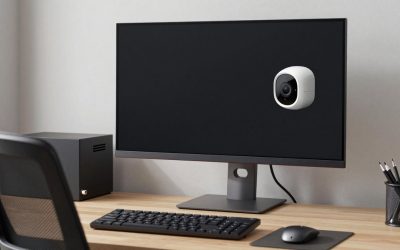
If you just want to look sharper than the built-in camera with zero setup, a basic 1080p USB webcam is still the sensible buy. It will give you better exposure control, a wider but less distorted field of view, and a physical privacy shutter.
Don’t expect miracles. In side-by-sides, a good 1080p external is only about 15-20% sharper than the M2 / M3 / M4 Air’s built-in camera in good light. Where it wins is consistency: less hunting for focus, better handling of overhead office lights, and no shine on your forehead.
Common failure modes: autofocus that pulses during screen shares, and mics that pick up keyboard clatter. Fix the first by sitting 2-3 feet away and avoiding busy backgrounds. Fix the second by setting your meeting app to use the MacBook Air mic instead.
An affordable 1080p webcam for MacBook is the right call if you do internal standups, tutoring, or customer support and just need to look clear and professional. No need to pay for 4K if your company records everything at 720p anyway.
Option 3: A 4K webcam for presenting and recording
If you lead webinars, coach, sell, or record Loom-style videos from a home office, 4K is worth it. Not because anyone sees full 4K on Zoom – they don’t – but because the larger sensor crops better. You can use 2x digital zoom to tighten framing without turning mushy, and low-light noise is much lower.
Look for a model with a large sensor, good auto-exposure, and a Mac-compatible settings app. Shutter speed control and manual white balance make a bigger difference than raw pixels. A camera that lets you lock exposure prevents that annoying bright-dark pulsing when you share a white screen.
The downsides: price, heat, and USB bandwidth. Many 4K webcams need USB 3.0 and a direct port, not a cheap hub, to hold 4K at 30fps. On an Air with only two ports, that can conflict with an external SSD or dock. Most people end up running them at 1080p for calls and only switching to 4K for recordings.
A well-reviewed 4K webcam for Mac with autofocus suits managers, founders, creators, and anyone whose face is on screen for hours. Pair it with a cheap ring light or a window in front of you and you’ll look dramatically better than any laptop lid camera.
Option 4: Compact 2K for hybrid and travel
There’s a middle ground that’s ideal for MacBook Air users: compact 1440p (2K) cameras. Sharper than 1080p, less demanding than 4K, and usually smaller enough to toss in a laptop sleeve.
These are the best travel companions. They clip securely to a thin Air lid without wobbling, work off bus power, and don’t need extra software. Field of view around 75-80 degrees is ideal – wide enough for a small huddle room, tight enough that you don’t look tiny at your desk.
Watch for two failure modes. First, cheap clip mounts that scratch the lid or slip when you adjust the screen angle. Second, aggressive noise reduction that makes you look waxy. If your camera app on Mac allows it, turn sharpening and beauty filters down to zero.
A portable portable 2K webcam with USB-C for Mac is a good fit if you split time between home, office, and coworking spaces and want one camera that lives in your bag.
Quick comparison for MacBook Air owners
If you only look at specs, every camera looks good. In daily work use, the differences are about convenience and lighting, not megapixels.
| Option | Typical resolution | Best for | Main drawback on Mac |
|---|---|---|---|
| iPhone via Continuity Camera | 1080p to 4K (depends on iPhone) | Best image for $0 extra, interviews | Ties up phone, needs mount, heats up |
| Basic 1080p USB webcam | 1080p30 | Daily standups, support, students | Only modest upgrade over built-in |
| 4K business webcam | 2160p30 / 1080p60 | Presenting, coaching, recording | Needs direct USB-C port, costs more |
| Compact 2K travel webcam | 1440p30 | Hybrid workers, small desks | Mount quality varies, mic often weak |
Practical tip: whatever you buy, mount it at eye level. Stack your Air on a stand and use an external keyboard, or put the webcam on a small tripod on top of a monitor. A $70 camera at eye level with window light looks better than a $250 camera shooting up your nose in a dark room.
What not to buy
Skip old 720p webcams – your Air already beats them. Skip cameras that are Windows-only for settings; you’ll be stuck with default exposure that’s usually too bright on Mac. And skip buying a 4K camera if your home upload speed is under 10 Mbps. Your meeting app will compress it to 720p anyway, so fix lighting and audio first.
If your calls sound echoey or people ask you to repeat yourself, spend the camera budget on a USB headset or a simple desk mic instead. Video gets the attention, but audio decides whether you seem professional.
FAQ
Do I need a webcam if my MacBook Air already has a 1080p camera?
Not always. For short internal calls in good light, the built-in camera is fine. Buy external if you present often, work in low light, need better framing on an external monitor, or want background blur without glitches.
Will any USB webcam work with MacBook Air?
Almost any modern UVC webcam works plug-and-play in Zoom, Teams, Meet, and FaceTime. Just check that advanced features like 4K, auto-framing, or noise removal don’t require Windows-only software, and budget for a USB-C adapter if the cable is USB-A.
Is 4K worth it for Zoom and Teams?
For live calls alone, usually no. Most platforms show you at 720p or 1080p. 4K helps if you crop in, record videos, or have poor lighting, because the bigger sensor holds detail better. Otherwise save money and get a good 1080p model plus better lighting.
Why does my external webcam look worse than expected on Mac?
It’s almost always lighting or bandwidth. Face a window or lamp, avoid a bright window behind you, plug directly into the Air instead of a cheap hub, and close cloud backup apps during calls. Also select the external camera and mic explicitly in each meeting app – macOS sometimes defaults back to the built-in.
Related Reviews & Guides
Best Video Camera Compatible with Mac

Best Computer Camera for Meetings