Last Updated: October 18, 2026
VTube Studio does not care how pretty your webcam image looks on Zoom. It cares about how consistently it can find your face, eyebrows, eyes, and mouth 30 to 60 times per second. That changes what makes a webcam good.
A soft, cinematic 4K image with heavy noise reduction is actually worse for tracking than a slightly noisier 1080p image at 60 fps with locked exposure. If your avatar jitters, freezes, or mouth tracking lags behind your voice, the problem is usually frame rate, lighting, or autofocus — not resolution.
📄 In This Review
What VTube Studio actually needs from a camera
VTube Studio on PC and Mac uses RGB face tracking for webcams. It is estimating landmarks from a normal video feed, not depth data. That means it needs sharp, well-lit eyes, eyebrows, and mouth corners with minimal motion blur.
Three things matter most. First, frame rate. 60 fps gives noticeably smoother mouth and head movement than 30 fps, and it recovers faster when you turn quickly. Second, consistent exposure. Auto-exposure that constantly brightens and darkens will make tracking pulse and drift. Third, locked focus. If the lens hunts for focus every time you lean in, tracking drops for a half-second.
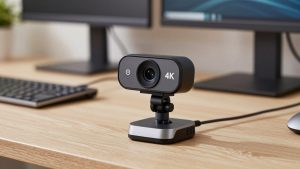
Resolution helps, but only to a point. Clean 1080p is enough for tracking at desk distance. 4K does not improve tracking much unless you are sitting far away and cropping in, and 4K at 30 fps will look smoother on stream but track worse than 1080p at 60 fps.
The iPhone question: should you just use your phone?
See also: Best Monitor for MacBook Air: Two USB-C 4K Screens and Six Adapter-Dependent Alternatives • Best Monitor for MacBook Pro: Eight Listings Sorted by Cable, Sharpness and Scaling
If you already own a recent iPhone with Face ID, it is still the best tracker for VTube Studio. The TrueDepth camera does real depth-based face tracking, not just webcam estimation. Eyebrows, eye open/close, mouth shapes, and head angle are more stable, especially in bad light.
You can connect it over USB with the VTube Studio iOS app as a tracker and use a separate webcam for your actual facecam, or just run faceless and let the iPhone drive the avatar. The downside is setup friction: mount, cable, battery drain, and occasional Wi-Fi/USB disconnects if you try to do it wirelessly.
For most beginners, a good 1080p 60fps webcam is simpler. It is always plugged in, always framed the same way, and works for work calls too. Use your phone if you want maximum tracking quality. Use a webcam if you want a set-and-forget desk setup.
What to look for in a webcam for VTubing
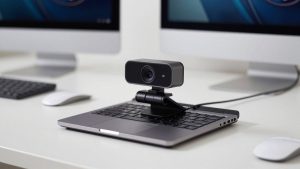
Prioritize 1080p60 or 720p60 with low latency. Many webcams advertise 4K or 1080p but only do 30 fps at full resolution, and drop to even lower fps in dim rooms. Look for an explicit 60 fps mode at 1080p or 720p, and check whether it requires MJPEG mode to hit it.
Manual control matters more than sensor size marketing. You want to be able to turn off autofocus, turn off auto white balance, and set manual exposure in the camera software. Once you find exposure that keeps your face bright without blowing out, lock it. That alone fixes half of all jitter complaints.
Field of view around 65 to 78 degrees is ideal. Ultra-wide 90-degree webcams force you to sit farther back or crop, which gives VTube Studio fewer pixels on your face. A narrower view at arm’s length is better for tracking.
Low-light behavior is the main failure mode. In a dark room, webcams automatically lengthen exposure, which creates motion blur and drops effective frame rate to 15-20 fps. Your avatar will feel drunk and delayed. You do not need a better camera, you need more light on your face. A basic key light helps tracking more than spending another $100 on a camera.
Webcam options compared for VTube Studio
There are really four practical paths, not dozens. Pick based on whether you already own an iPhone and whether you stream in a dark room.
| Setup | Tracking smoothness | Strength | Weakness | Best for |
|---|---|---|---|---|
| iPhone with Face ID as tracker | Excellent | True depth tracking, works in low light | Mount, cable, battery, extra setup | Serious VTubers who want best mouth/eye accuracy |
| 1080p 60 fps webcam, manual controls | Very good | Smooth motion, lockable focus/exposure, good for work calls too | Needs decent face lighting | Most PC VTubers, hybrid work + streaming desks |
| 4K 30 fps webcam | Good, less smooth | Sharper facecam image for viewers | 30 fps motion, higher CPU/USB load, often softens detail with noise reduction | Streamers who prioritize facecam sharpness over avatar smoothness |
| Budget 1080p 30 fps webcam | Usable | Cheap, fine to start | Jitter and lag in low light, focus hunting, blur on fast moves | Testing VTubing before you commit |
Which one should you buy?
Best for most people: 1080p60 with manual settings
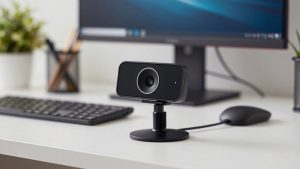
This is the sweet spot. At desk distance — about 2 to 3 feet — VTube Studio gets a large, sharp face at 60 updates per second. Mouth sync looks natural, head tilts do not overshoot, and blinking is detected cleanly. These cameras also make excellent work webcams because motion looks natural on Teams and Zoom.
The trade-off is that you must light yourself. Without a key light, even a good sensor will blur. Put a soft white light in front of you, slightly above eye level, and turn off overhead-only lighting that casts shadows under your eyebrows. That shadow is what kills eyebrow tracking.
Do not pay extra for digital zoom, background blur, or AI framing for VTubing. Auto-framing that slowly pans and zooms will fight VTube Studio calibration. Turn all of that off.
Best tracking quality: iPhone + cheap webcam combo
If your avatar is your brand, use your iPhone as the tracker and a separate webcam only if you show your real face. Tracking stays locked when you laugh, cover your mouth, wear glasses, or dim the room for atmosphere. Webcam-only tracking struggles with all four.
Failure modes here are practical, not image quality. Wireless connections add latency and dropouts. Use a wired USB connection, a sturdy iPhone tripod mount for desk, and keep the phone plugged into power. Mount it at eye level, centered — not off to the side like a side-angle stream camera. Off-angle mounting causes asymmetric mouth tracking.
When 4K makes sense — and when it does not
Buy 4K if viewers see your real face in a corner box and you want maximum detail, and you have good lighting and a modern PC. Do not buy 4K expecting better avatar control. In many apps, enabling 4K forces 30 fps, increases CPU usage, and triggers heavier noise reduction that smears eyebrows.
A common mistake is running 4K over a USB hub with a microphone and capture card, then getting stutter. If you go 4K, plug directly into the PC, close other camera apps, and consider running VTube Studio tracking at 1080p while recording/streaming at higher resolution.
When the cheap option is fine
If you are just testing VTube Studio, a basic 1080p30 webcam in a bright room is fine. Add light, sit closer, set the camera to 30 fps locked, disable autofocus after it locks on your face, and lower the smoothing in VTube Studio. You will get usable tracking for practice, Discord hangouts, and shorts.
Upgrade only if you see persistent problems: mouth lagging audio by a noticeable beat, eyes flickering open/closed, or avatar freezing when you move fast. Those are frame-rate and blur problems that light and a 60 fps camera fix.
Setup matters more than the camera
Mount the camera at eye level, centered, 24 to 36 inches away. Too low and your eyebrows compress. Too far and VTube Studio has too few pixels for your mouth. Wear glasses? Tilt your key light up slightly to avoid a horizontal glare bar across your eyes — that glare is a classic cause of blink detection failing.
Lock settings in this order: set frame rate to the highest available at 1080p or 720p, turn off auto-focus after focus is sharp, set exposure manually so your face is bright but the background is not pulsing, then calibrate in VTube Studio in that same lighting. Recalibrate if you change lights, move the camera, or put on heavy makeup or a mask.
Finally, give your face even light. You do not need studio gear. A simple ring light for streaming webcam or small LED panel at 4000-5500K, plus a dim room behind you, will improve tracking more than any camera upgrade. Avoid colored RGB lights on your face while tracking — pink and blue face lighting confuses skin and lip detection.
FAQ
Do I need 4K for VTube Studio?
No. VTube Studio tracks best with clean, bright 1080p at 60 fps. Buy 4K only if you also want a sharper facecam for viewers and have the light and USB bandwidth to run it without dropping frames.
Why is my avatar jittery or laggy?
Almost always low light causing motion blur and low effective fps, plus autofocus or auto-exposure shifting. Add frontal light, lock focus and exposure, set 60 fps if available, and sit closer and centered.
Can I use a laptop or MacBook webcam?
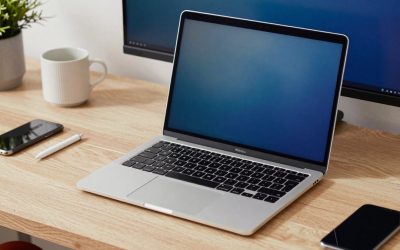
You can practice with it, but most built-in webcams are 1080p30 with small sensors and aggressive noise reduction. Expect more smoothing lag and worse low-light tracking than an external 60 fps webcam or iPhone.
Is iPhone tracking really better than a webcam?
Yes for accuracy, especially for mouth shapes and in dim rooms, because it uses depth data. The downside is extra mounting, charging, and connection setup. Many VTubers use iPhone for tracking and a webcam for work calls.