Last Updated: October 18, 2026
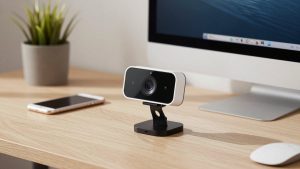
If you are pricing a Logitech webcam for a PC, the range is wider than it looks. As of 2025-2026, street prices run from about $25 for a basic 720p office cam to over $200 for 4K business models. Most people doing Zoom, Teams, and Meet calls land in the $70 to $130 band. That is where 1080p, decent autofocus, and usable noise reduction live.
Logitech dominates PC webcams because its drivers are boring in a good way. Plug it into Windows 10 or 11, macOS on Intel or Apple Silicon, or even a Chromebook, and it shows up as a standard UVC device. You rarely need Logi Tune or Logi Capture unless you want to tweak zoom, white balance, or firmware updates. That plug-and-play reliability is a big part of what you pay for versus no-name 1080p cams.
📄 In This Review
What drives the price
Resolution is the headline, but it is not the whole story. A cheap 1080p sensor with a tiny lens and no autofocus often looks worse than a good 720p sensor in a dim home office. What moves Logitech prices up is the stack around the sensor: glass lens quality, autofocus speed, field of view control, dual noise-canceling mics, light correction, shutter, and USB connection.
For work calls, prioritize autofocus and low-light correction over 4K. A 1080p/30fps image that stays sharp when you lean back, does not blow out your face from a window, and does not stutter on an older laptop will read as more professional than a soft 4K feed compressed by Zoom anyway.
Connection matters too. Most Logitech PC cams are still USB-A. If your laptop is USB-C only, budget $12-20 for a good USB-C hub or adapter. It is a common failure mode: people buy the cam, then get choppy video or disconnects from a cheap dollar-store adapter that cannot sustain power.
Budget tier: $25 to $50
See also: Best Monitor for MacBook Air: Two USB-C 4K Screens and Six Adapter-Dependent Alternatives • Best Monitor for MacBook Pro: Eight Listings Sorted by Cable, Sharpness and Scaling
This is the fix-a-broken-laptop-camera tier. You get 720p or basic 1080p, fixed focus, 60- to 78-degree field of view, and one or two mics without much noise reduction. In good daylight it is fine. In a basement office or evening call, expect grain, soft edges, and that gray, washed-out look.
Who it suits: students, second PC, warehouse or shop PC where it might get dusty or knocked over. Be honest here: if you take two calls a week and your room is bright, the cheaper option is fine. Do not pay double for features you will not touch.
Failure modes to know: fixed focus means if you sit more than 3-4 feet away you look soft. No shutter on most budget models, so you will rely on tape or unplugging. Mic pickup is narrow – keyboard clatter comes through loud. If you type while talking, use a headset.
Shoppers in this tier often start with a basic Logitech HD webcam for laptop use to see current street pricing before deciding whether to step up to autofocus.
Sweet spot for work: $70 to $130
This is where most home office buyers should look. You typically get true 1080p/30fps, autofocus, 78- to 90-degree lens, RightLight-style auto light correction, and a privacy shutter on many models. The Logitech C920s class defined this segment for years: sharp enough for screen-share plus face cam, wide enough for one person without showing the whole room.
Trade-offs inside this band are real. A $70 1080p cam may have slower autofocus that hunts when you move or hold up a document. A $100-130 version usually locks faster, handles backlight better, and has better dual mics. If you present, interview, teach, or do client sales calls, that $30 jump pays off daily.
Who it suits: remote workers, managers, therapists doing telehealth admin, teachers, job seekers. If your PC is 3+ years old, 1080p/30 is also safer than 4K for CPU load. Teams and Zoom will downscale you anyway, so clean 1080p wins.
| Price band | What you typically get | Best for | Watch out for |
|---|---|---|---|
| $25 – $50 | 720p to basic 1080p, fixed focus, single mic | Occasional calls, kids PC, bright room | Grain in low light, soft at distance, no shutter |
| $70 – $130 | 1080p with autofocus, light correction, shutter | Daily Zoom/Teams, job interviews, teaching | Autofocus speed varies, needs good USB port |
| $150 – $230 | 4K or premium 1080p/60, AI framing, USB-C | Creators, exec presence, large monitor setups | Overkill if network is weak, higher CPU use |
Most buyers comparing options in this middle band search Logitech 1080p webcam for PC with autofocus because autofocus and light correction matter more than the megapixel number.
Premium tier: $150 to $230+
Here you are paying for 4K, larger sensors, 4x digital zoom without falling apart, premium mics, USB-C, and features like auto-framing or Show Mode for desk documents. Models in the Brio family and the newer MX Brio class sit here. On a good fiber connection and a 27-inch monitor, you do look crisper, especially if you crop in.
When is it worth it? If you record training videos, stream, or you are on camera 4-6 hours a day and want to look sharp without a mirrorless camera setup. Also useful if you sit far from the camera and need to zoom without mush.
When is it not? If your office has bad upload speed, if you use virtual backgrounds heavily, or if your PC lacks USB 3.0 and a modern CPU. 4K over a weak link often gets compressed to something that looks like $80 1080p anyway, while running hotter. One practical failure: leaving a 4K cam at full 4K in Logi Tune while running Teams, Slack, Chrome with 20 tabs, and VPN on an older i5 leads to dropped frames. Drop to 1080p in settings and it smooths out.
Mac users on M1/M2/M3 should check cable and hub compatibility specifically. A direct USB-C to C cable is cleaner than daisy-chaining through a monitor. If that is your setup, compare Logitech 4K webcam USB-C options for Mac and read recent reviews for sleep-wake issues with your dock.
How to avoid overpaying
Logitech prices swing $20-40 around back-to-school, Black Friday, and Prime Day. The mid-tier models are frequently discounted, while flagship 4K models drop less often. Refurbished business cams can be a good value, but check shutter, mount clip tension, and mic holes for dust – a loose clip that will not grip a thin laptop lid is a common complaint.
Do not pay extra for bundled tripods and ring lights unless you need them. A $15 tripod is often flimsy and a window plus a $20 desk lamp gives better light than a cheap ring. Spend the savings on a stable mount and positioning the camera at eye level. That improves perceived quality more than jumping from 1080p to 4K.
For a shared family PC, buy the cheaper 1080p model and spend the difference on a headset. For a dedicated home office where you earn a living on video, buy the best autofocus and low-light performance you can afford in the $90-170 range and leave it mounted. Unplugging and remounting daily wears out clips and USB plugs.
FAQ
How much should I pay for a Logitech webcam for daily work calls?
Most remote workers are well served at $80 to $120. You get reliable 1080p, autofocus, and light correction without paying for 4K you will rarely use at full quality.
Is 4K worth it for Zoom and Teams on a PC?
Usually not for meetings alone. Both platforms compress video heavily. 4K helps if you record locally, crop in, or want better digital zoom, but you need good light, upload speed, and a modern PC to see the benefit.
Why does my new webcam look worse than my laptop camera?
Three common causes: sitting too far for fixed focus, backlight from a window behind you, and a low-power USB hub. Move to within 2-3 feet, face the light, plug directly into the PC, and set the app to 1080p.
Do Logitech webcams work on Mac and Windows without software?
Yes for basic video and mic. They appear as standard USB video devices. Install Logitech software only if you want manual focus, field-of-view, firmware updates, or background tweaks beyond what Zoom or Teams offers.
Related Reviews & Guides

Best Laptop Camera for Video Conferencing
6 Best HP Laptop Docking Stations 2026