Last Updated: September 15, 2026
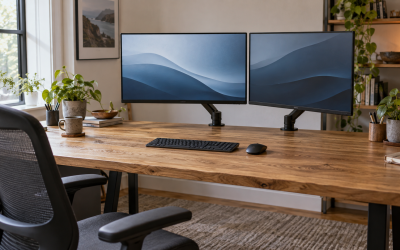
Adding a second monitor solves a software problem and creates a physical one. Two screens side by side push your working area from about 24 inches wide to 48 or more, and unless you arrange them deliberately, the result is hours of repeated neck rotation toward the screen you never quite centered. The people who complain that dual monitors made their neck worse are almost always running the symmetric layout, two identical screens flanking a centerline that nothing actually occupies.
The correct arrangement depends on one question: do you use both screens roughly equally, or is one clearly primary? That answer determines whether you center the seam between screens or center your main screen and angle the second one in. Everything else, height matching, the arc, the gap, tilt, follows from there. Below is the layout logic with measurable targets, plus the mounting hardware that makes each layout achievable, at current US prices.
📄 In This Review
Quick answer: Our top pick in 2026 is the VIVO Dual Monitor Stand, Fully Adjustable Arms for 17 to 32 inch — our #1 rated choice. See the full ranked comparison, alternatives and buying advice below.
Quick Verdict
| Product | Best for | Price |
|---|---|---|
| VIVO Dual Monitor Stand, Fully Adjustable Arms for 17 to 32 inch | Best overall: independent height and angle on both screens | $49.99 |
| WALI Adjustable Dual Monitor Arm, 13-32″, 22 lbs per Arm | Best value dual arm | $32.99 |
| HUANUO FlowLift Dual Monitor Stand, Fully Adjustable | Smooth gas-spring repositioning through the day | $59.99 |
| HUANUO Dual Monitor Stand for 13″-40″ with USB, Height Adjustable | Mixed screen sizes and built-in ports | $119.99 |
| VIVO Dual Monitor Desk Mount, 2 Screens up to 30 inches, 22 lbs each | Cheapest true dual mount | $34.99 |
| BONTEC Dual Monitor Stand Riser, Adjustable Length and Swivel, White | Non-VESA screens or no-clamp desks | $29.99 |
| gianotter Dual Monitor Stand Riser With Drawer | Small lift plus desk storage | $26.99 |
| VIVO Black Clamp-on 27 x 11 in Keyboard Tray, MOUNT-KB05E | Recovering desk depth a dual setup eats | $49.99 |
How to Choose
See also: Monitor arm vs monitor stand which to buy in 2026 • Best monitor height to avoid neck pain in 2026
Decide primary-plus-secondary or true 50/50 first
If you spend most of your day in one application, that screen is primary and it belongs directly in front of you, centered on your nose, with the second screen angled in from the side. If you genuinely split attention, for example a trader watching two chart sets or an editor comparing documents, center the seam between the two screens on your centerline so each display sits an equal, modest rotation away. Picking the wrong model is the single most common dual-monitor mistake, and almost everyone is primary-plus-secondary even when they believe otherwise. Track which screen your mouse pointer lives on for a day if you are unsure.
Build a shallow arc, not a flat wall
Two screens in a straight line put the outer edges further away than the inner ones, which forces you to lean. Angle each screen inward roughly 15 to 30 degrees so both surfaces face your head, and pull the outer edges slightly forward. The goal is that every point on both screens sits about the same distance from your eyes, roughly an arm’s length, 20 to 30 inches. On a 24-inch-deep desk this is only achievable with arms, because monitor bases cannot be angled without walking the whole screen forward.
Match the heights precisely
Mismatched screen heights are worse in a dual setup than in a single one, because your head has to tilt as well as rotate every time you switch. Set both so the top edges land at or slightly below seated eye level. If the two monitors are different sizes, match the top edges rather than the bottoms, or match the vertical centers if the size gap is large. Independent height adjustment on each arm is what makes this possible with mismatched panels, and it is the main reason a $50 dual arm beats a $27 dual riser.
Close the gap between the bezels
Leave as little space as possible between the inner edges of the two screens. Every inch of gap is an inch your eyes travel with no information in it, and a wide gap encourages a head turn rather than an eye movement. Dual arms and adjustable-length risers both let you slide the screens together; fixed dual stands often do not.
Check total weight and clamp load
A dual mount carries two panels on one clamp. Two 27-inch monitors at 12 pounds each put 24 pounds plus the hardware on a single point of your desktop, and the leverage at full extension multiplies the effective force. Confirm the per-arm rating covers your heavier screen, and use a solid desktop rather than a thin hollow-core one. If your screens are 30 inches or larger, a single dual arm may be the wrong tool and two separate single arms the right one.
Plan for depth you are about to lose
Two monitors plus two stands can consume 10 to 12 inches of a 24-inch-deep desk, which is exactly the space your forearms need. Mounting both screens on a clamp arm that cantilevers over the rear edge gives that depth back. If you cannot clamp, a clamp-on keyboard tray moves the typing surface outward and downward instead, achieving a similar result from the other direction.
The Picks in Detail
VIVO Dual Monitor Stand, Fully Adjustable Arms for 17 to 32 inch Screens – $49.99
The best balance of price and capability for a two-screen desk. Each arm adjusts height independently, which is what makes the top-edge alignment target realistic when your two monitors are not identical, and the mechanical spring holds position without constant retensioning. The 17 to 32 inch range covers the vast majority of home office pairings. At fifty dollars for two screens this is the most consequential fifty dollars in a dual setup.
WALI Adjustable Dual Monitor Arm, 13-32 inch, 22 lbs per Arm – $32.99
The value pick, and 22 pounds per arm is a genuinely useful rating rather than a marketing number, comfortably covering two 27-inch panels. Adjustment is a little stiffer than the VIVO and setting spring tension correctly during assembly matters, but for a setup you configure once and leave alone, the savings are real. Tighten the tension bolts to your actual screen weight or expect slow droop.
HUANUO FlowLift Dual Monitor Stand, Fully Adjustable – $59.99
Worth the premium if you reposition screens regularly, for example swinging a secondary monitor out of the way for meetings or rotating it to portrait for long documents. Gas springs move with one hand and stay put, which is the difference between a layout you adjust as needed and one you leave wrong because adjusting it is annoying.
HUANUO Dual Monitor Stand for 13″-40″ with USB, Height Adjustable – $119.99
The one to buy when your two screens are very different sizes, for example a 34-inch ultrawide beside a 24-inch vertical panel. The 13 to 40 inch range and the heavier build handle that mismatch, and the integrated USB ports pull connectivity up to screen level instead of leaving you fishing behind the desk. Expensive relative to the category, and only justified by the size range.
VIVO Dual Monitor Desk Mount, Holds 2 Screens up to 30 inches and 22 lbs Each – $34.99
The cheapest legitimate dual VESA mount here. It covers screens up to 30 inches at 22 pounds each, which is nearly everything short of a large ultrawide, and it gets you the two things risers cannot deliver: independent height and the ability to push both screens back off the desk edge to true arm’s-length distance.
BONTEC Dual Monitor Stand Riser, Adjustable Length and Swivel Angle, White – $29.99
For monitors without VESA holes, or desks you cannot clamp. Adjustable length means you can slide the two platforms together to close the bezel gap, and the swivel lets you build a rough version of the inward arc. It will not match arms for height precision, but it is the best available answer when mounting is off the table.
gianotter Dual Monitor Stand Riser With Drawer and 2 Pen Holders – $26.99
A single long riser rather than two platforms, so both screens rise by the same fixed amount. That works when your monitors are identical and your required lift is small. The drawer underneath is the real selling point on a crowded desk, absorbing the cable ties, dongles, and sticky notes that accumulate around a two-screen setup.
VIVO Black Clamp-on 27 x 11 in Keyboard Tray, MOUNT-KB05E – $49.99
Dual monitors eat desk depth, and the first casualty is forearm support. A clamp-on tray moves the keyboard off the desktop and slightly lower, which restores room for the screens and gets your elbows closer to 90 degrees at the same time. Pair it with a riser setup where arms are not an option.
Related guides: best desk height for your body height, best desk setup for a small apartment, best footrest for desk posture, best lighting for home office video calls, best monitor height to avoid neck pain
FAQ
Should my two monitors be at the same height?
Yes. Align the top edges at or slightly below seated eye level so switching screens is an eye movement rather than a head tilt. If the monitors are different sizes, match the top edges for a small difference and the vertical centers for a large one.
Where should the primary monitor go?
Directly in front of you, centered on your body, if one screen carries most of your work. Center the seam between the two screens only if you truly split attention evenly. Most people overestimate how balanced their usage is.
What angle should the second monitor be at?
Roughly 15 to 30 degrees inward, so the screen surface faces your head rather than the opposite wall. Combined with pulling the outer edge slightly forward, this keeps every part of both screens at similar viewing distance.
Is a vertical second monitor a good idea?
It works well for code, documents, chat, and long web pages, and it reduces the horizontal sweep of a dual setup considerably. The caution is height: a rotated 27-inch panel becomes very tall, and its top edge can end up well above eye level. Lower the whole screen so its upper third, the part you read most, sits near your gaze line.
Do I need two arms or one dual arm?
One dual arm is simpler, cheaper, and easier to keep height-matched, and it suits two similar screens. Two independent single arms cost more and use two clamp points, but they give you full freedom over angle, depth, and orientation, which matters when the monitors differ in size or when one is rotated to portrait.
Ready to decide? Our #1 pick for 2026 is the VIVO Dual Monitor Stand, Fully Adjustable Arms for 17 to 32 inch.
Live price & availability on Amazon.
Related Reviews & Guides


6 Best Ergonomic Stand Monitors 2026
11 Best Monitor Arms: Top Picks Reviewed and Compared (2026)