Last Updated: September 18, 2026
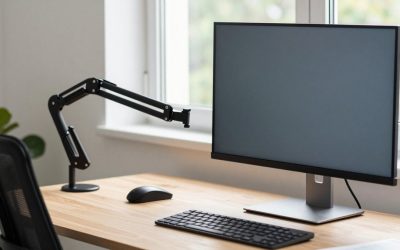
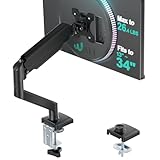
- Top Pick: WALI Adjustable Single Monitor Arm for 13-34 inch Screens, up to 26.4 lbs
- Best Value: ErGear Single Monitor Arm, Fully Adjustable Monitor Mount for 13–34 Inch Screens, Fast Install Computer Monitor Stand with Tool-Free VESA Mount, Cable Management, Holds 19.8 lbs
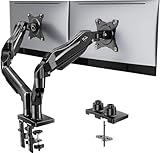
- Premium Choice: HUANUO FlowLift™ Dual Monitor Stand, Fully Adjustable Gaming Monitor Desk Mount for 13–32″ Computer Screens, Full Motion VESA 75×75/100×100 with C-Clamp & Grommet Base, Each Arm Holds 4.4 to 19.8 lbs
Choosing between a single monitor arm and a dual monitor arm is less about the number of screens you own today and more about how you use your desk every day. The real decision is whether you want maximum flexibility for one display or a workstation built around two screens. A single arm usually gives one monitor more room to move, while a dual arm can make work, gaming, and multitasking faster—but takes more planning, desk space, and adjustment.
The right choice also depends on your monitor sizes, desk construction, mounting method, budget, and household. A 27-inch monitor on a compact desk has very different needs from two 32-inch displays on a permanent home office setup.
As an Amazon Associate we earn from qualifying purchases at no extra cost to you.

📄 In This Review
Quick Verdict
Choose a single monitor arm if you use one screen, want the cleanest setup, or expect to change your desk layout. It is generally cheaper, easier to install, and simpler to adjust. A single arm also leaves more usable space for speakers, notebooks, a laptop, or a lamp.
Choose a dual monitor arm if two screens are central to your workflow. It is especially useful for remote work, video editing, spreadsheets, programming, gaming with a second screen, and households where a desk serves multiple purposes. The tradeoff is a larger footprint, more cable management, and a greater chance of uneven screen alignment.
For 2026 buyers, the best value is often a well-supported single arm bought for a current monitor, unless a second display is a near-term certainty. If you already own two compatible monitors, a dual arm usually creates a cleaner and more cohesive setup than two separate arms.
Side by Side
See also: How to Clean a Monitor Arm (2026): Step-by-Step • How to Tighten a Loose Monitor Arm (2026): Step-by-Step
| Factor | Single monitor arm | Dual monitor arm |
|---|---|---|
| Comfort | Excellent control over one screen’s height, depth, and angle | Excellent for multitasking, but alignment can take longer |
| Durability | Fewer joints and less total weight to support | More moving parts and greater load on the desk clamp |
| Price range | About $25–$100 for common home-office models | About $35–$180, depending on capacity and arm design |
| Maintenance | Usually limited to tightening hardware and organizing one cable set | May require balancing, tightening, and managing two cable sets |
| Space needed | Works well on desks around 24–30 inches wide | Usually needs a wider desk and more clearance behind it |
| Look | Minimal and visually calm | More substantial, but can create a symmetrical workstation |
| Resale | Broad appeal to students, renters, and home-office users | Appeals to dedicated multitaskers, gamers, and professionals |
| Best for | One-screen work, compact rooms, and flexible layouts | Two-screen workflows and permanent workstations |
Where Single Monitor Arm Wins
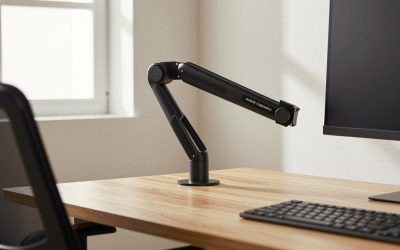
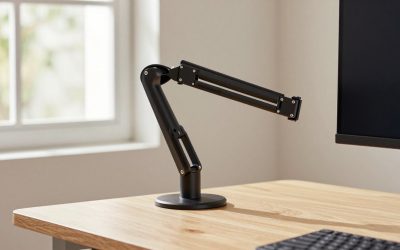
The biggest advantage of a single arm is control. You can center one monitor precisely in front of your chair, pull it closer for detailed work, or push it back when you need desk space. Many models support tilt, swivel, height adjustment, and rotation into portrait orientation. That flexibility is valuable if you alternate between writing, browsing, gaming, and video calls.
A single arm is also easier on a smaller desk. Many compact desks are only 40 to 48 inches wide, and a 27-inch monitor already takes up a meaningful portion of that surface. One arm keeps the base and clamp concentrated in one location. The remaining area can hold a keyboard, speakers, a laptop, or a charging station without making the desk feel crowded.
Weight capacity is another reason to choose one. A basic single arm may support roughly 13 to 26 pounds, depending on the model and extension position. The WALI Adjustable Single Monitor Arm, for example, is listed for 13- to 34-inch screens and up to 26.4 pounds, while the ErGear Single Monitor Arm is listed for screens in the same size range and up to 19.8 pounds. Always compare your monitor’s weight without its original stand against the arm’s stated capacity.
Installation and adjustment are generally more straightforward, too. There is only one VESA plate to attach, one set of tension controls to balance, and one group of cables to route. For a first-time buyer, that reduces the chance of a screen slowly dropping, tilting, or pulling the arm toward one side.
Single arms also cost less in many entry-level setups. Common prices begin around $25 and run toward $100 or more for premium gas-spring designs. The WALI model is priced at $25.49, while the ErGear single-arm model is $26.99. At that price, a single arm can be a practical upgrade over a monitor stand without becoming a major furniture purchase.
Where Dual Monitor Arm Wins
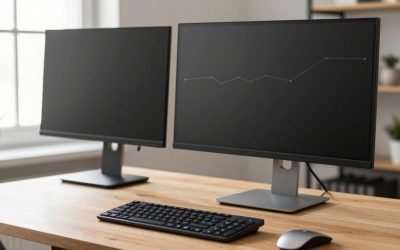
A dual arm earns its space when two screens genuinely improve your routine. You might keep email or research on one display while writing on the other, monitor a video timeline beside a preview window, or run a game on one screen while using the second for chat and guides. Keeping both displays at the same height can also make a workstation look more intentional than placing one monitor on a stack of books or a separate stand.
Dual arms can free more desk surface than two independent monitor stands. Instead of having two heavy bases occupying the middle of the desk, one clamp or grommet mount supports both displays from the rear. That leaves more room underneath for a keyboard, documents, and other accessories.
However, a dual setup needs careful measurement. Two 27-inch monitors side by side require roughly 48 to 50 inches of horizontal width before accounting for bezels, viewing angles, or side clearance. Two 32-inch screens can approach 56 to 60 inches. Curved displays may require even more depth or a wider angle between the arms.
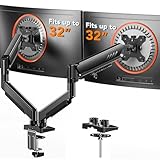
Load capacity must be checked per arm, not just for the entire mount. The HUANUO FlowLift Dual Monitor Stand is listed for 13- to 32-inch screens, with each arm supporting 4.4 to 19.8 pounds. The ErGear Dual Monitor Arm supports 13- to 32-inch screens with a maximum listed load of 19.8 pounds per arm. That does not mean every combination will feel equally stable: fully extended arms place more leverage on the clamp than screens kept close to the mounting post.
Dual arms also introduce more adjustment points. Screens may need separate height, tilt, and rotation corrections, and mismatched monitor sizes can make a perfectly level arrangement difficult. If the displays are frequently moved, a dual arm may become annoying. If they stay in a fixed position, the initial setup effort is easier to justify.
Cost Over 5 Years
Purchase price is only part of the cost. For a basic home setup, a single arm may cost $25–$100 upfront. A dual arm may cost $35–$180. The low end includes models such as the $25.49 WALI single arm, the $26.99 ErGear single arm, the $34.99 ErGear dual arm, and the $59.99 HUANUO dual stand.
Over five years, assume the mount remains compatible with your monitor, requires no replacement parts, and is installed on a suitable desk. Under those conditions, a $25 single arm costs about $5 per year, while a $60 dual arm costs about $12 per year. That is modest compared with the price of a monitor, but a dual setup can lead to additional costs if you need a stronger desk, longer DisplayPort or HDMI cables, cable extensions, or a monitor upgrade to match screen sizes.
There is also an opportunity cost. Buying a single arm now and adding another later may cost more than choosing a dual mount initially, particularly if the two arms use different clamps or mounting systems. On the other hand, buying a dual mount for a screen you never add leaves you with unused hardware and a larger visual footprint. A dual arm is most economical when two monitors are part of your plan within the next year or two.
Which One for Your Home
Small apartment
Pick a single monitor arm unless your work depends on two screens. Apartments often have narrow desks, limited wall clearance, and rooms that serve several purposes. A single 24- to 27-inch monitor can be pushed against the rear of the desk when you need more surface area. If you need a second screen occasionally, a laptop placed beside the main monitor may be more practical than a permanent dual mount.
Family with kids or pets
Stability matters more than maximum adjustability. A single arm has fewer extended parts that can be bumped, and one screen is easier to keep centered and secure. Choose a model with a solid clamp or grommet installation, confirm that the desk is thick and sturdy enough, and route cables through the built-in management channels. If you choose a dual arm, keep both screens close to the mounting post rather than fully extended.
Rental
Either style can work, but a clamp mount is usually the least disruptive option because it does not require drilling into the desk. Check the desk edge before buying: some clamp bases need several inches of unobstructed clearance and may not fit desks with drawers, raised backs, or a thick rear lip. A single arm is easier to move when you relocate, while a dual arm makes sense if you already have a permanent rental-office desk.
Long-term home
A dual arm is a strong choice for a dedicated office with a desk at least 48 to 60 inches wide and enough rear clearance. It is particularly worthwhile if you regularly compare documents, manage several applications, edit media, or play games while monitoring another window. Choose a single arm instead if you value a calm, minimal room or expect your monitor setup to change frequently.
FAQ
Is a dual monitor arm better than two single monitor arms?
Not automatically. A dual arm usually saves desk space and creates a unified look, but two single arms offer more independent placement and can be easier to upgrade. Two single arms are useful when the monitors differ substantially in size, weight, or viewing position.
Can one monitor arm hold any monitor?
No. Check three specifications: screen size range, weight capacity, and VESA pattern. Many home-office monitors use VESA 75×75 or 100×100 millimeter patterns, but the mount must also support the monitor’s weight without its original stand.
Should both monitors be the same size?
No, but matching sizes simplify alignment. Two screens with similar height and bezel thickness create a cleaner side-by-side arrangement. Different sizes can work well when one display is your main screen and the other is used for chat, reference material, or monitoring.
Do monitor arms damage desks?
They can if the desk is weak, hollow, too thin, or clamped without a protective pad. Follow the manufacturer’s thickness limits, tighten the clamp evenly, and consider a reinforcement plate for particleboard or laminated desks. A strong desk is as important as a strong monitor arm.
Ready to decide? Our #1 pick for 2026 is the Comfort.
Live price & availability on Amazon.
Related Reviews & Guides



6 Best Wood Computer Monitor Stands 2026

6 Best Wood Stand Monitors 2026