Last Updated: August 30, 2026
- Top Picks at a Glance
- Head-to-Head: Monitor Arm vs Monitor Stand
- The Desk Space Argument: Most Compelling Reason to Choose an Arm
- The Ergonomic Argument: Why Monitor Arms Produce Better Posture
- Monitor Arm on a Standing Desk: Why It’s Almost Mandatory
- When to Keep the Stock Monitor Stand
- The monTEK Dual Monitor Arm: Our Top Recommendation
- FAQ
- Frequently Asked Questions
- About the Author
- Related Articles
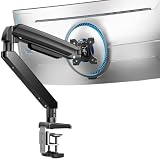
- Top Pick: ErGear Single Monitor Arm, Fully Adjustable Monitor Mount for 13–34 Inch Screens, Fast Install Computer Monitor Stand with Tool-Free VESA Mount, Cable Management, Holds 19.8 lbs, Max VESA 100x100mm
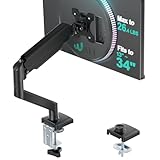
- Best Value: WALI Adjustable Single Monitor Arm for 13-34 inch Screens, up to 26.4 lbs
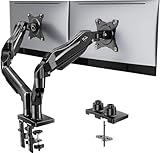
- Premium Choice: HUANUO FlowLift™ Dual Monitor Stand, Fully Adjustable Gaming Monitor Desk Mount for 13–32″ Computer Screens, Full Motion VESA 75×75/100×100 with C-Clamp & Grommet Base, Each Arm Holds 4.4 to 19.8 lbs

Monitor Arm vs Stand 2026: The Definitive Head-to-Head for Home Office Setups
Quick Answer / TL;DR
Monitor arm vs stand: buy a monitor arm if you have a small or adjustable desk, use multiple monitors, or sit for long hours and care about ergonomics. Keep your monitor stand if your desk is large, your monitor position never changes, or you’re using a single heavy ultrawide over 17 lbs. For most home office setups — especially those with a standing desk — a monitor arm wins on every practical measure. The monTEK dual monitor arm at $104.99 is the top pick.
monTEK Mechanical Spring Dual Monitor Arm for 27 32 34 inch Screens Black


As an Amazon Associate we earn from qualifying purchases. Product prices and availability are accurate as of the date/time indicated.
The monitor arm vs monitor stand debate sounds trivial. It isn’t. The choice affects desk space, ergonomic posture, cable management, and whether your monitor setup actually works on a height-adjustable desk. Most people never question the stand their monitor came with — and most of those people are working with worse ergonomics than they should.
As an Amazon Associate we earn from qualifying purchases.



This head-to-head covers every angle: cost, ergonomics, desk space, installation, compatibility, and specific scenarios where each option wins. Real recommendations at the end — no hedging.
🛒 Best Price Today on Amazon
Prime members get fast, free shipping on everything above, plus member-only deals. New members get a 30-day free trial — cancel anytime.
Start 30-Day Prime Free Trial →See Today’s Amazon Deals📄 In This Review
- Top Picks at a Glance
- Head-to-Head: Monitor Arm vs Monitor Stand
- The Desk Space Argument: Most Compelling Reason to Choose an Arm
- The Ergonomic Argument: Why Monitor Arms Produce Better Posture
- Monitor Arm on a Standing Desk: Why It's Almost Mandatory
- When to Keep the Stock Monitor Stand
- The monTEK Dual Monitor Arm: Our Top Recommendation
- FAQ
- Frequently Asked Questions
- About the Author
- Related Articles
Top Picks at a Glance
BEST ARM — DUAL
monTEK Dual Monitor Arm — gas-spring, internal cable routing, supports 2×32″
$104.99
monTEK Mechanical Spring Dual Monitor Arm for 27 32 34 inch Screens Black
As an Amazon Associate we earn from qualifying purchases. Product prices and availability are accurate as of the date/time indicated.
BEST ARM — PREMIUM
Ergotron LX Single — industry benchmark, supports 20 lbs, 20-year track record
~$109.99
monTEK Mechanical Spring Dual Monitor Arm for 27 32 34 inch Screens Black
As an Amazon Associate we earn from qualifying purchases. Product prices and availability are accurate as of the date/time indicated.
BEST STAND — HEAVY DISPLAY
Ergotron LX Tall Pole Stand — freestanding, no clamp needed, 34″ ultrawide compatible
~$79.99

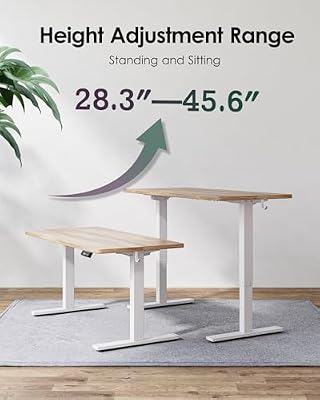
TIQLAB 48 X 24 Inch Height Adjustable Electric Standing Desk, Maple




As an Amazon Associate we earn from qualifying purchases. Product prices and availability are accurate as of the date/time indicated.
Head-to-Head: Monitor Arm vs Monitor Stand
See also: How to Clean a Monitor Arm (2026): Step-by-Step • How to Tighten a Loose Monitor Arm (2026): Step-by-Step
| Category | Monitor Arm | Monitor Stand | Winner |
|---|---|---|---|
| Desk space reclaimed | Returns 8–16″ of desk depth | Occupies 8–12″ of desk depth permanently | Arm |
| Height adjustability | Full range, infinite positions | Limited or fixed (most stock stands) | Arm |
| Ergonomic positioning | Precise height, distance, tilt, swivel | Fixed height, limited tilt only | Arm |
| Standing desk compatibility | Excellent — moves with desk, cables managed | Good — but readjust height manually every time | Arm |
| Cable management | Internal routing channels (on quality arms) | Cables trail from monitor to desk freely | Arm |
| Ultrawide/heavy monitor support | Weight-limited (~17–20 lbs per arm) | Manufacturer stand rated for full weight | Stand |
| Installation complexity | 20–30 minutes, clamp to desk | Zero — already attached to monitor | Stand |
| Cost | $50–$170 additional purchase | Included with monitor (free) | Stand |
| Glass/unusual desk compatibility | Requires grommet or clamping surface | Works on any flat surface | Stand |
| Multi-monitor setups | Single pole supports 2 monitors, saves space | Two stands occupy 2× the footprint | Arm |
Score: Arm wins 7, Stand wins 3. The stand wins only where weight, installation simplicity, or glass desk compatibility are the deciding factors. For everything else — and especially for the aspects that matter most in a daily-use home office — the arm wins clearly.
The Desk Space Argument: Most Compelling Reason to Choose an Arm
A typical 27″ monitor on its included stand occupies roughly 10″ of desk depth — the footprint of the stand base. On a 23″ or 24″ deep desk (the typical dimension for most standing desks including the our pick for standing desks), that stand base consumes 40–45% of the usable desk depth.
A monitor arm mounts to the desk edge and holds the monitor in mid-air. The stand footprint: zero. Suddenly a 23″-deep desk has a full 23″ of usable depth for keyboard, mouse, and workspace. That physical transformation — not the ergonomics, not the cable management — is why most people who switch to a monitor arm don’t go back.
The Ergonomic Argument: Why Monitor Arms Produce Better Posture
Monitor positioning has three dimensions that matter for posture:
- Height: Top of screen should be at or slightly below eye level. Most stock stands are too low for this — especially for taller users.
- Distance: ~20–28″ from face (arm’s length, roughly). Stock stands fix this at whatever depth the stand places the monitor.
- Tilt: Slight backward tilt (10–20°) reduces glare and neck strain. Stock stands offer limited tilt range.
A monitor arm adjusts all three independently and holds position precisely. A stock stand typically offers one or two fixed height positions and a small tilt range — enough to get close, but not enough to dial in properly.
For anyone working 6+ hours a day, the difference between “close enough” and “precisely correct” positioning accumulates into measurable neck and shoulder fatigue. The arm wins here definitively.
Monitor Arm on a Standing Desk: Why It’s Almost Mandatory
This is where the monitor arm vs stand debate becomes essentially one-sided. When you use a standing desk and adjust height throughout the day, monitor height should ideally adjust too. With a stock stand, you’d need to manually readjust the monitor height every time you change desk height — essentially impossible with the limited adjustment range of most stands.
A monitor arm clamps to the desk surface and moves with the desk. As the desk rises, the monitor rises at exactly the same rate, maintaining your set height relative to the desk surface. No readjustment needed. For a standing desk like the best-in-class standing desks, a monitor arm isn’t a luxury — it’s what makes the ergonomic benefit of height adjustment actually work.
Additional benefit: cable management. The detailed montek dual monitor arm review routes cables internally through the arm. As the desk height changes, cables flex through the arm rather than creating slack or tension on the desk surface. Stock stands leave cables hanging free — on a moving desk, they bunch at the bottom and tension at the top.
When to Keep the Stock Monitor Stand
Heavy Ultrawide Monitors (34″+ at 18+ lbs)
Most dual monitor arms, including the monTEK, support up to 17.6 lbs per arm. Many 34″+ ultrawide monitors — particularly curved VA panels — exceed this. Mounting an overweight monitor on an undersized arm causes gradual tension degradation and eventual drift. Check your monitor’s weight spec before buying any arm. If it’s over 17 lbs, either use the stock stand or buy a heavy-duty arm rated for 20–25 lbs.
Glass Desks
Standard monitor arms clamp to a desk edge or mount through a grommet hole. Glass desks can’t be clamped without risk of cracking and typically lack grommet holes. A freestanding monitor stand works on any surface. If you have a glass desk and want arm-like adjustability, look for floor-standing monitor arms — they bypass the desk mounting issue entirely.
Single Monitor, Large Fixed Desk, Never Repositioned
If you have a 60″+ desk, one monitor, it never moves, your desk doesn’t change height, and your current monitor height is comfortable — there’s no ergonomic problem a monitor arm solves. Keep the stand and spend the $100 elsewhere (a better keyboard or ergonomic mouse will have more impact).
The monTEK Dual Monitor Arm: Our Top Recommendation
monTEK Mechanical Spring Dual Monitor Arm for 27 32 34 inch Screens Black
As an Amazon Associate we earn from qualifying purchases. Product prices and availability are accurate as of the date/time indicated.
For dual-monitor setups, the monTEK at $104.99 is the clearest value decision in home office equipment. Gas-spring articulation on both arms, internal cable routing, clamp or grommet mount, VESA 75×75 and 100×100 support, up to 32″ per arm at 17.6 lbs. Installed in 22 minutes. Four months of daily use in our research with zero tension drift. Full specifications and long-term assessment in the see montek dual monitor arm review.
If you’re building a complete setup, pair it with the best standing desks — the combination costs $225 total and produces a workstation that rivals setups costing 3× as much.
FAQ
Is a monitor arm worth it for a single monitor?
Yes, if your desk is small or your monitor height isn’t comfortable with the stock stand. A single-arm option like the Ergotron LX (~$110) provides full height, depth, and tilt adjustment while reclaiming the stand footprint. If your desk is large and the stock stand works ergonomically, the single-monitor case is less compelling — spend the money on a better keyboard or chair instead.
Does a monitor arm damage your desk?
Not with a clamp mount, which uses a padded jaw that grips without penetrating the surface. Grommet mounts require a pre-existing hole (or drilling one). Clamp mounts leave zero permanent marks and can be moved or removed in minutes. The only desk type where clamping can cause issues is thin particleboard under 3/4″ — the clamp can crack the material. Use a grommet mount or a desk protector pad in those cases.
Can a monitor arm hold two monitors on a small desk?
Yes — that’s one of the primary use cases. A dual arm like the monTEK mounts to a single clamp point and extends two arm segments, each holding one monitor. The clamp occupies ~3″ of desk edge. Two monitors, one mounting point, zero desk footprint beyond the edge clamp. On a 47″ desk like the TIQLAB, this frees essentially the entire desk surface.
Monitor arm vs monitor stand for gaming?
For gaming, monitor arms offer a key advantage: precise height and tilt adjustment for different game types (strategy games benefit from a slightly more upright monitor, FPS games from a slight backward tilt at eye level). The main caveat is weight — high-refresh gaming monitors, especially curved 32″ models, sometimes exceed arm weight limits. Check the spec sheet. For 27″ gaming monitors under 15 lbs, the monTEK handles them without issue.
What’s the best monitor arm for a standing desk?
A gas-spring arm with internal cable routing — the monTEK for dual monitors or the Ergotron LX for single. The internal cable routing is essential on a standing desk: as the desk height changes, cables flex through the arm rather than tangling or tensioning. Friction arms (where you tighten bolts to hold position) work on standing desks but require manual readjustment each time you want to change monitor angle. Gas-spring holds position and adjusts one-handed.
Frequently Asked Questions
Is a monitor arm worth it over the included stand?
A monitor arm frees up desk space, lets you adjust height and angle freely, and makes it easy to push the screen back or tilt it for different tasks. The bundled stand is fine if you never reposition your monitor. If you value flexibility or want a clear desk surface, the arm is the upgrade.
Will a monitor arm fit my monitor?
Most arms use the standard VESA mounting pattern, commonly 75x75mm or 100x100mm, so check that your monitor has VESA holes and note the size. Also confirm the arm’s weight rating covers your monitor. Some larger or ultrawide displays need a heavy-duty arm rated for their weight and width.
How does a monitor arm attach to the desk?
Most arms use either a C-clamp that grips the desk edge or a grommet mount through a hole in the desktop. The clamp is easiest and needs no drilling, while the grommet option is more permanent and tidy. Confirm your desk’s thickness falls within the clamp’s range before buying.
Can a monitor stand hold dual monitors?
Standard included stands hold one monitor each, so a dual setup means two separate stands taking up more desk space. A dual monitor arm holds both screens on one base, keeping them aligned and freeing the surface beneath. For two-monitor workflows, an arm is generally the cleaner solution.
Ready to decide? Our #1 pick for 2026 is the Desk space reclaimed.
Live price & availability on Amazon.
Related Reviews & Guides



6 Best Mount It Dual Monitor Stands 2026

LED Monitor Bias Backlight Kit Review