Last Updated: October 18, 2026
If you want better picture quality on video calls, ignore most of the marketing. Sharpness on the box means very little if the sensor is tiny, the lens is slow, and your room lighting is bad. For work calls, what reads as “good picture” is usually clean skin tones, low noise in a dim home office, and stable exposure when you move or a window is behind you.
I test webcams the way you will actually use them: 9am standup in a spare bedroom, overhead lights on, face 2-3 feet from the camera, laptop or Mac docked to a monitor. Under those conditions, the differences between categories are consistent and worth understanding before you spend more.
📄 In This Review
What actually determines picture quality
Resolution is only one piece. A cheap 4K sensor can look worse than a good 1080p sensor because it captures more noise, not more detail, in low light. For most home offices at 150-300 lux, which is typical with one ceiling light and a window to the side, sensor size, pixel size, lens aperture, and processing matter more than 4K versus 1080p.
Autofocus and auto-exposure also make or break perceived quality. A webcam that hunts for focus every time you lean back, or blows out your face when you wear a white shirt, will look bad on Zoom or Teams even if still frames look sharp. Mac users should pay extra attention here: macOS handles webcam exposure differently than Windows, and some business webcams look darker on a MacBook until you adjust them in their desktop app.
1080p vs 1440p vs 4K for work calls
See also: Best Monitor for MacBook Air: Two USB-C 4K Screens and Six Adapter-Dependent Alternatives • Best Monitor for MacBook Pro: Eight Listings Sorted by Cable, Sharpness and Scaling
For one-on-one calls and small meetings, good 1080p is still fine. Zoom, Teams, and Meet compress video heavily anyway, often to 720p or 1080p for most participants. You will not see full 4K on the other end. Where higher resolution helps is if you crop in, use digital zoom, or present while sitting farther back. A 4K sensor downscaled to 1080p can also look cleaner, but only if the sensor is large enough to avoid excess noise.
The trade-off is light sensitivity. Many small-sensor 4K webcams need a lot of light to look good. In a dim room they smear detail with noise reduction and your face looks waxy. A larger-sensor 1080p or 1440p webcam with an f/2.0 or faster lens will usually beat it after 5pm in winter. If you take calls all day in the same poorly lit room, prioritize sensor and low-light performance over maximum resolution.
Which type suits which worker
| Type | Picture strengths | Weaknesses | Best for |
|---|---|---|---|
| Good 1080p business webcam | Reliable exposure, low noise, works without tweaking | Less cropping room, softer if you sit far back | Daily standups, customer calls, shared home office |
| 1440p mid-range webcam | Sharper than 1080p, better digital zoom, usually larger sensor | Needs decent USB bandwidth, some models run warm | Managers, coaches, anyone on camera 3+ hours per day |
| 4K large-sensor webcam | Best detail in good light, clean downscaled 1080p, nicer background blur | Expensive, exposes bad lighting, larger file load for old laptops | Presenters, interviews, YouTube plus work hybrid use |
| Mirrorless / action cam as webcam | Far better depth, color, and low light than any USB webcam | Complex setup, heat limits, needs capture device and power | Only if video quality is part of your job |
If you just want to look clear and professional without thinking about settings, a proven 1080p business webcam with autofocus is enough. Do not pay for 4K if your calls are 30-minute check-ins from a laptop at a kitchen table.
If you sit in front of your desk for hours and want head-and-shoulders framing with a little background blur, step up to the 1440p class. That middle tier is currently the sweet spot for picture quality per dollar. Look at options in the 1440p USB webcam for home office range with a larger sensor and dual noise-reducing mics, not the cheapest 1440p badge.
Buy 4K only if you control your lighting and want maximum flexibility. In good light a 4K USB webcam with large sensor looks genuinely better: sharper glasses and hair, smoother gradients on walls, less blockiness when you share a wide shot. In bad light, it can look worse until you add a $30 key light. That is the failure mode people miss.
Lighting beats a more expensive camera
In testing, a $70 webcam with a cheap LED panel 2 feet away beats a $200 webcam in a backlit room almost every time. If your picture looks grainy, gray, or flickery, fix light first. Face a window if you can, or put a soft white light behind your monitor at face height. Avoid sitting with a bright window directly behind you; no webcam HDR can fully save that, and your face will go dark while the window goes white.
Lens field of view matters too. Very wide 90-95 degree lenses make a small home office look bigger but make your face smaller and softer, and they show more clutter. For picture quality, 75-82 degrees is better for solo work calls. You fill the frame, the camera uses more pixels on you, and autofocus has less background to get confused by.
Laptops and Macs: practical trade-offs
Built-in laptop cameras have improved, especially on recent MacBooks, but they are still small sensors tuned for thin lids. They are fine for travel and quick calls. They fall apart in warm indoor light: noise on walls, soft detail, and aggressive sharpening around hair. If colleagues say you look dark or blurry on every call, an external camera is the fix, not a new laptop.
On Windows laptops, most USB webcams are plug-and-play at 1080p. Full 4K at 30fps sometimes needs a direct USB 3.0 port, not an old hub or dock passthrough. If the image stutters or drops to a lower resolution, try another port before returning the camera. On Mac, check that the vendor has a current macOS tuning app. Without it you may be stuck with default exposure that is too dark, and features like background blur or auto-framing may not work in all apps.
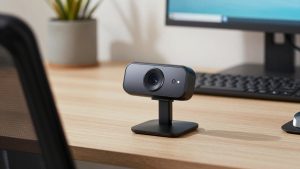
Mounting also affects perceived sharpness. Clipping a webcam to a 27-inch monitor puts it 30+ inches from your face. That is far. Move it closer with a small tripod behind your laptop, or sit closer, and picture quality jumps without spending more. This is especially true for 1080p cameras.
Failure modes to check in the first week
Test these early so you can return if needed. First, low-light noise: take a call at night with only room lights on. If walls crawl with speckles and your face pulses, the camera needs more light than you have. Second, autofocus hunting: lean forward and back, hold up a document. If it breathes in and out for seconds, turn off continuous autofocus if the app allows, or switch to fixed focus at desk distance.
Third, white balance shifts: wear a colored shirt, turn on a warm desk lamp. If your face goes orange then blue repeatedly, lock white balance to auto-indoor or 4000-5000K. Fourth, over-sharpening: look at hair and text behind you. Crunchy halos mean the camera is adding edge enhancement to fake detail. Reduce sharpness in the app. If a camera cannot hold stable focus, exposure, and color through a normal workday, resolution specs do not matter.
FAQ
Is 4K worth it just for Zoom and Teams?
Usually not. Those platforms compress heavily, so the other person sees 720p to 1080p most of the time. Buy 4K if you want better downscaled 1080p, cropping flexibility, or you also record video. Otherwise a good 1080p or 1440p camera in good light looks the same to colleagues.
Why do I look grainy even with a good webcam?
Almost always low light. Small sensors need a lot of photons. Add a soft light in front of you, move closer to the camera, and avoid backlight. That fixes more grain than upgrading cameras.
Do I need special software on Mac?
Not always, but it helps. Basic video works plug-and-play, but exposure tuning, firmware updates, background effects, and field-of-view controls usually need the maker’s macOS app. Check compatibility before buying if you use a MacBook as your main machine.
When is the cheaper 1080p option fine?
When your calls are short, your room has decent frontal light, and you sit 2-3 feet away. In that setup a solid 1080p camera looks clean and professional. Spend the savings on a light or a better mic, which colleagues will notice more.
Related Reviews & Guides

Best Webcam for MacBook Pro and Zoom
6 Best USB C Docking Stations For HP Laptop 2026