Last Updated: October 18, 2026
If you work from a Windows PC all day, a 4K webcam sounds like an easy upgrade. Sharper image, more professional on Zoom and Teams, done. In practice, 4K helps in very specific ways and creates new problems if you buy the wrong one. Most video apps still show you at 1080p or 720p, 4K sensors struggle more in dim rooms, and some 4K modes will stutter on older laptops.
That does not mean you should skip 4K. It means you should buy it for the right reasons: digital zoom without mush, better cropping for auto-framing, and cleaner downscaled 1080p. For a home office PC that stays plugged in, those are worth paying for. For a five-year-old laptop you carry to coffee shops, often not.
📄 In This Review
What 4K actually gets you on a PC
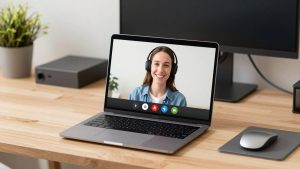
On a typical work call, no one sees your full 4K feed. Teams, Zoom, and Meet compress aggressively and usually cap at 1080p. Where 4K still matters is what happens before that compression. A good 4K sensor downscaled to 1080p looks cleaner than a native 1080p sensor, with less noise and sharper text on a whiteboard behind you. It also lets you crop in 2x and still send a sharp 1080p image.
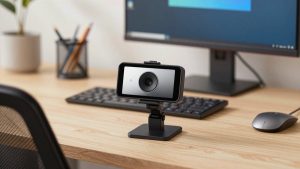
That crop is the real reason to buy 4K for work. Premium models use it for auto-framing, desk-view modes, and virtual PTZ that follows you if you stand up at a standing desk. You can also set a tight head-and-shoulders shot in software while the camera sits 3-4 feet away on a 32-inch monitor. A 1080p camera doing the same digital zoom turns soft fast.
The trade-off is light and processing. Small 4K sensors need more light than good 1080p sensors. In a dim home office at 7pm, a cheap 4K webcam often looks darker and grainier than a solid 1080p one. 4K at 30fps over USB also takes more CPU, especially if you leave background blur and auto-framing on. On a modern desktop with a wired connection, no issue. On a thin laptop on battery with three Chrome windows open, expect fan noise.
What to check before you buy for PC
See also: Best Monitor for MacBook Air: Two USB-C 4K Screens and Six Adapter-Dependent Alternatives • Best Monitor for MacBook Pro: Eight Listings Sorted by Cable, Sharpness and Scaling
Sensor and lens matter more than the 4K badge. Look for a larger sensor with a bright lens, around f/2.0 to f/2.4, and honest low-light samples, not just spec sheets. Autofocus type matters too. Fast contrast or phase-detect autofocus is better if you move, show products, or lean in and out. Fixed focus is fine if you sit still 2-3 feet away, and it never hunts or pulses during a call.
Check Windows specifics: USB-A vs USB-C in the box, cable length for a desktop tower under the desk, Windows Hello support if you want face login, and certification for Teams or Zoom if IT requires it. Most current 4K webcams are UVC plug-and-play, but features like 4K/30, HDR, background blur, and head tracking often require the vendor app running. If your work PC locks down installs, you want a camera that stores zoom, exposure, and white balance on-device after one setup at home.
Do not overlook microphones and mounting. Almost every built-in webcam mic sounds thin and picks up keyboard clatter. Plan on a USB headset or desktop mic for daily calls. For mounting, a heavy camera on a thin laptop lid will wobble every time you type. A tripod thread and a small desktop tripod solve that and give you proper eye-level height, which does more for looking professional than 4K alone.
| Type | Typical image | Autofocus / framing | Best for | Watch out for |
|---|---|---|---|---|
| Premium AI 4K | 4K/30, downscaled 1080p/60 | Fast AF + auto-framing, 70-90 degree FOV | Home office, standing desks, presenters | Needs good light, vendor app for full features, higher price |
| Business 4K | 4K/30, HDR | Reliable AF, 65-90 degree FOV | Teams / Zoom all day, IT-managed PCs | Plainer image, mics still mediocre |
| Midrange 4K fixed-focus | 4K/30, softer low light | Fixed focus, 80-95 degree FOV | Still sitters on desktops, tight budgets | Focus hunting avoided but no close-up product demos |
| Good 1080p alternative | 1080p/60, better low light per dollar | Fast AF, wide software controls | Older PCs, dim rooms, travel laptops | No clean 2x zoom, weaker auto-framing |
Picks by use case
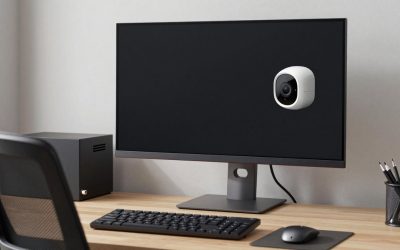
Best for most home office PCs: premium AI 4K with auto-framing. If your PC stays on a desk and you want one camera that handles sitting, standing, and pacing during calls, this is the category to get. You mount it once on top of a 27- to 34-inch monitor, set a medium field of view around 70-78 degrees, and let it crop to keep you centered. When you browse 4K webcams with auto framing for PC, prioritize fast, quiet autofocus and on-device settings memory over gimmicky gesture controls. Failure mode: in a dark room with only a monitor for light, faces go waxy from noise reduction. Fix it with a $30 LED panel behind the monitor, not a more expensive camera.
Best for Teams and Zoom workhorses: business-certified 4K. These tend to have less aggressive sharpening, more natural skin tones, and more predictable exposure when screen-sharing. They also behave better on locked-down work laptops where you cannot install utilities. Look through business 4K webcams with Teams certification and Windows Hello if you log in with your face or need IT approval. Who it suits: people doing 4-6 hours of calls daily on a company PC. Who should skip it: streamers who want punchy color and 60fps motion. These look intentionally boring, which is good for work.
Best value if you sit still: midrange 4K fixed-focus. Fixed focus sounds like a downgrade, but for desk work it removes the most annoying failure mode in this class: autofocus breathing mid-sentence. If you sit 24-36 inches away and rarely show objects to the camera, a simpler 4K camera at 50-60 percent of the flagship price is genuinely fine. Image will be a touch softer up close and poor for handheld product demos, but stable. Pair it with decent room light and a headset and most coworkers cannot tell the difference from cameras twice the price.
When to buy 1080p instead: older PCs, dim apartments, and travel laptops. A quality 1080p/60 camera with a larger pixel and good auto-exposure will beat a cheap 4K camera in a dark room every time, with lower CPU use and no dropped frames on USB 2.0 hubs. If you browse low-light 1080p webcams for laptops you will find lighter clip mounts that do not tip a 13-inch lid. Be honest about your setup: if your office is a corner with one overhead bulb and your PC is from 2019, put the savings toward lighting and audio first.
Setup tips that matter more than specs
Mount at eye level, about an arm’s length away, with a window or lamp in front of you, not behind you. Set Windows Camera or the vendor app to 1080p for daily calls and save full 4K for recordings; you will get smoother motion, less heat, and fewer Teams stutters. Turn off auto-exposure hunting by locking exposure once, then adjust gain manually until whites do not blow out.
For audio, use a headset or a dedicated USB mic and disable the webcam mic in Windows Sound settings so apps stop switching to it. If your PC has both USB-A 2.0 and USB 3.0 ports, plug the 4K camera directly into USB 3.0, not into a monitor hub with a keyboard and drive sharing bandwidth. And if you use background blur, do it in the camera app or in Zoom/Teams, not both stacked, or edges will flicker and CPU use will spike.
FAQ
Will my coworkers see me in 4K?
Usually no. Most calls are delivered at 1080p or lower. You buy 4K for cleaner downscaled 1080p and for zoom and auto-framing headroom, not because others see full 4K pixels.
Will a 4K webcam slow down my PC?
It can on older dual-core laptops, especially with 4K plus background blur and auto-tracking. Run calls at 1080p, close the vendor preview, and plug into USB 3.0. On a modern desktop, it is a non-issue.
Do I need Windows Hello or Teams certification?
Only if you use face login or your IT department requires certified devices. For personal home office PCs, they are nice but not worth a large premium over image quality and reliable autofocus.
Is a cheap 4K webcam better than a good 1080p one?
Often no for evening work calls. Cheap 4K sensors look noisy in low light and have slow autofocus. If you sit in a dim room or use an older laptop, the cheaper option that is fine is usually a proven 1080p camera plus a small light.
Related Reviews & Guides


Best Routers for Home Office in 2026: Compared and Ranked

Best Ergonomic Office Chairs: Top Picks Compared in 2026