Last Updated: September 29, 2026
- How White Glass Compares to Laminate and Bamboo on Specs
- Fingerprints, Glare, and Cleaning in a Real Room
- Can You Use a Mouse Directly on White Glass?
- The Biggest Compromise: Clamps, Grommets, and Cable Management
- Which Top Should You Choose for Your Situation?
- Durability and Long-Term Care Realities
- Frequently Asked Questions
A white glass top standing desk is worth it if you prioritize a bright, modern look and easy wipe-clean surface, but you trade off higher top weight, visible fingerprints, potential glare under overhead lights, and limited compatibility with clamp-on accessories compared to laminate or bamboo.
📄 In This Review
- How White Glass Compares to Laminate and Bamboo on Specs
- Fingerprints, Glare, and Cleaning in a Real Room
- Can You Use a Mouse Directly on White Glass?
- The Biggest Compromise: Clamps, Grommets, and Cable Management
- Which Top Should You Choose for Your Situation?
- Durability and Long-Term Care Realities
- Frequently Asked Questions
How White Glass Compares to Laminate and Bamboo on Specs
The core difference is not just aesthetics. Tempered glass tops add significant weight and have different structural requirements that affect which frames they can pair with, how stable they feel at standing height, and how long the finish lasts.
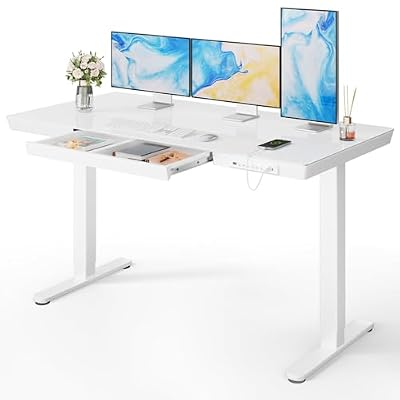
Marsail Glass Standing Desk, 55 x 28 Inch Electric Standing Desk,White
Included for 'White Glass Top Standing Desks: Durability, Glare, and Cleaning Trade-Offs' because the listing specifies 55 x 28 Inch Electric Standing Desk and White, details this guide uses to compare options.
View on Amazon| Top Material | Typical Thickness | Approx. Weight for 60×30 inch Top | Surface Hardness / Durability | Frame Requirement |
|---|---|---|---|---|
| Tempered White Glass (back-painted) | 5mm to 7mm glass + 0.7 inch frame tray | 42 to 55 lbs | Scratch-resistant, heat-resistant, can chip or shatter on hard edge impact | Requires reinforced crossbar and full perimeter support; usually rated for dual-motor frames only |
| Laminate over Particleboard/MDF | 0.75 to 1 inch | 28 to 38 lbs | Resists chips better than glass, but can peel, swell with moisture, and show wear at edges | Works with single or dual-motor frames |
| Solid Bamboo (or bamboo veneer) | 0.6 to 1 inch | 32 to 45 lbs | Naturally resilient, can dent and discolor with UV, needs occasional oiling if solid | Works with most frames; heavier solid slabs need dual-motor |
Most white glass standing desks use 6mm tempered glass bonded to a steel or MDF tray, not a solid slab of glass. Total top thickness often measures 1 to 1.4 inches because of that tray, which matters for clamp clearance. The glass itself is tempered for safety, so if it breaks it shatters into small granules instead of shards, but the back-painted white coating can chip at the corners if you hit a door frame while moving. Laminate is more forgiving during a move through a standard 29 to 32 inch doorway, while a 55 lb glass top is awkward for one person to carry and often ships in a separate, heavily padded box weighing 65 to 75 lbs total.
Weight also affects stability. At 42 to 47 inches standing height, a heavier glass top raises the center of gravity. On a budget single-motor frame with a low 150 to 180 lb lift capacity, you may feel more wobble when typing. Most reputable glass top models pair the top with a dual-motor frame rated for 220 to 310 lbs total lift capacity to compensate, leaving you about 165 to 255 lbs of usable capacity after subtracting the top itself.
What About a White and Gold Standing Desk?
If you are searching for a white and gold standing desk, you are almost always looking at a white glass top paired with a gold or champagne-gold frame. The construction is identical to other white glass desks – same 6mm tempered glass and tray system – only the powder-coated steel legs and feet are finished in gold. Expect the same weight, glare, and clamp limitations as any white glass model, and check the frame finish carefully: a matte brushed gold hides fingerprints on the legs far better than a high-gloss gold.
Fingerprints, Glare, and Cleaning in a Real Room
See also: Best 49 Inch Monitor: Eight Super Ultrawides Compared by Bandwidth and Desk Depth • Working Table for Home: Sit-Stand and L-Shaped Setups Compared
Retail photos hide two realities of white glass. First, it shows everything.
Under direct overhead lighting, especially recessed 4000K LEDs or a central ceiling fixture 8 to 9 feet above the desk, white glass creates sharp specular reflections. In a typical 10×12 ft home office with the desk centered or facing a wall, you will see a bright hotspot reflected in the top. The white backing diffuses some glare compared to clear glass, but it is still more reflective than matte laminate or bamboo, which scatter light. If your light is directly above, tilting the top is not an option, so position the desk so the light is slightly in front of or behind you, or use a diffused light source like a floor lamp or a monitor light bar to reduce overhead bounce.
Second, fingerprints and dust are highly visible. The glossy surface holds oils from hands and leaves faint smudges even after a quick wipe with a dry cloth. In a household with kids or pets, you will notice prints around the front edge where wrists rest, and fine dust that is invisible on bamboo shows as a gray haze on white glass within a day or two.
Cleaning is simple but specific. Use a microfiber cloth with water or a 50/50 mix of water and isopropyl alcohol. Avoid ammonia-based glass cleaners over time, as they can degrade the white back-paint at chipped edges, and avoid abrasive pads. Unlike laminate, you do not need to worry about moisture swelling, and unlike bamboo you never need to oil or reseal. The trade-off is frequency: plan to wipe a white glass top 2 to 3 times per week to keep it looking pristine, versus weekly for a matte laminate.
Can You Use a Mouse Directly on White Glass?
Most modern optical and laser mice will not track reliably directly on glossy white glass. The sensor sees through or reflects off the surface inconsistently, causing cursor jitter, skipping, or complete dropout, especially with older sensors or red LED mice.
There are three workarounds:
- Use a large desk mat or mouse pad. A 31×15 inch or 35×15 inch felt or PU leather desk mat solves tracking and also reduces fingerprints where your arms rest.
- Choose a mouse rated for glass tracking. Several Logitech models with Darkfield sensors and some Razer models with 30K DPI optical sensors advertise glass tracking, but even they perform more consistently with a mat on white back-painted glass.
- Avoid clear glass mouse pads on top of white glass – they create double reflections and do not improve tracking.
If you prefer the minimalist look of an uninterrupted white surface, a transparent matte mouse pad defeats the purpose. Most owners end up covering at least the primary work zone with a mat, which is worth factoring into the visual appeal you are paying for.
The Biggest Compromise: Clamps, Grommets, and Cable Management
This is where white glass standing desks differ most from wood or laminate, and product listings often understate it.
Tempered glass cannot be drilled for grommet holes after tempering, and the supporting tray is not designed to be drilled either. That means:
- No built-in grommet holes. You will not get the 2 to 3 inch cable pass-throughs common on laminate tops. Cables must route around the back edge, which leaves more visible cable slack when the desk is at standing height.
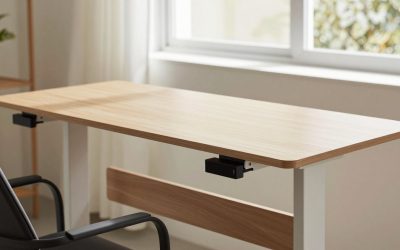
- Clamp-on monitor arms, desk shelves, and power strips are often not recommended. Most manufacturers warn against clamping to glass because point pressure can crack the glass or dent the tray. Even if the clamp sits on the steel tray edge, the total clamping thickness of 1.2 to 1.4 inches plus the risk of overtightening makes many C-clamps incompatible.
- Grommet-mount monitor arms are not an option at all. You must use freestanding monitor stands, or choose a frame that offers an integrated monitor arm mount bolted to the frame itself rather than the top, or a through-desk bolt that is engineered for that specific tray.
Before you buy, check the usable clamp zone. Measure the lip under the top – many glass tops have only a 0.5 to 0.8 inch steel lip with no wood backing, giving a clamp depth of under 1 inch. If you already own a heavy dual-monitor arm that needs a 2.5 inch clamp depth or a grommet, a laminate or bamboo top will be far more compatible. For cable management on glass, look for models that include an under-desk cable tray and cable clips that adhere to the steel tray, not to the glass. Adhesive clips stick poorly to the painted underside, so screw-mounted trays are more durable.
Assembly also reflects this design. You typically bolt the frame to the pre-attached threaded inserts in the tray, not directly into glass. Do not overtighten leg screws, and never lift the desk by the glass edge – always lift from the frame. Leave at least 30 inches of clearance behind the desk if it is against a wall to allow cables to drape without pinching when the desk raises to 47 inches.
Which Top Should You Choose for Your Situation?
| Your Situation | Best Top Choice | Why |
|---|---|---|
| Small apartment or rental, need to move often, standard doorway and elevator | Laminate | Lightest top, easiest for one person to move, most clamp and grommet options, usually $300 to $600 for a complete desk |
| Design-first home office with controlled lighting and a desk mat | White Glass | Brightest, most reflective look, easiest to disinfect and wipe clean, pairs well with white and gold frames; usually $500 to $900 |
| Heavy monitor arm + accessories, dual monitors over 27 inches | Laminate or Bamboo | Reliable clamp and grommet support, no risk of glass cracking from clamp pressure |
| Kids, pets, or high daily wear | Bamboo or thick laminate | Hides dust and prints better, withstands bumps and dropped objects without chipping; bamboo usually $450 to $800 |
| Sensitive to glare or overhead fluorescent lighting | Matte Laminate or Bamboo | Diffuses light, no hotspot reflection while standing |
For back pain or long standing sessions, the top material matters less than frame height range and stability. Look for a height range of about 27 to 47 inches to accommodate both a 26 inch dining-chair height when seated and true standing height for users 5’4″ to 6’2″, with memory presets so you can switch without hunting for the right height. In a compact 10×10 ft room, a 48×24 inch glass top saves 6 inches of depth versus a 60×30 inch model and leaves the recommended 36 inch clearance behind your chair, but it also leaves less room for a desk mat and freestanding monitor base that glass requires.
Durability and Long-Term Care Realities
A well-made white glass top will not stain, fade, or absorb odors, and the tempered surface resists heat up to about 300 degrees Fahrenheit, so a hot mug will not mark it like it can on laminate. What wears first is the edge and the back-paint. Edge chips from striking a wall corner during a move are difficult to repair invisibly, and deep scratches through the paint appear as dark lines on the white surface. The steel tray underneath can also show rust if the paint is chipped and exposed to humidity.
Laminate wears at the edge banding and shows swelling if water sits at seams. Bamboo wears through finish in the wrist-rest area after a few years and may show subtle yellowing with prolonged sunlight. None of these failures affect the standing mechanism itself, which typically lasts longer than any top surface when kept within weight limits and not overloaded with clamp pressure.
If you love the look of white glass, protect it by using a desk mat for the main work area, choosing a grommet-free cable strategy from the start, and verifying monitor mounting before you order. If you need maximum flexibility for accessories and a forgiving surface for daily life, laminate or bamboo will give you fewer limitations at a lower total weight and often a lower price.
Frequently Asked Questions
Does a white glass top yellow over time?
Quality back-painted tempered glass does not yellow like some white laminates can with UV exposure. The glass itself is inert, though prolonged direct sunlight can fade the wall behind the desk while the top stays bright. Low-quality painted glass may show slight warming of the white tone after many years near a sunny window, but this is far less common than yellowing on laminate or epoxy.
How much weight can a white glass standing desk hold?
Check the frame rating, not just the glass. A dual-motor frame rated for 265 lbs with a 48 lb glass top leaves about 217 lbs for monitors, PCs, and accessories. Stay at least 20 lbs under the rated lift capacity for smoother height transitions and less motor strain at full standing height.
Can you put a keyboard tray on a white glass top?
Most clamp-on keyboard trays are not advised on glass for the same reason as monitor clamps. If you need a tray, choose one that bolts to the steel frame or tray inserts, or select a freestanding keyboard solution. Always confirm the mounting method with the desk maker before drilling or clamping.
Related Reviews & Guides
How to Choose a Standing Desk Frame in 2026: What Actually Matters
L-Shaped Adjustable Desks With Storage: Corner Fit, Drawers, and Weight Limits