Last Updated: September 29, 2026
- What a 55×27 Top Actually Fits
- Frame, Height Range and Lift Rating
- Controller and Memory Presets: How They Actually Work
- The 27-Inch Depth Trade-Off: Viewing Distance and Clamp Placement
- Room Fit, Clearance and Weight Limits
- Decision Matrix: Is the 55×27 the Right Pick for You?
- Materials, Assembly and What Wears First
- Frequently Asked Questions
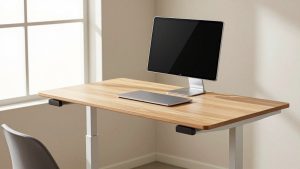
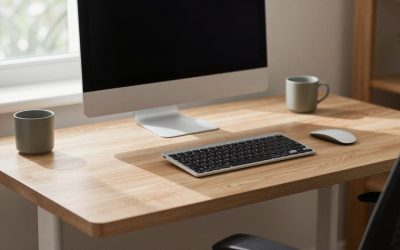
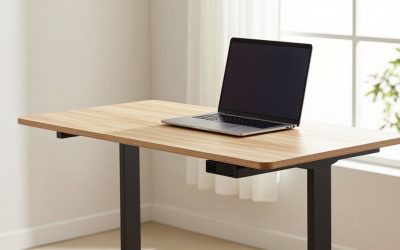
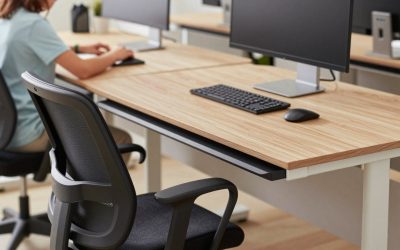
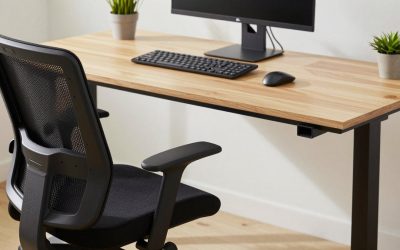
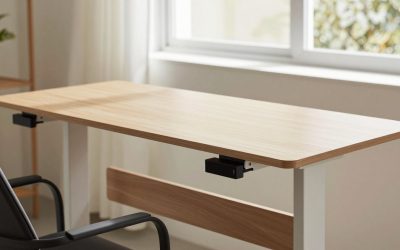
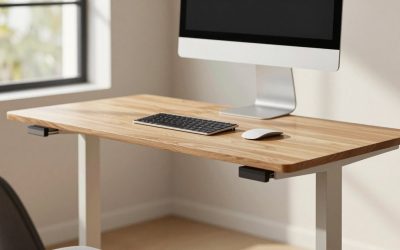
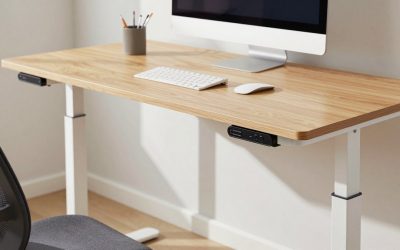
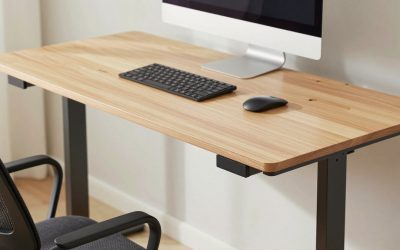
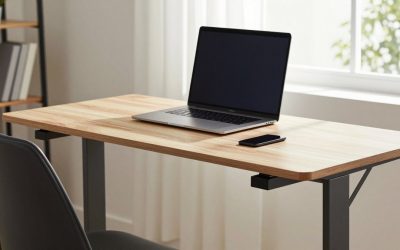
The ApexDesk Vortex M Series 55 x 27 height adjustable desk is a 55-inch wide by 27-inch deep rectangular sit-stand desk with electric height adjustment from approximately 29 to 48 inches, a dual-motor lift capacity generally rated around 235 lbs, and a 4-position memory controller, making it a space-saving alternative to 60×30 desks that still handles dual monitors or a single ultrawide without dominating a small office.
📄 In This Review
- What a 55×27 Top Actually Fits
- Frame, Height Range and Lift Rating
- Controller and Memory Presets: How They Actually Work
- The 27-Inch Depth Trade-Off: Viewing Distance and Clamp Placement
- Room Fit, Clearance and Weight Limits
- Decision Matrix: Is the 55×27 the Right Pick for You?
- Materials, Assembly and What Wears First
- Frequently Asked Questions
What a 55×27 Top Actually Fits
At 55 inches wide and 27 inches deep, you get 1,485 square inches of usable surface. That 5-inch width reduction compared to a standard 60-inch desk is noticeable on paper, but in practice it still leaves room for a full work setup. The 27-inch depth is where you feel the difference most.
Here is how common configurations fit on the 55×27 surface:
| Setup | Width Used | Depth Used | Remaining Usable Space on 55×27 | Verdict |
|---|---|---|---|---|
| Dual 27-inch monitors on stands | ~48-50 inches with bezels and angle | ~9-10 inches for stock stands | ~5-7 inches on sides, ~17 inches in front of stands for keyboard/mouse | Fits, but leaves little side space for speakers or desk lamp |
| Dual 27-inch monitors on single arm | ~48 inches, but single pole base ~6 inches wide | ~5 inches for clamp and pole | ~22 inches of clear depth in front of monitors, full side wings free | Ideal use case for this size |
| Single 49-inch super ultrawide on stand | ~47 inches | ~12 inches for large factory stand | ~8 inches on sides, ~15 inches in front | Fits well, stand depth eats into ergonomics – arm recommended |
| Single 34-inch ultrawide + laptop | ~32 inches + 14 inches | ~8-9 inches | ~9 inches on sides, ~18 inches in front | Comfortable fit with room for notebook or tablet |
The practical takeaway is that the Vortex M 55×27 works for two monitors only if you reclaim depth. Stock monitor stands will push your keyboard to the front edge. A clamp-mounted arm or wall of one ultrawide solves the depth problem and is almost mandatory to keep proper 20 to 30-inch viewing distance on a 27-inch deep top.
Frame, Height Range and Lift Rating
See also: Best 49 Inch Monitor: Eight Super Ultrawides Compared by Bandwidth and Desk Depth • Working Table for Home: Sit-Stand and L-Shaped Setups Compared
The Vortex M Series uses a dual-motor, three-stage frame. That matters more than the top size for daily use.
- Height travel: Approximately 29 inches at its lowest to 47.5 to 48 inches at its highest. The useful seated range is 29 to 30.5 inches for most people 5’4″ to 5’11” with a standard 17 to 19-inch seat height office chair and no keyboard tray. If you are under 5’4″ you will likely need a footrest at the lowest setting. If you are over 6’2″ the top end allows elbow height of 46 to 48 inches for standing without hunching.
- Lift capacity: Rated around 235 lbs total, including the top itself (the 55×27 MDF top is typically 45 to 55 lbs). Usable payload is therefore roughly 180 to 190 lbs. Two monitors (15 to 20 lbs), a desktop PC (25 to 35 lbs) if placed on the desk, and accessories stay well under that, but lifting a heavy solid wood replacement top plus multiple monitors approaches the limit and will slow travel speed.
- Travel speed and noise: Usually 1.3 to 1.5 inches per second with soft start/stop. Expect motor noise around 45 to 50 dB, comparable to a quiet conversation, not silent but not disruptive.
- Stability: Three-stage legs are more stable at mid-height (36 to 42 inches) than at full extension. At 47+ inches with a 27-inch deep top, some lateral wobble is normal when typing hard or leaning on the desk. Adding weight low on the frame or not extending to absolute max reduces it.
How Height Translates to Real Ergonomics
| User Height | Seated Elbow Height (approx.) | Ideal Seated Desk Height | Standing Elbow Height (approx.) | Ideal Standing Desk Height | Vortex M 55×27 Coverage |
|---|---|---|---|---|---|
| 5’2″ (157 cm) | 23.5 inches | 25.5 – 26.5 inches* | 39 inches | 38 – 40 inches | Requires footrest seated, covered standing |
| 5’8″ (173 cm) | 26 inches | 28 – 29 inches | 42.5 inches | 41.5 – 43.5 inches | Fully covered |
| 6’0″ (183 cm) | 28 inches | 30 – 31 inches | 45 inches | 44 – 46 inches | Fully covered |
| 6’4″ (193 cm) | 30 inches | 32 – 33 inches | 48 inches | 47 – 49 inches | Near max height standing |
* Ideal desk height is typically 2 to 3 inches below elbow height when keyboard tray is not used. Users under 5’4″ often need the desk lower than 29 inches, which is a limitation of most 29-inch minimum frames.
Controller and Memory Presets: How They Actually Work
The Vortex M Series uses a rectangular LED controller with up/down paddles and four memory buttons (M1-M3 plus an M button for programming). It is not a simple up/down switch.
To set a memory position, you hold the M button until the display flashes S-, then press 1, 2, or 3 within a few seconds. The display will show the saved height. A single press then moves the desk automatically to that height without holding the button. A long press is required if the anti-collision sensitivity is set high.
Other controller behaviors to expect:
- Display: Shows current height in inches. Accuracy is usually within 0.3 to 0.5 inches after calibration.
- Anti-collision: Integrated gyro/ampere sensor stops and slightly retracts if it hits an object. Sensitivity is medium by default. It will not prevent light scratches, but it stops major jams against a filing cabinet or windowsill.
- Lockout: Child lock is activated by holding M for several seconds. Useful if you have kids or pets who bump the paddles.
- Calibration: If heights read incorrectly after a move or power loss, holding the down button to the lowest point until it beeps resets the zero point.
Most users program three positions: seated (around 29 to 30 inches), standing (42 to 44 inches), and a perched or stool height (36 to 38 inches). The fourth slot is often used for a clearance height to roll a chair with armrests under.
The 27-Inch Depth Trade-Off: Viewing Distance and Clamp Placement
Depth is the most overlooked dimension. A 27-inch deep top versus the common 30-inch top costs you 3 inches of monitor distance, which directly affects eye strain and how far your arms extend.
For comfortable viewing, the distance from eyes to screen should be roughly 20 to 26 inches for 24 to 27-inch monitors and 26 to 32 inches for 34 to 49-inch ultrawides. On a 27-inch deep desk, your eyes are typically 6 to 8 inches from the front edge when typing, leaving only 19 to 21 inches to the back edge. With a monitor stand that sits 4 to 6 inches from the wall, the screen ends up 15 to 18 inches from your eyes, which is too close for large panels.
This is why arm-clamp placement changes on a 27-inch desk:
- Clamp overhang: The clamp and pole need 2 to 3 inches behind the top, but still eat 1.5 to 2.5 inches of surface. On a 27-inch desk, center the clamp between the grommet hole (if present) and the rear edge, and choose an arm with a slim 2-inch clamp rather than a bulky 4-inch C-clamp.
- Edge clearance: Leave at least 1.5 inches from the clamp edge to the desk edge to avoid MDF crushing. The Vortex M top is MDF with laminate, not solid wood, so overtightening a single-point clamp can dent the edge. Use the included reinforcement plate or add a 4×4-inch metal washer plate if your arm ships without one.
- Solution: Mount the arm at the rear center, push the monitor pole to the absolute back, and angle monitors slightly. This gains 4 to 6 inches of depth versus stock stands and brings viewing distance back to the 22 to 26-inch sweet spot.
If you use a keyboard tray, the 27-inch depth becomes an advantage because the tray moves typing 6 inches off the desk, letting you push monitors fully back without sacrificing elbow position.
Room Fit, Clearance and Weight Limits
The 55×27 footprint is designed for smaller rooms where a 60×30 or 72×30 dominates. In a typical 10×12 foot home office with a door swing of 30 inches and a closet, a 55-inch desk allows 36 to 42 inches of chair roll-back clearance while still fitting a 2-drawer file cabinet or bookshelf on the side wall. A 60-inch desk in the same layout often leaves only 30 to 32 inches of passage, which feels tight for a 26-inch wide office chair.
Plan for these real clearances:
- Back wall: Leave 1 to 1.5 inches behind the desk if against a wall for cable slack and motor housing. At full height the top rises vertically, so wall contact is not a collision risk, but cables can snag.
- Side clearance: 4 to 6 inches on the side with the controller and power cable to avoid pinching cords when lowering.
- Floor load: Total desk weight is 95 to 115 lbs assembled. With 80 to 100 lbs of equipment, total floor point load is under 250 lbs on four feet, suitable for any residential floor and apartment use without reinforcement.
- Moving through doorways: Standard interior doorway is 28 to 30 inches wide. The 55×27 top will not pass flat through a 28-inch doorway. Carry it vertically on edge or remove the top from the frame, which is two people for 10 minutes with an Allen key.
Decision Matrix: Is the 55×27 the Right Pick for You?
| Your Situation | 55×27 Is a Good Fit If | Consider a Different Size If |
|---|---|---|
| Small apartment / 10×10 room | You need passage space and mainly use 1-2 monitors on arms | You need a large L-shape or want a printer + scanner on the same desk |
| Back pain / frequent sit-stand | You will use memory presets daily and need 29-48 inch range for shared users | You are under 5’3″ and need a desk that drops to 25 inches without a footrest |
| Gamer with ultrawide | You have a 34-inch ultrawide on an arm and want compact footprint | You have a 49-inch super ultrawide + separate streaming mic arm that needs 30+ inch depth for proper distance |
| Renters / frequent movers | You want lighter 55-inch top that is easier to carry up stairs than 60-72 inch tops | You move often and need a desk that breaks down tool-free – this one needs Allen keys and two people |
| Kids and pets at home | You value lockable controller and anti-collision for safety | You need rounded solid wood edges – the MDF laminate edge is square and harder on bumps |
Materials, Assembly and What Wears First
The Vortex M Series top is engineered wood (MDF core with laminated surface), not solid wood or bamboo. The frame is powder-coated steel. This construction keeps the price in the usual $350 to $600 market range for dual-motor 55-inch desks and keeps weight manageable, but it has trade-offs.
| Material / Part | Pros | Cons | What Wears First |
|---|---|---|---|
| MDF with laminate top | Flat, consistent finish; resistant to warping vs solid wood | Vulnerable to moisture at edges and heavy clamp point loads | Edge chips and laminate lift near grommet/clamp after 2-3 years if overtightened |
| Solid wood or bamboo top (alternative) | More durable to clamps, can be refinished | Heavier (+20-40 lbs), expands with humidity, costs more | Surface scratches, needs oiling/waxing |
| Steel T-frame legs | Strong lift, good stability for weight | Heavier to move, can wobble at max height if not leveled | Leveling glides and leg stage telescoping felt liners |
Assembly realities: The box typically ships in two cartons totaling 95 to 115 lbs. The top carton alone is 50+ lbs and over 58 inches long, so measure your stairwell and elevator before delivery. Assembly takes 45 to 75 minutes for one person with the included Allen keys, but lifting the assembled desk upright requires two people. You will need a drill for your monitor arm, a Phillips head for cable tray if included, and 24 inches of clear floor space on each side during build.
Long-term durability: The motors and controller are generally reliable for 5 to 7 years of 2 to 4 adjustments per day. What typically shows wear first is not the motor but the laminate edge where chairs bump it, the controller paddle membrane, and cable management clips that loosen from repeated height cycles. Adding a stick-on cable chain and felt pads under clamp plates extends that wear point significantly.
Frequently Asked Questions
Can the 55×27 Vortex M hold dual 32-inch monitors?
Yes, if both are on a single heavy-duty arm rated for 30+ lbs per arm. On stock stands, two 32-inch monitors at 28 inches wide each will overhang the 55-inch width and their stands will crowd the depth. Weight is not the issue, geometry is.
Does 27-inch depth work for a keyboard and mouse without an arm?
It does for most users if you remove monitor stands. With stands, you will be typing with wrists at the front edge. Without stands, you have about 20 inches from monitor to front edge, which allows neutral wrist posture.
Will it fit under a window sill or low shelf?
Check your sill height. At 29 inches minimum, the desk will not lower enough to slide under a typical 28-inch sill. Measure sill height from the floor and subtract 1 inch for cable clearance.
Related Reviews & Guides

Live Edge Sit Stand Desk: What to Know Before You Buy
Standing Desk Buying Guide Weight Capacity in 2026: What Actually Matters