Last Updated: September 29, 2026
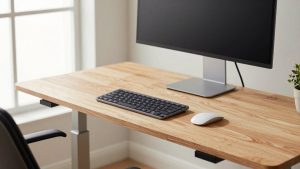
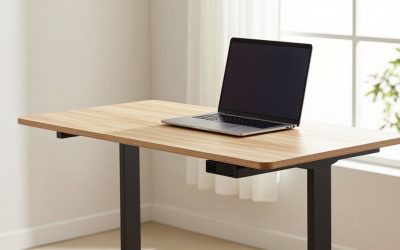
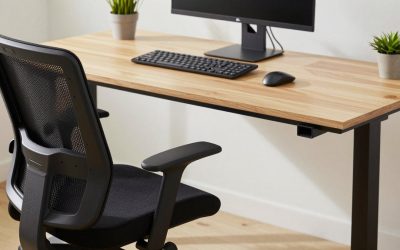
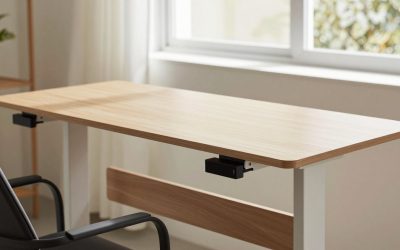
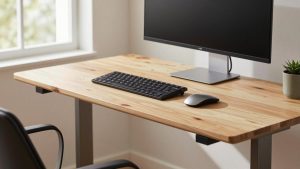
A live edge sit stand desk is worth buying if you want the look of natural wood on an adjustable frame, but you should choose a solid wood slab if you prioritize lighter weight and refinishing potential, and choose an epoxy-filled live edge slab if you need maximum stability, spill resistance, and less frequent sealing.
📄 In This Review
Solid Wood vs. Epoxy Live Edge: The Core Trade-Off
Both styles use a real wood slab with the natural outer edge preserved, but how that slab is built changes everything for a sit-stand frame. A solid wood live edge top is one or two book-matched slabs of walnut, maple, or acacia with the voids and cracks left natural or filled with small bow-ties. An epoxy live edge top, often called a river or hybrid top, encases the wood in clear or tinted epoxy resin, filling voids, cracks, and often the space between two live edges to create a fully flat, sealed rectangle.
On a sit-stand desk, this construction difference affects the three things that matter most: how stable the desk feels when raised, how much weight the motor has to lift, and how much maintenance the top needs to prevent warping.
| Feature | Solid Wood Live Edge Slab | Epoxy Live Edge Slab (Epoxy River / Filled) |
|---|---|---|
| Typical Thickness | 1.5″ – 1.75″ (38-44mm) | 1.5″ – 2.0″ (38-51mm), epoxy adds 15-20% mass |
| Average Top Weight (60×30 inch) | 70 – 95 lbs | 110 – 150 lbs |
| Usable Lift Capacity Left* | 180 – 250 lbs remaining | 110 – 190 lbs remaining |
| Seasonal Wood Movement | Up to 1/8″ per 12″ of width across grain | Less than 1/32″ per 12″ due to epoxy encapsulation |
| Warp / Cup Tolerance | Can cup 1/16″ – 1/8″ if humidity swings >20% | Resists cupping; epoxy stabilizes but can crack if slab was not kiln-dried below 10% moisture |
| Sealing Required | Oil or hardwax oil every 6-12 months | Oil on wood portions every 12-24 months; epoxy needs buff/polish every 2-3 years |
| Heat & Stain Resistance | Low; rings and stains penetrate if not wiped quickly | High; epoxy is waterproof and resists coffee, ink, and solvents |
| Refinishing | Can be sanded and refinished 3-5 times | Cannot spot-sand epoxy easily; deep scratches require professional flood coat |
| Typical Market Range (Top Only) | Usually $600 – $1,200 | Usually $900 – $1,800 |
*Based on common dual-motor frames rated at 270-355 lbs total lift capacity, including the top itself. A heavier top leaves less capacity for monitors, PCs, and accessories.
Stability on a Sit-Stand Frame: What Actually Moves
See also: Best 49 Inch Monitor: Eight Super Ultrawides Compared by Bandwidth and Desk Depth • Working Table for Home: Sit-Stand and L-Shaped Setups Compared
A live edge sit stand desk will wobble for two reasons: frame deflection and top flex. Frame deflection is the main cause above 42 inches high. Solid wood slabs are lighter, so the motors strain less and cross-bracing works more effectively. Epoxy slabs are significantly heavier and shift the center of gravity higher, which can amplify side-to-side sway on C-leg frames at standing height (42″ – 48″ for users 5’8″ to 6’2″).
For stability, look for these specs rather than marketing terms:
- Frame type: Dual-motor, 3-stage legs are more stable above 45″ than single-motor, 2-stage legs. Foot depth of at least 27″ – 28″ reduces front-to-back rock.
- Top flatness: Epoxy tops are factory-flattened to within 1/32″ tolerance, so monitors don’t shimmy. Solid wood slabs may vary 1/16″ due to natural grain, which can make monitor arms feel loose unless you use a reinforcing plate.
- Attachment points: A solid wood top needs elongated screw slots or threaded inserts to allow expansion. If a top is screwed down tightly with wood screws directly into the slab, seasonal expansion will cause cracking or bowing regardless of finish.
Weight Capacity Reality Check
Most product listings advertise frame lift capacity without subtracting top weight. A common dual-motor frame from brands like UPLIFT Desk, FlexiSpot, or Jarvis is rated at 310 lbs – 355 lbs. Once you place a 130 lb epoxy river top on it, you have only about 180 lbs left before the motors slow or overheat. Add two 27-inch monitors (12 lbs each), a monitor arm (10 lbs), a desktop PC (25 lbs), and accessories, and you are at 60-80 lbs quickly.
Solid wood Live edge tops keep you safely under the limit for most setups. Epoxy tops require you to verify the frame’s net lifting capacity. If you plan to use a heavy top over 120 lbs, choose a frame rated at 355 lbs or higher and avoid adding a drawer or under-desk treadmill without recalculating.
Warping, Cracking, and Sealing: Maintenance by Numbers
Natural wood moves with humidity. Indoor relative humidity that swings from 30% in winter to 55% in summer will cause a 30-inch wide solid walnut slab to expand and contract by roughly 1/4″ to 3/8″ across its width. If both faces are not sealed equally, the slab cups toward the drier side.
Solid wood live edge: Needs a penetrating hardwax oil, Rubio Monocoat-type oil, or polyurethane on all six sides, including the bottom and live edge. Re-oil every 6 to 12 months in dry climates or homes with forced-air heating. Keep indoor humidity between 35% and 50%. Expect to tighten or adjust mounting brackets after the first heating season as the wood settles.
Epoxy live edge: Epoxy seals 90-100% of the surface, so moisture exchange drops dramatically. The wood portions still need oiling, but every 12 to 24 months is usually enough. Epoxy itself does not need sealing, but it will micro-scratch and haze from cleaning. Use only soft cloths and non-abrasive cleaners; avoid acetone. Every 2-3 years, polish with a fine polishing compound to restore gloss. Epoxy will yellow slightly with prolonged direct sunlight, so avoid placing the desk in a south-facing window without UV film.
Either type should be kiln-dried to 6-10% moisture content before fabrication. Ask the seller for that number. A slab sold at 12-14% moisture will warp significantly after one winter indoors, even with epoxy.
Fit, Clearance, and Room Planning
Live edge tops are not standard rectangles. A top listed as 60×30 inches may be 29 inches wide at one end and 32 inches at the other due to the natural edge. Plan for the maximum dimension, not the average.
- Clearance around furniture: Leave at least 30 inches behind the desk for chair movement and sit-stand transition, plus 4-6 inches on the cable side so the top does not scrape the wall when rising. The live edge protrudes, so allow an extra 2-3 inches if the natural edge faces a walkway.
- Desk height range: Standard sit-stand frames adjust from 24-25 inches (good for seated height with a 18-19 inch chair) to 49-51 inches (good for standing for users up to 6’4″). Check that low height works for you if you are under 5’4″ and use a fixed-height chair.
- Room-size fit: In a 10×12 ft room, a 60-inch live edge desk on a 42-inch wide frame leaves about 78 inches of width remaining. That allows a 30-inch side cabinet and 48-inch walkway on one side, which is tight but workable. A 72-inch slab dominates the same room and leaves only 18-24 inches to a bed or wall, blocking airflow and making the standing motion feel cramped.
- Weight and moving: A 60-inch solid wood top ships at 75-100 lbs in one box; an epoxy top ships at 120-160 lbs. Frames ship separately at 60-85 lbs. Most interior doorways are 29-30 inches wide, so a 30-inch deep top must be carried on edge. Measure stairwells and elevator doors before ordering a 72-inch slab.
Which Live Edge Top Should You Choose?
| Your Situation | Best Choice | Why |
|---|---|---|
| Small apartment or renter who moves often | Solid wood, 55-60 inch, under 90 lbs | Lighter to move, fits through doors, easier to repair dings from moving |
| Kids, pets, frequent spills | Epoxy-filled live edge | Waterproof surface, no open cracks to trap crumbs, wipes clean |
| Home office with stable humidity and you like to refinish | Solid wood with hardwax oil | Can be sanded and re-oiled to remove wear, develops patina |
| Heavy multi-monitor setup (3+ monitors, desktop PC on desk) | Solid wood or lightweight epoxy hybrid | Preserves lift capacity; heavy epoxy may require upgrading to 4-leg frame |
| Direct sunlight or underfloor heating | Epoxy hybrid with UV-resistant epoxy | Resists rapid moisture loss and cupping better than solid wood |
| Budget-sensitive or first sit-stand desk | Solid wood | Usually $300 – $600 less than comparable epoxy river top |
Assembly and Long-Term Durability
Expect 45-90 minutes for assembly with two people. The frame assembles first, then the top is flipped onto it. Do not drive screws deeper than 3/4″ into a 1.5″ slab. Pre-drill and use the threaded inserts provided by manufacturers like UPLIFT Desk or Fully. Over-tightening into solid wood will strip the grain and cause seasonal movement to crack the slab.
What wears first is not the motor but the finish and grommet area. On solid wood, the front edge where wrists rest lightens and dries within 8-12 months if not re-oiled. On epoxy, the junction where wood meets epoxy can develop a hairline separation of 1/64″ if humidity drops below 30%, which collects dust but is structural only if moisture enters. Keep a small bottle of matching oil for touch-ups and use a desk mat under keyboards to reduce abrasion on both types.
For any live edge sit stand desk, add felt pads under decor, use a monitor arm with a large clamp plate to distribute pressure, and avoid mounting heavy under-desk power strips directly to the wood with long screws. A 6-8 lb cable tray should be anchored into pilot holes less than 2/3 the slab thickness.
Related Reviews & Guides
Vari Desk Standing Desk Review: Models, Prices and Which One to Choose
Vernal Standing Desk Review: Features, Build Quality and Value