Last Updated: September 29, 2026
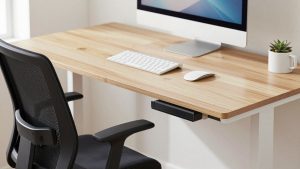
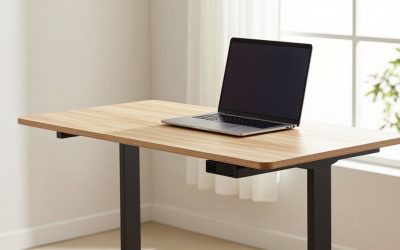
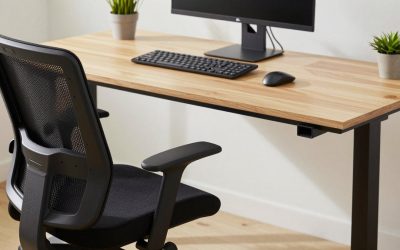
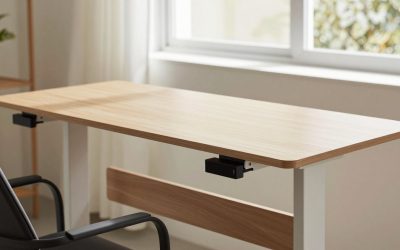
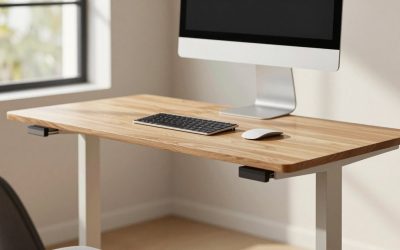
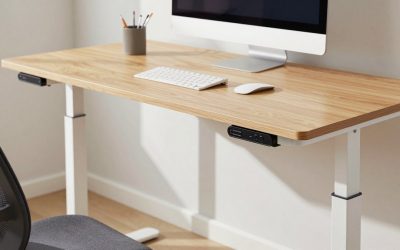
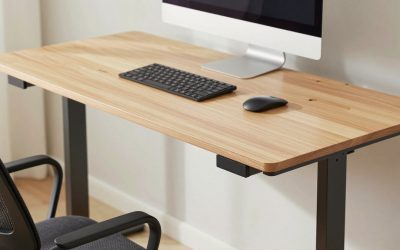
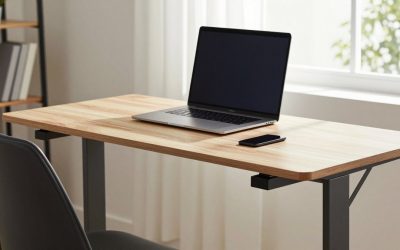
A real mid-century modern sit-stand desk doesn’t exist in the pure sense, because true tapered legs are solid wood, fixed length, and structurally can’t hide a telescoping lift column. What the market actually sells as a “mid century modern adjustable desk” is a hybrid: a walnut or walnut-veneer top with mid-century detailing paired with a metal lifting frame that’s either disguised, minimized, or accepted as a visible compromise. Knowing which substitute you’re buying, and how well it matches the rest of your walnut furniture, is the real decision here.
📄 In This Review
Why tapered legs and lift columns don’t mix
Classic mid-century desks rely on four splayed, tapered legs, often angled 10-15 degrees off vertical, for both looks and stability. That geometry works fine at a fixed height because the load path is straight down through solid wood. A sit-stand desk needs a lift mechanism, either dual telescoping columns or a single center column, that has to stay vertical and rigid through 12-20 inches of travel. Angled wooden legs can’t house that mechanism, and grafting a motor onto a splayed leg would make the desk unstable at full extension.
So manufacturers do one of three things:
- Hide the lift entirely inside a boxier frame and add cosmetic tapered leg panels or end caps that don’t actually move.
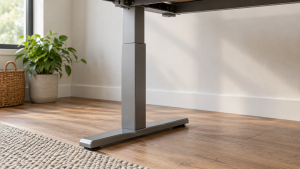
- Use straight (not splayed) telescoping legs finished in a wood-look laminate or wood-grain powder coat, sacrificing the taper but keeping a warm tone.
- Pair a genuinely mid-century-styled top with an unapologetically modern black or white metal frame, leaning on the tabletop and cable management to carry the aesthetic.
None of these are “wrong,” but each reads as mid-century to a different degree, and that matters if the desk sits next to a real walnut credenza or dining set.
The substitutes, ranked by how convincingly they pass as MCM
See also: Best 49 Inch Monitor: Eight Super Ultrawides Compared by Bandwidth and Desk Depth • Working Table for Home: Sit-Stand and L-Shaped Setups Compared
1. Walnut veneer tops with mitered or waterfall edges
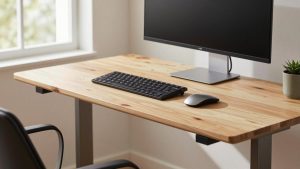
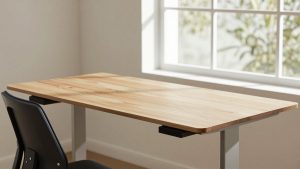
This is the single biggest lever. A tabletop in walnut veneer over engineered wood core, with a mitered edge that wraps the grain around the corner (a waterfall effect), reads as mid-century even on a fully rectangular lift frame. Look for a book-matched veneer pattern rather than a repeating stamped grain; repeats are the fastest tell that it’s a printed laminate, not real veneer.
2. Hairpin-look leg covers and sleeves
True hairpin legs are thin bent steel rod, and a handful of manual crank desks still use them. Electric lift versions can’t, because hairpin rod has no room for a motor or telescoping tube. Instead, some brands sell slim rectangular steel legs with a matte black or brass-toned finish that echoes the visual weight of hairpin legs without the actual bend. It’s a reasonable stand-in from a few feet away, less so up close.
3. Wood-grain end caps and modesty panels
A plastic or MDF cap over the top of a steel leg, grained and stained to match the desktop, softens the metal-to-wood transition. This is cosmetic only and doesn’t affect function, but it’s often the difference between a desk that looks assembled from two catalogs and one that looks intentional.
4. Cable management as a design element, not an afterthought
Mid-century furniture is defined partly by clean lines and minimal visual clutter. A sit-stand desk with a control paddle, power brick, and dangling cables undercuts that instantly. Under-desk cable trays, a routed grommet hole finished in matching veneer, and a fabric cable sleeve in a neutral tone do more for the mid-century read than almost any leg detail.
Matching finish and grain against real walnut furniture
If you already own solid walnut pieces from the 1950s-60s or a modern reproduction, matching a veneer desktop against them is mostly about undertone and sheen, not exact grain.
- Undertone: Vintage walnut often ambers with age into a warmer, slightly reddish-brown. New walnut veneer tends to run cooler and more purple-brown until it oxidizes over a year or two of light exposure. Expect a visible difference for the first several months.
- Sheen: Older pieces are usually satin or low-gloss lacquer. Many new adjustable desks ship with a semi-gloss or matte poly finish; matte generally sits closer to a vintage look than satin or gloss.
- Grain scale: Vintage American walnut veneer was often cut thinner with tighter grain; some current veneer runs bolder and more figured. If close matching matters, ask for a physical finish sample before buying rather than judging from product photos, which are frequently color-corrected.
Material trade-offs at a glance
| Component | Option | MCM authenticity | Durability / trade-off |
|---|---|---|---|
| Desktop | Solid walnut | Highest | Heaviest (often 60-90 lb for a 60″ top), prone to seasonal movement, usually $700-$1,400 on its own |
| Desktop | Walnut veneer over MDF/plywood core | High if book-matched | Stable, lighter (30-45 lb), edges can chip if banding is thin |
| Desktop | Wood-grain laminate (printed) | Low | Very stable and cheap, repeating grain pattern visible under raking light |
| Legs/frame | Solid tapered wood, fixed height | Highest | No lift function at all |
| Legs/frame | Straight steel telescoping, wood-tone powder coat | Medium | Handles 200-275 lb typical lift capacity, motor adds 15-25 lb to shipping weight |
| Legs/frame | Black/white steel telescoping, no wood styling | Low | Same lift performance, cheapest to produce, relies on top and accessories for the MCM cue |
Measurements that actually matter
Most mid-century-styled electric standing desks land in a fairly narrow band regardless of leg style:
- Height range: typically 24.5-27 in at lowest to 47-51 in at full extension, which covers roughly a 5’0″ seated user up to a 6’4″ standing user.
- Top sizes: common widths are 48, 55, and 60-63 in, with depths of 24-30 in; a 60×30 in top needs about 6.5-7 ft of wall run once you allow 30 in of chair clearance behind it.
- Weight capacity: dual-motor frames generally lift 220-275 lb; single-motor center-column frames often cap lower, around 150-180 lb, which matters if you’re adding a monitor arm, a second display, and a walnut-cased CPU stand.
- Clearance for lift travel: confirm nothing (a windowsill, shelf, art) sits within the top 4-6 in of travel; that’s the range most buyers forget to check before the first sit-to-stand cycle.
- Box weight for delivery: expect 90-140 lb across one or two boxes for a solid-wood-veneer top plus dual-motor frame; confirm doorway and stairwell width (standard interior doors are 28-32 in wide) before ordering if the desk has to go around a corner.
Which substitute fits which situation
| Your situation | Best-fitting choice | Why |
|---|---|---|
| Pairing with existing vintage walnut furniture | Book-matched veneer top, wood-tone powder-coated frame | Closest grain and tone match; fixed solid-wood legs aren’t an option once you need lift |
| Small home office, budget-focused | Laminate top, plain black steel frame, add a wood-grain cable tray | Cable management and a single wood accent do more visual work per dollar than a pricier top |
| Want a true mid-century sit-stand desk look with minimal metal showing | Desk with modesty panel or wood-grain leg sleeves plus a waterfall-edge top | Covers the most visible metal without needing a custom frame |
| Renters or frequent movers | Veneer top over solid-core (lighter than solid wood), bolt-together frame | Easier to disassemble and carry through doorways; solid walnut tops are impractical to move solo |
| Two monitors, dock, and accessories | Dual-motor frame rated 250+ lb regardless of leg styling | Weight capacity matters more than aesthetics once you’re near the limit |
Assembly and long-term wear
Assembly typically takes 30-60 minutes for two people; the top is usually pre-finished, so the work is attaching the frame and running the cable tray. The parts that show wear first are the leg end caps and modesty panels, since they’re often a softer material than the frame or top and can scuff or fade unevenly if one side gets more sun. Veneer edges, particularly on a waterfall miter, are the second most common failure point if the desk is dragged rather than lifted during moves. Motors themselves are generally reliable within warranty periods (most sit-stand desk warranties run 3-10 years on the frame, shorter on electronics), but keep the desk near the middle of its height range when not in use rather than parked at full extension, since that reduces sustained strain on the lift mechanism over years of use.
Related Reviews & Guides


Standing Desk Won’t Go Up? 9 Fixes to Try Before You Call Support

FlexiSpot EC1 Standing Desk Honest Review 2026