Last Updated: September 29, 2026
- Move 40 vs. Move 60: The Real Difference
- Materials and Construction Trade-Offs
- Fit, Clearance, and Room Planning With Real Numbers
- Assembly, Moving, and What Wears First
- Decision Matrix: Which Model Fits Your Situation
- How to Choose Finish and Matching Collections
- What to Check Before You Buy
- Frequently Asked Questions
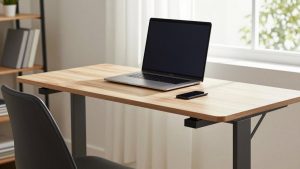
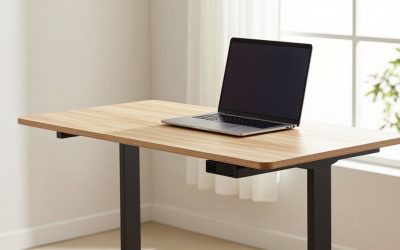
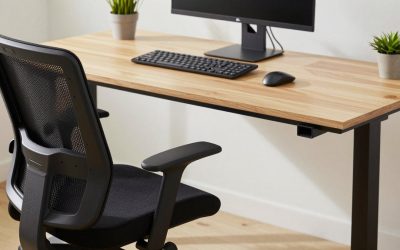
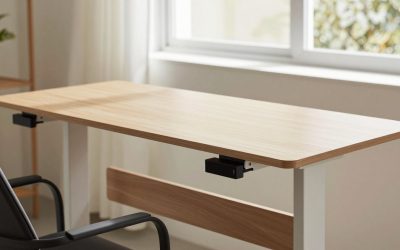
Bush Business Furniture standing desk options in 2026 come down to two core electric lines — the Move 40 Series and Move 60 Series — both are 3-stage height-adjustable desks with commercial-grade steel bases and thermally fused laminate tops, and the right choice depends on how much worksurface, weight capacity, and integrated storage you need for daily office use.
📄 In This Review
- Move 40 vs. Move 60: The Real Difference
- Materials and Construction Trade-Offs
- Fit, Clearance, and Room Planning With Real Numbers
- Assembly, Moving, and What Wears First
- Decision Matrix: Which Model Fits Your Situation
- How to Choose Finish and Matching Collections
- What to Check Before You Buy
- Frequently Asked Questions
Move 40 vs. Move 60: The Real Difference
Bush Business Furniture does not sell dozens of unrelated standing desks. Most listings you see are size and finish variations of the same two platforms built for 8+ hour workdays. Understanding the platform first makes the buying decision much faster.
| Spec | Move 40 Series Standing Desk | Move 60 Series Standing Desk |
|---|---|---|
| Height Range (without top) | 27 in to 47 in (add 1 in for top = 28 in to 48 in working height) | 27 in to 47 in (add 1 in for top = 28 in to 48 in working height) |
| Lift Type / Stages | Electric, 3-stage dual motor | Electric, 3-stage dual motor |
| Lift Speed | ~1.3 in per second | ~1.3 in per second |
| Weight Capacity (including top) | 170 lbs total | 170 lbs total |
| Common Top Sizes | 48W x 24D, 60W x 24D, 60W x 30D | 60W x 30D, 72W x 30D |
| Top Thickness | 1 in thermally fused laminate over engineered wood | 1 in thermally fused laminate over engineered wood |
| Base Construction | C-frame steel legs, 1.5 in leveling glides | C-frame steel legs, wider foot for 72 in tops |
| Control Panel | 4-position memory preset + up/down | 4-position memory preset + up/down |
| Typical Market Range | usually $500–$800 depending on size/finish | usually $600–$900 depending on size/finish |
Both series meet ANSI/BIFMA standards for stability and durability and include a 10-year manufacturer warranty on the desk. The electronics (motors, controller, handset) are typically warrantied for 5 years. In practice, that means the steel base and laminate top outlast the electronics, which is normal for electric desks in this class.
What You Get With Either Series
- Commercial height range: 28 to 48 inches accommodates seated height (around 28-30 in) for a standard 17-19 inch office chair plus keyboard tray, and standing height up to about 6 ft 4 in without needing a footrest.
- Low noise and anti-collision: Both use dual motors rated around 50 dB during adjustment with gyroscopic anti-collision that stops and reverses if it hits a filing cabinet or chair arm.
- Laminate, not veneer: All Bush Business Furniture tops use thermally fused laminate over engineered wood core with 3mm edge banding. It resists scratches and moisture rings better than printed vinyl wrap, but it cannot be sanded or refinished like solid wood.
- Integrated wire management: Notched back edge and leg-channel cable clips are standard, but you will still want a separate cable tray for a full dual-monitor setup.
Materials and Construction Trade-Offs
See also: Best 49 Inch Monitor: Eight Super Ultrawides Compared by Bandwidth and Desk Depth • Working Table for Home: Sit-Stand and L-Shaped Setups Compared
Bush Business Furniture intentionally uses the same construction across its standing desks to hit a durability target for daily office use, which creates clear trade-offs versus other desk types you might be considering.
| Material / Construction | Durability for Daily Use | Weight and Stability | Maintenance Reality |
|---|---|---|---|
| Thermally Fused Laminate on Engineered Wood (Bush Business Furniture standard) | High resistance to scratches, stains, and heat from laptops/monitors; will not crack like solid wood in dry offices | Heavy top (60×30 in top is ~55-65 lbs) adds stability; less vibration than hollow tops | Wipe clean; chips on dropped corners are permanent; cannot refinish |
| Solid Wood / Butcher Block top (not offered by Bush, common third-party upgrade) | Can be sanded and resealed; dents and water rings show faster | Very heavy (80+ lbs), lowers wobble but requires checking base capacity | Needs oiling/sealing yearly; expands/contracts with humidity |
| Steel C-Frame Base (Bush standard) | Powder-coated steel resists rust and daily kicks; crossbar prevents racking | Base alone ~60-70 lbs; wide feet improve anti-tip | Touch-up paint for chips; leveling glides need adjustment on carpet |
| Hollow-core or Particleboard with Thin Foil (budget standing desks) | Peels at edges within 1-2 years of daily use; sags under monitors | Light, more wobble at standing height | Difficult to repair; screws strip easily on reassembly |
Foam and fabric are not a factor here — Bush Business Furniture standing desks are worksurfaces only. If you are comparing to a fabric storage ottoman or upholstered task chair, the durability question shifts to the chair itself, where foam density over 1.8 lbs/cu ft and mesh vs. fabric back make a bigger difference for long sessions.
Fit, Clearance, and Room Planning With Real Numbers
These desks are commercial depth, so they need more clearance than a typical 24-inch deep home desk.
- Footprint with chair movement: A 60W x 30D desk needs a minimum 60 in x 54 in floor area to allow a chair to slide back. Add 36 in behind the desk for walking clearance if the desk faces a wall, 42-48 in if it is behind a door swing.
- In a 10 x 12 ft room: A 60 x 30 in desk on the 10-foot wall leaves ~30 in on each side for a 2-drawer file cabinet (15.5W x 20D) and a bookcase. A 72 x 30 in desk on the same wall leaves only ~24 in on one side, which blocks lateral file drawers from fully extending. For small home offices, the 60 x 24D top saves 6 inches of depth without losing monitor width.
- Standing clearance: At 47-48 in high, you need 15-18 in of overhead clearance above the desktop for monitors on arms. Check for window sills, floating shelves, and pendant lights. The C-frame legs sit inset 6-8 in from the ends, so the feet will not hit baseboards but will interfere with floor outlets centered on a wall.
- Weight limits in practice: The 170-lb capacity includes the top. That leaves roughly 105-115 lbs for equipment on a 60×30 model. A realistic load: two 27-in monitors (14 lbs each), dual monitor arm (10 lbs), desktop PC on floor (not on desk), plus books and accessories (20 lbs) = ~58 lbs, well within limits. Avoid placing a 50+ lb small safe or multiple reams of paper on the same end.
- Doorway and stair fit: Boxes for Bush Business Furniture standing desks ship in two cartons. The base box is typically 48-52 in long and weighs 65-75 lbs; the top box is 62-74 in long and weighs 55-70 lbs. Both fit through a standard 29-30 in interior doorway, but the top box will not turn easily in a tight 90-degree apartment hallway without standing it on edge.
Assembly, Moving, and What Wears First
Expect 60 to 90 minutes with two people and a Phillips head screwdriver plus the included Allen keys. One person can do it, but flipping the assembled desk upright alone risks stripping the leg bolts.
Assembly sequence is consistent: attach feet to columns, connect crossbar, flip and mount top brackets, attach control box and handset with pre-drilled holes, then install top. Cable management clips go last. The control box auto-calibrates on first power-up — you will run the desk to lowest and highest height once before setting memory presets.
What actually wears in daily office use over 3-5 years:
- First: Leveling glides and felt pads under the feet compress on carpet, creating slight wobble at 44 in+ height. Re-leveling every 6 months fixes it.
- Second: Handset buttons and cable connections loosen if the desk is rolled on its side to move. Disconnect the handset before moving.
- Third: Laminate edge banding chips on the front corners from chair arms hitting the same spot. Adding a soft edge bumper or keeping chair arms 1 in below the top prevents it.
- Motors: Dual motors are rated for thousands of cycles at full load, but consistently lifting near the 170-lb limit shortens lifespan. Keep the load 20% under max if you adjust 4-6 times per day.
For renters and frequent movers: the desks disassemble into top and base in about 20 minutes, but the wood screws that hold the top to the frame lose bite after 2-3 reassemblies. Keep the original hardware and do not overtighten. If you move yearly, consider threaded inserts or keep the top and base as one unit and move it with a dolly.
Decision Matrix: Which Model Fits Your Situation
Use your room, work style, and storage needs to pick, not just price.
| Your Situation | Best Pick | Why |
|---|---|---|
| Small apartment or 10×10 ft bedroom office, single laptop + monitor | Move 40 Series 48W x 24D or 60W x 24D | 24-in depth saves floor space, still fits 2 monitors side-by-side; lighter to move up stairs |
| Full-time work with dual monitors, paperwork, and daily sit-stand switching | Move 40 Series 60W x 30D | 30-in depth allows monitor arms to clamp without blocking the back edge; most stable size for typing while standing |
| Shared home office or executive look, need to match Bush Business Furniture storage | Move 60 Series 60W x 30D or 72W x 30D | Move 60 finishes align with Series C, Studio C, and Echo collections; 72-in top matches 72-in credenzas and hutches visually |
| Taller user over 6 ft 2 in or back pain requiring frequent height changes | Either series, prioritize 30D depth + add anti-fatigue mat | Both reach 48 in, but deeper top lets you step back and keep elbows at 90 degrees; program all 4 presets (sit, perching stool, low stand, full stand) |
| Renter who moves or needs to reconfigure often | Move 40 Series 60W x 24D | Fewest panels, fastest teardown, narrowest box for elevators and hallways |
| Need integrated storage that moves with the desk | Neither — pair with separate Bush file cabinet | Bush standing desks do not include built-in pedestals; add a Series C 2-drawer mobile file (on casters) so storage stays accessible at any height |
How to Choose Finish and Matching Collections
Bush Business Furniture sells the same desk in finishes tied to its office collections: Mocha Cherry, Hansen Cherry, Natural Cherry, Storm Gray, White Spectrum, and Modern Hickory are the most common. The steel base is usually black or white. For a cohesive office, match the top finish to what you already own — Move 60 in particular is designed to sit flush with Studio C or Series C hutches and lateral files if you later add a return or credenza beside it, though the standing desk itself remains a standalone height-adjustable unit.
If you cannot match exactly, go with White Spectrum or Storm Gray tops. They show dust less than high-gloss white and blend more easily with metal file cabinets and black monitor arms than cherry finishes, which can clash if the wood tones are even slightly off.
What to Check Before You Buy
- Measure your seated and standing elbow height: Sit in your office chair with shoulders relaxed and forearms parallel to the floor. Measure floor to underside of forearm. That number is your ideal seated desk height, usually 27-29 in. Repeat standing in the shoes you wear to work. Most people land at 41-45 in. Both Move series cover that range.
- Confirm power location: The motor cord is about 6 ft. You need an outlet within that distance, ideally behind the desk leg, not under the center where the crossbar sits.
- Plan for monitor stability: At 44 in+ height, a heavy monitor on a tall single pole will vibrate when you type. Use a low-profile clamp or place monitors directly on the top if you are sensitive to wobble.
- Check chair arm clearance: C-frame legs are wide. Measure the inside distance between legs (about 42 in on a 60-in desk) to ensure your chair base fits without hitting the columns when you push in.
Frequently Asked Questions
Can I add a keyboard tray to a Bush Business Furniture standing desk?
Yes, but choose a tray rated for height-adjustable desks with a track shorter than 22 in. A standard 26-in track can hit the crossbar on the Bush frame. Many users skip the tray and keep the 30-in deep top instead, which keeps the keyboard at the same height as the monitors and avoids another moving part.
Do these desks work on carpet?
Yes, but add a low-pile chair mat or adjust the leveling glides. High-pile carpet compresses the feet unevenly and makes the desk feel unstable at standing height, especially with a 72-in top.
Is the top pre-drilled for the base?
The top has pilot holes for the frame brackets. Control box and handset screw into pre-drilled locations as well. You will drill no new holes unless you add aftermarket accessories.
How loud is the adjustment?
Conversation-level hum for about 10-15 seconds per full transition. It is not silent, but it will not carry through a closed office door.
Related Reviews & Guides

Best Standing Desks 2026: Top 7 Ranked for Every Budget
Standing Desk Dimensions for Two Monitors Size Guide With Measurements (2026)