Last Updated: October 18, 2026
- What students actually need in a webcam
- Quick comparison
- Best budget pick: basic 1080p fixed-focus webcam
- Best for daily classes: mid-range 1080p with autofocus
- Best for commuters and library use: compact travel webcam
- When a 2K upgrade makes sense — and when it doesn’t
- Cheap fixes that matter more than the camera
- FAQ
Most students don’t need a fancy webcam. They need something that works in a dim dorm room, doesn’t make them look washed out on Zoom or Google Meet, and survives being tossed in a backpack twice a week. The built-in camera on a lot of laptops still tops out at grainy 720p with bad low-light handling, which is fine until you have a semester of online classes, group projects, and office hours.
We compared the common types students actually buy — basic plug-and-play 1080p cams, mid-range autofocus models, and compact travel-friendly options — on Windows laptops, MacBooks, and Chromebooks. Here’s what matters and where you can save money.
📄 In This Review
- What students actually need in a webcam
- Quick comparison
- Best budget pick: basic 1080p fixed-focus webcam
- Best for daily classes: mid-range 1080p with autofocus
- Best for commuters and library use: compact travel webcam
- When a 2K upgrade makes sense — and when it doesn't
- Cheap fixes that matter more than the camera
- FAQ
What students actually need in a webcam
Resolution is not the whole story. A good 1080p sensor with decent low-light performance will look better on a live call than a cheap “4K” camera that drops frames and over-sharpens your face. Video apps compress everything anyway.
For class use, prioritize three things: low-light handling, autofocus or a wide fixed-focus sweet spot, and a microphone that doesn’t pick up your entire room. Dual noise-reducing mics help a lot in dorms and libraries. Autofocus helps if you move, hold up notes to the camera, or share a whiteboard.
Mounting matters more than students expect. A clip that grips a thin MacBook Air lid without sliding, and also sits stable on a monitor in a dorm desk setup, saves a lot of frustration. A standard 1/4-inch tripod thread is useful if you want to put it on a small tripod for lab demos or music lessons.
Quick comparison
See also: Best Monitor for MacBook Air: Two USB-C 4K Screens and Six Adapter-Dependent Alternatives • Best Monitor for MacBook Pro: Eight Listings Sorted by Cable, Sharpness and Scaling
This table covers the three categories that make sense for most students. Skip 4K unless you are also recording YouTube videos or need to crop in tightly.
| Type | Best for | What you get | Watch out for |
|---|---|---|---|
| Basic 1080p fixed-focus | Tight budgets, mostly lectures | Sharp enough at arm’s length, simple plug-and-play | Soft in low light, no real autofocus, narrow mic pickup |
| Mid-range 1080p autofocus | Daily classes, presentations, office hours | Better low light, faster focus, dual mics | Needs decent USB port / lighting to look its best |
| Compact 1080p travel cam | Commuters, library / classroom hopping | Small, light, lens cover, wide compatibility | Smaller sensor, can look noisy in dark dorms |
| 1440p / 2K upgrade | Recording + live classes | More detail for recordings, better digital zoom | Overkill for Zoom, larger files, higher price |
Best budget pick: basic 1080p fixed-focus webcam
If your classes are mostly watching lectures and answering questions a few times a week, the cheaper option is fine. A basic 1080p fixed focus webcam for students will be a clear step up from an old 720p laptop camera, especially on a Chromebook or older Windows laptop.
Who it suits: freshmen, anyone on a shared family laptop, and students who mostly need to be visible and intelligible. Setup is usually plug in USB-A, select it in Zoom / Teams / Meet, done.
Trade-offs: fixed focus means you need to sit about 2-4 feet away. Lean too close and your face goes soft. In a dark room with just a laptop screen lighting you, expect grain. The mics on budget models pick up keyboard clatter, so use headset mode or push-to-talk in a noisy dorm.
Failure mode we see a lot: the clip is too loose for thin laptop lids and slowly tips forward during class. If yours does that, put a small piece of removable mounting putty under the foot or set it on a stack of books behind the laptop instead of clipping it.
Best for daily classes: mid-range 1080p with autofocus
If you are on video 3-5 hours a day for seminars, language classes, tutoring jobs, or group work, spend a little more. A mid-range 1080p autofocus webcam with dual microphone handles movement better and keeps whiteboards, notebooks, and faces in focus without you thinking about it.
Who it suits: sophomores and juniors doing discussion-heavy majors, grad students who teach sections, and anyone who presents. This is also the sweet spot for Mac users because most of these are UVC-compliant — they work on macOS without drivers, and you control them through Zoom, Photo Booth, or the camera app.
Trade-offs: autofocus can hunt in very low light, pulsing in and out. Fix it with a $15 desk lamp bounced off a wall, not pointed at your face. These cameras also show more background detail, which is good or bad depending on your dorm. Use background blur sparingly; on older laptops it can make your fan spin up and drop frames.
Failure mode: plugging into an unpowered USB hub with a hard drive and a phone charger also attached. The camera will freeze or drop to low frame rate. Plug directly into the laptop, especially on MacBook Air models with limited power per port.
Best for commuters and library use: compact travel webcam
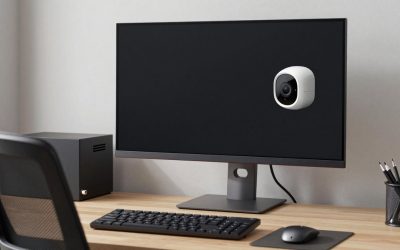
If you carry your laptop all day, size and privacy matter. A small clip-on camera with a built-in shutter is easier to pack and less awkward to mount on a library computer for a quick meeting. Look for a compact compact portable webcam with privacy shutter under 4 ounces with a short cable or detachable cable.
Why it works as a student pick: you can leave your laptop lid closed on a dorm monitor setup and still have a camera at eye level, then pull it off and go. The physical shutter also helps in shared rooms where roommates walk behind you.
Trade-offs: small sensors struggle after dark. If your dorm has only overhead fluorescent light, you will look yellow and noisy. Sit facing a window during the day, or turn on a warm desk lamp behind the laptop. Mics are adequate for one-on-one, not for recording a lecture from the back row.
When a 2K upgrade makes sense — and when it doesn’t
A 1440p camera makes sense if you record lessons, make study videos, or need to zoom in on problem sets without everything turning to mush. For live calls alone, classmates will not see the difference because Zoom and Meet downscale aggressively.
Don’t buy 4K for a 5-year-old laptop and expect miracles. Higher resolution needs more light, more CPU, and more upload bandwidth. On dorm Wi-Fi, you may have to drop back to 1080p or 720p anyway to stop stuttering. If you do want more detail for recordings, shop a 2K QHD webcam for recording classes and test it with your actual editing app before the return window closes.
Cheap fixes that matter more than the camera
Lighting beats megapixels. Face a window or put a lamp at 45 degrees behind your laptop. Don’t sit with a bright window behind you — every webcam will turn you into a silhouette.
Set eye level. Stack the laptop on books so the camera is at eye height. It reduces double-chin angle and makes attention look natural. If you use an external monitor, put the webcam on that monitor, centered, not off to the side on the laptop.
Check audio separately. Do a 10-second test recording in your actual room. If your mic picks up HVAC hum or hallway noise, switch to earbuds with a mic for exams and presentations. Most professors care more about clear audio than sharp video.
On Macs, remember there is no system-level camera settings panel. Set exposure and framing inside Zoom, Teams, or Meet. On Windows, avoid installing the vendor’s extra effects software unless you need it — it often adds lag and starts with the computer.
FAQ
Do I need a webcam if my laptop already has one?
Not always. If your built-in camera is 1080p and looks clean in low light, save your money. Upgrade if you have grainy 720p, no background handling for a shared room, or a broken mic. An external cam also helps when your laptop is docked to a monitor.
Will these work with Chromebook, Mac, and Windows?
Most modern USB webcams are plug-and-play across all three because they use the standard UVC driver. You select the camera in your meeting app. Very cheap no-name models sometimes have flaky mics on macOS, so buy from a listing with clear returns.
Is 4K worth it for online school?
Usually no. Live class apps compress video heavily, and dorm lighting and Wi-Fi limit what 4K can do. A good 1080p camera with solid low-light performance looks better in practice. Only get higher resolution if you are also recording content.
How do I look better without buying anything?
Face soft light, raise the camera to eye level, wipe the lens with a microfiber cloth, and close bandwidth-heavy apps during calls. In most dorm tests, those four steps improved image quality more than switching cameras.
Related Reviews & Guides
Best Webcam for Dell Computer
Best Webcam for Conference Calls