Last Updated: October 18, 2026
📄 In This Review
What a small room actually needs
A small conference room is usually 2 to 6 people around a table, 6 to 10 feet from the screen. That distance breaks most laptop webcams and desk webcams. Faces go small and dark, the built-in mic picks up keyboard and HVAC noise, and anyone at the edge of the table gets cropped out. For this size room you need three things: a 100 to 120-degree field of view, mics that can clearly pick up voices at 8 to 12 feet, and decent backlight handling because someone is almost always sitting in front of a window or a glass wall.
You do not need 4K for its own sake, and you do not need pan-tilt-zoom in a room this small. What matters more is a wide but not distorted image, reliable auto-exposure, and a speaker loud enough that remote voices do not sound thin. If your room already has a TV or large monitor, plan on mounting the camera just above or just below it, centered on the table. That eye-line matters more for natural conversation than resolution.
The three setups that actually work
See also: Best Monitor for MacBook Air: Two USB-C 4K Screens and Six Adapter-Dependent Alternatives • Best Monitor for MacBook Pro: Eight Listings Sorted by Cable, Sharpness and Scaling
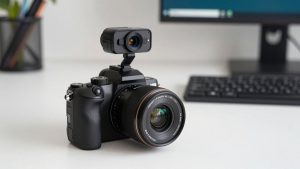
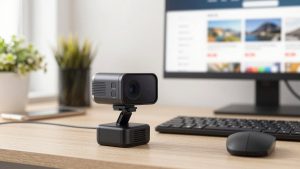
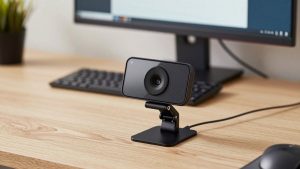
First is the wide-angle USB webcam on top of the TV. It is just a bigger version of a desk webcam with a wider lens and a multi-mic array. You plug one USB cable into the room laptop and you are in Zoom, Teams, or Meet. This suits rooms that already have a computer and where you want zero learning curve. Failure mode: the mics are fine to about 10 feet in a quiet room, but they struggle with echo and typing noise, and the small speaker in most of these units is not enough for three people to hear comfortably.
Second is the all-in-one video bar with camera, mics, and speaker in one enclosure. It sits under or over the TV and acts as webcam + speakerphone. This is the best fit for most small rooms because the speaker is larger, the mic array is usually beamforming, and many models have auto-framing that zooms slightly to fit everyone at the table. Failure mode: auto-framing can hunt or crop too tight if people move, and cheaper bars over-sharpen the image under fluorescent lights. You also need to check USB cable length and whether it needs external power.
Third is a separate camera plus a table speakerphone. You use a wide angle conference webcam for video and a USB or Bluetooth speakerphone in the middle of the table for audio. It is two devices instead of one, but audio is noticeably better because the mics are close to people. This suits rooms with a long table, rooms with echo, or teams that complain they cannot hear soft talkers. Failure mode: users have to select the right mic and speaker in Zoom or Teams, and someone will get it wrong.
Quick comparison
Use this to match the hardware to how your room is actually used, not how it looks on paper.
| Setup | Best for | Field of view | Audio range | Trade-off |
|---|---|---|---|---|
| Wide-angle USB webcam | 2-4 people, room laptop, tight budget | 100-120 degrees | Up to ~10 ft, quiet rooms only | Weak speaker, picks up room noise |
| All-in-one video bar | 3-6 people, TV-based room, frequent calls | 110-120 degrees with auto-frame | 12-15 ft, better echo control | Needs power, framing can annoy |
| Camera + table speakerphone | Long table, echoey rooms, hearing matters | 100-120 degrees | 15 ft+, mics close to talkers | Two devices, input selection errors |
| PTZ camera | Rarely needed for small rooms | Zoomable, narrower | Usually needs separate audio | Overkill, remote not used |
What to buy for your situation
If you have a 2 to 4 person huddle room and want the simplest fix, get a wide-angle conference webcam with dual mics and a 110-degree or wider lens. Mount it on the TV, plug it into the room Mac or PC, and set the room lights to avoid a bright window directly behind people. Be honest here: for short internal calls, the cheaper option is fine. You do not need AI tracking or 4K. Look for solid 1080p at 30fps, good auto white balance, and a privacy shutter people will actually use.
If you have a 4 to 6 person room and run client calls all day, get an all-in-one video bar with integrated speaker. This is where spending more pays off. The larger speaker means fewer “can you repeat that?” moments, and the longer mic pickup means the person at the far end of the table is still intelligible. When you shop for an all-in-one conference video bar with USB, check three specs vendors bury: USB cable length in the box, whether Mac is supported without extra drivers, and whether auto-framing can be turned off. You will want it off about half the time.
If people complain they cannot hear you, fix audio before you upgrade video. A table speakerphone with echo cancellation does more for meeting quality than moving from 1080p to 4K. Pair it with the camera you already have. A USB conference room speakerphone in the center of the table will beat any camera-mounted mic past 8 feet, especially in rooms with hard walls, glass, or a loud vent. Who this suits: legal, finance, and HR rooms where every word has to be clear, and any room where one or two soft-spoken people sit far from the TV.
Skip PTZ cameras for small rooms. Pan-tilt-zoom makes sense for training rooms and 12-person boardrooms where you need to focus on the presenter or whiteboard. In a 10×12 room, everyone is already in frame. A PTZ remote will sit unused, and the narrower starting field of view often cuts off the people at the ends of the table.
Setup mistakes that ruin good hardware
Most bad conference video is not the camera. It is placement and settings. Mount the camera at eye height when seated, not high on a wall pointing down. If you have to mount above a 55-inch TV, tilt it down slightly and pull the table a foot forward so faces are not tiny. Leave auto-focus on but turn off “auto” beauty filters and low-light boost if faces look waxy.
Audio fails more often than video. Mute the TV speakers and use only the bar or speakerphone for output, or you will get echo. In Zoom and Teams, turn off duplicate noise suppression if you already have it in hardware, because double processing makes voices pump in and out. Use a 6-foot or shorter USB run if possible. Long passive USB extensions are a common cause of freezing and “camera not found” on Macs. If you must go 10 feet or more to reach the room laptop, use an active USB extension or a powered hub.
For Mac-based rooms, test before you mount anything. Most conference webcams and bars are UVC-compliant and work plug-and-play on macOS, but companion apps for framing, firmware updates, and mic tuning are often Windows-only. Set your preferred framing and mic level on a Windows laptop first if needed, because the device usually remembers the setting when you move it back to the Mac.
FAQ
What field of view do I need for a small conference room?
Look for 110 to 120 degrees diagonal. Under 100 degrees will crop people at the ends of the table. Over 120 degrees can look distorted and push faces too small unless the software has de-warping and auto-framing.
Is 4K worth it for conference rooms?
Usually not for rooms under 6 people. Most platforms send 720p to 1080p anyway. Better lenses, better low-light performance, and better mics improve call quality more than 4K on the box. 4K helps mainly if you want digital zoom or auto-framing without the image falling apart.
Can we just use a laptop in the room instead of a conference webcam?
For two people huddled around one laptop, yes. For three or more, no. The laptop lens is too narrow, the mic is too far from half the table, and the fan noise gets into the call. A TV-mounted camera plus table audio is a large step up.
Why do remote people hear echo from our room?
Usually two speakers are playing at once, or the mic gain is too high for a reflective room. Use one output device only, lower the mic level one notch, move a speakerphone to the center of the table, and add soft surfaces if the room is all glass and drywall.
Related Reviews & Guides

Herman Miller Office Chair: Top Picks Compared in 2026
Best Resolution for Webcam