Last Updated: October 18, 2026
If you use a Mac for work, the webcam decision is different than on Windows. Apple got better with the 1080p and 12MP cameras in recent MacBooks, but the image is still small-sensor, wide-angle, and noisy in home-office light. An external webcam fixes framing, low-light grain, and microphone distance, but only if you pick one that actually plays well with macOS.
For most Mac users, you do not need the most expensive 4K option. You need reliable plug-and-play over USB, good auto-exposure for mixed window light, and a microphone that does not pick up your whole room. This guide breaks down when to stick with what you have, and when to upgrade.
📄 In This Review
What makes webcams tricky on Mac
Most webcams will work on Mac over USB UVC – no driver needed – but the software story is thinner. Windows-only apps for background blur, manual focus, firmware updates, and AI framing often do not have full Mac versions. That means you should buy for the hardware defaults, not for features you can only unlock in an app you cannot run.
Three common failure modes: First, USB hubs. Many 4K webcams need USB 3.0 bandwidth and direct power. Plugged through a cheap dock with an external drive and monitor, they will drop to 1080p, stutter, or disconnect mid-call. Second, macOS camera permissions. After a macOS update, Zoom or Teams can lose access until you re-enable it in System Settings > Privacy & Security > Camera, which looks like a broken webcam. Third, ultrawide lenses. A 90-95 degree field of view sounds good, but on a desk 2 feet away it shows your laundry, doorway, and stretches your face at the edges.
Your three options: Built-in, iPhone, or USB webcam
See also: Best Monitor for MacBook Air: Two USB-C 4K Screens and Six Adapter-Dependent Alternatives • Best Monitor for MacBook Pro: Eight Listings Sorted by Cable, Sharpness and Scaling
Recent MacBook Pro, MacBook Air, and iMac built-ins are fine for internal standups if you have good frontal light. They are centered, always available, and apps like Zoom and FaceTime can use Apple’s image processing. The limit is physics: tiny sensor, fixed focus, and you are stuck with laptop camera angle looking up your nose unless you raise the MacBook.
Apple’s Continuity Camera, which mounts your iPhone on top of the Mac and uses it as the webcam, is genuinely better than most sub-$150 webcams for image quality. Detail, color, and low-light are excellent, and Desk View and Center Stage work well. The trade-offs are practical: it ties up your phone, it can overheat on 45-minute calls, the mount can wobble, and audio handoff gets confusing if you get a call mid-meeting. Great backup, annoying as a daily driver for full-time remote work.
A dedicated USB webcam is best if you take 3+ hours of calls per day, use an external monitor with a Mac mini, Mac Studio, or MacBook in clamshell mode, or need consistent framing without thinking about it. It stays plugged in, stays aligned, and leaves your phone free.
Which type to buy for work from home
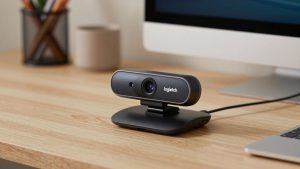
For basic office work – email, Slack huddles, 1:1s – a simple 1080p webcam for Mac with autofocus and dual mics is fine. Honest trade-off: 1080p looks soft on a 27-inch 4K monitor in full-screen, but in a Zoom gallery box no one can tell. You save money, use less USB bandwidth, and have fewer compatibility headaches. Pick this if your room has decent light and you just want to look clearer than the 720p camera on an older MacBook Air.
For client-facing calls, teaching, coaching, or recording Loom videos, step up to a mid-range 2K or 4K USB webcam with a larger sensor and autofocus. You get better dynamic range when you have a bright window behind you, less noise at night, and the ability to crop in slightly without falling apart. Trade-off: many 4K webcams bin down to 1080p in Zoom/Teams anyway unless you record locally, and autofocus can hunt if you gesture a lot. Look for physical privacy shutter, tripod thread, and on-device controls rather than app-dependent features.
A premium 4K webcam with a large 1-inch type sensor, good built-in mics, and noise reduction makes sense for podcast-style recording, livestreaming, or if you never want to think about light. Trade-off: they run warm, cost 2-3x more, and still will not fix bad placement. If your face is backlit or lit only by a ceiling can light, a $60 webcam plus a $30 desk light will beat a $250 webcam in a dark room. Do not buy premium expecting it to rescue a cave office.
Quick comparison for Mac users
| Option | Typical resolution | Best for | Watch out for |
|---|---|---|---|
| MacBook / iMac built-in | 1080p to 12MP Center Stage | Casual calls, travel, second camera | Fixed angle, noisy in low light, bad when laptop is low |
| iPhone Continuity Camera | 1080p / 4K via iPhone | Occasional high-quality calls, no extra purchase | Ties up phone, heat, mount stability, mic confusion |
| Budget 1080p USB webcam | 1080p30 | Daily standups, students, support roles | Soft on large monitors, weak mics past 3 feet |
| Mid-range 2K/4K USB webcam | 1440p or 4K30 | Client calls, managers, coaches, creators | Needs USB 3.0 direct port, autofocus hunting |
| Premium large-sensor 4K + desk light | 4K30 with better low light | Recording, streaming, all-day callers | Price, heat, still needs good placement |
How to set it up right on macOS
Mounting matters more than megapixels. Put the lens at eye level on top of your external monitor, about arm’s length away, and frame from mid-chest up. A 65-78 degree field of view is ideal for a home office – wide enough to look natural, tight enough to hide the room. If you buy ultrawide for whiteboard capture, expect to use a crop mode on Mac or you will look tiny.
Plug 4K cameras directly into the Mac or a powered Thunderbolt dock, not a passive USB hub. If you use a MacBook in clamshell, test that the Mac does not throttle or drop the camera when the lid is closed and hot. In Zoom, Teams, and Meet, manually select the external camera and microphone once – macOS will sometimes revert to the built-in after sleep.
For light, face a window or put a soft white lamp behind your monitor, not behind you. For sound, sit within 2-3 feet of the webcam mic. Beyond that, voices get echoey on Macs in hard-floor rooms, and you will sound better with a basic USB microphone for home office or wired earbuds. Also test Screen Sharing: some virtual-camera and blur features that work on Windows do not load on Apple Silicon Macs.
Who should skip the upgrade? If you only do two calls a week on a 2021 or newer MacBook in a bright room, keep your money. Clean the lens, raise the laptop on a stand, and turn on Improve Lighting in FaceTime or Touch Up in Zoom. The cheaper option is genuinely fine here.
FAQ
Do I need drivers for a webcam on Mac?
Usually no. Most modern webcams are UVC-compliant and work plug-and-play on macOS Sonoma and later. What you often do not get is the full Windows settings app, so choose a webcam that looks good with default settings.
Why does my 4K webcam only show 1080p on Mac?
Zoom, Teams, and Google Meet often cap to 1080p or 720p to save bandwidth, and low-power USB ports or hubs can also force a lower mode. You will only see full 4K in local recording apps like QuickTime or Photo Booth, or when you plug directly into a USB 3.0 / Thunderbolt port.
Is Continuity Camera better than buying a webcam?
For pure image quality, a recent iPhone beats most budget webcams. For daily work, a dedicated USB webcam is more convenient because it stays mounted, does not drain your phone battery, and does not interrupt meetings with notifications or heat warnings.
What field of view is best for home office?
Around 65 to 78 degrees for one person at a desk. Wider than 90 degrees is useful only if you need to show two people or a whiteboard, otherwise it makes you look small and captures too much background.
Related Reviews & Guides


Best Monitor for MacBook Pro: Eight Listings Sorted by Cable, Sharpness and Scaling
Camera for Desk Top Computer