Last Updated: October 18, 2026
📄 In This Review
What “value” actually means for a work webcam
For video calls, value is not the highest resolution per dollar. It is a clear face, stable exposure, and understandable voice without fiddling with settings before every meeting. Most buyers overpay for 4K they will never use, then lose the actual gain to bad lighting, a noisy mic, or aggressive office backlight.
In practice, Zoom, Teams, and Meet compress video hard. A clean 1080p feed at 30fps with good autofocus and auto-exposure will look better to coworkers than a soft or over-sharpened 4K feed. That is why the value winners are almost always in the middle: solid 1080p with autofocus, dual mics with noise reduction, and a usable clip mount.
The rule is simple. If you take 2-5 calls per week in a quiet home office, cheaper is fine. If you present, teach, interview, or sell on camera daily, pay for better autofocus, low-light handling, and a wider but not distorted field of view.
When the cheapest option is fine
See also: Best Monitor for MacBook Air: Two USB-C 4K Screens and Six Adapter-Dependent Alternatives • Best Monitor for MacBook Pro: Eight Listings Sorted by Cable, Sharpness and Scaling
A basic fixed-focus 1080p webcam is enough if you sit at a consistent distance, have decent frontal light, and mostly listen in. Fixed focus means fewer hunting pulses, which is actually an advantage for static desk setups. The trade-off is that anything held up close, like a document or product, will be blurry, and low light turns mushy fast.
Failure modes to know: cheap models tend to blow out windows behind you, turning you into a silhouette. Their mics also pick up keyboard clatter and room echo. If your laptop mic is already decent, use that instead and mute the webcam. Do not expect privacy shutters, tripod threads, or Mac-friendly software at this tier.
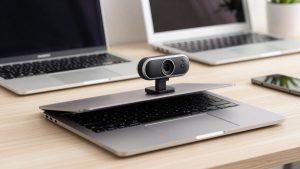
Who it suits: students, part-time remote workers, and second-computer setups. Pair it with a $15-20 desk lamp placed behind your monitor and you will look better than most people with a $150 camera and overhead lighting. If that describes you, a basic 1080p fixed focus webcam for laptop is the honest value pick.
The sweet spot: midrange 1080p and 2K with autofocus
For most home offices, this is the best value for money. You get autofocus that keeps your face sharp when you lean in, better sensors for evening calls, and noise-reducing dual microphones that actually help in apartments and shared rooms. Many also add a 75-90 degree field of view, which fits one or two people without the stretched edges of ultra-wide cameras.
Look for three specifics, not marketing specs: autofocus rather than fixed focus, auto light correction that does not pump brightness up and down, and a physical shutter or lens cap. A tripod thread matters if you want to mount it higher than your monitor, which improves eye contact immediately.
Concrete trade-offs: 2K sounds better than 1080p, but on most office broadband you will be downscaled to 720p or 1080p anyway. What you are paying for is a larger sensor and better processing, not pixels. Autofocus can also hunt in low light or with busy backgrounds. If yours does, lock focus in the vendor app or improve frontal light before blaming the camera.
A well-reviewed 1080p autofocus webcam with dual mic covers about 80% of remote workers. Step to 2K only if you crop, present full-screen often, or sit farther from the desk.
When it is worth paying more
Pay more for three jobs: frequent presenting, poor lighting you cannot fix, and a need for natural background blur. Higher-end 4K webcams usually win on dynamic range, skin-tone handling, and software features like auto-framing and tighter noise control. Auto-framing is useful if you stand, whiteboard, or move around.
But the failure modes get expensive. Many 4K cameras default to heavy sharpening and smoothing that looks artificial. They also need more USB bandwidth and CPU; on older laptops they may drop frames or run hot. And their built-in background blur is still worse than a real tidy background or good lighting.
Who it suits: managers, coaches, creators, freelancers who meet clients on video, and anyone on camera 4+ hours per day. If that is you, compare a 4K webcam for home office with autoframing against a midrange 2K model plus a small key light. The light often wins.
Laptops and Macs: compatibility checks that save returns
Most modern webcams are plug-and-play over USB-A or USB-C, but details matter. Check cable length if your dock is under the desk, and check whether the clip fits thin laptop lids without wobbling. For Macs, confirm the vendor app supports macOS for firmware updates and field-of-view controls; some features are Windows-only.
On Apple Silicon Macs, avoid cameras that require kernel extensions or old capture software. UVC-compliant cameras work in FaceTime, Zoom, and Teams without drivers. If you use a Studio Display or external monitor, test mic selection explicitly. macOS will often keep using the internal mic, which can be good, but it confuses echo cancellation if both inputs stay live.
For travel laptops, size and shutter matter more than resolution. A compact camera you will actually carry beats a better one left at home. For desktops with dual monitors, prioritize a sturdy mount and manual tilt over auto-framing.
Quick comparison
| Category | Best for | Strengths | Weaknesses |
|---|---|---|---|
| Budget 1080p, fixed focus | Occasional calls, students | Cheap, simple, no focus hunting | Weak low light, poor mics, soft close-ups |
| Midrange 1080p / 2K, autofocus | Daily home office work | Sharper face, better exposure, usable mics | Autofocus can hunt; 2K often downscaled |
| Premium 4K | Presenting, client-facing video | Best dynamic range, framing features | Price, CPU/USB load, over-processing risk |
Before you upgrade tiers, fix light first. Face a window or put a diffuse lamp at 45 degrees behind your webcam, close blinds behind you, and raise the camera to eye level. That $0 change often does more than a $100 jump in hardware.
FAQ
Is 4K worth it for Zoom and Teams?
Usually not for value. Calls are compressed to 720p or 1080p, so a clean 1080p sensor with good light looks the same or better. Buy 4K only if you present full-screen, crop heavily, or want better dynamic range and framing features.
Do I need an external mic?
Not always. Midrange webcam mics are fine in quiet rooms. If you type while talking, have echo, or share a space, a basic USB headset or desktop mic is a bigger upgrade than a pricier camera.
Why do I look dark with a window behind me?
Backlight overwhelms auto-exposure. Move to face the window, close the blinds, or add frontal light. No value webcam can fix strong backlight cleanly without washing out the background.
What should Mac users check before buying?
Look for UVC plug-and-play support, a macOS app for updates and field-of-view settings, and USB-C cable or adapter in the box. Avoid models where key features are Windows-only.
Related Reviews & Guides




6 Best Laptop Docking Stations With HDMI 2026
Best External Webcam for MacBook Air