Last Updated: September 26, 2026
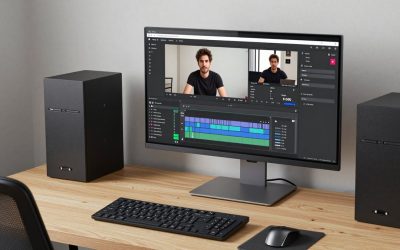
Music production desks carry an unusual mix of equipment: studio monitors, a MIDI keyboard controller, an audio interface, sometimes a mixing console or control surface, plus one or two screens for the DAW. Everything is sensitive to position, especially the speakers, whose placement relative to your ears defines what you hear. A standing desk can help producers avoid long hours locked in one posture, and many musicians enjoy playing and recording parts standing. This guide explains how to choose a standing desk that keeps your monitoring accurate and your gear safe.
📄 In This Review
Why producers need special consideration
The listening position is the heart of a mix setup. Studio monitors should form an equilateral triangle with your head, tweeters roughly at ear height. If the speakers sit on the desk and the desk moves, the triangle stays intact because your head and the speakers rise together. That is actually a benefit of a standing desk, but only if the speakers are securely placed and the desk does not resonate.
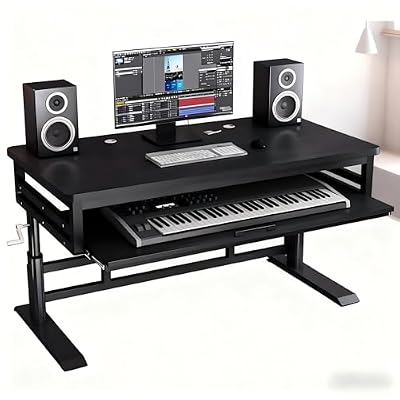
HEXIMANX Studio Desk with Keyboard Tray | Hand-Crank Adjustable Standing Desk Workstation for Music Production, Cable Management, MIDI Keyboard Shelf (Black, 47in)
Included for 'Best standing desk for music production' because the listing specifies Cable Management and MIDI Keyboard Shelf (Black, details this guide uses to compare options.
View on AmazonWeight is also a concern. A pair of 5 to 8 inch studio monitors weigh roughly 10 to 25 lb each, a 49 or 61-key MIDI controller 8 to 15 lb, and a small console or control surface more. Add a monitor and interface, and a loaded desk can easily exceed 100 lb.
Features to prioritise
See also: Best Monitor for MacBook Air: Two USB-C 4K Screens and Six Adapter-Dependent Alternatives • Best Monitor for MacBook Pro: Eight Listings Sorted by Cable, Sharpness and Scaling
Load capacity and stability
Choose a dual-motor frame rated for 250 to 350 lb. A three-stage frame keeps the desk steadier at standing height, which matters when you play a controller with some force.
Top size and depth for a keyboard
A 49-key controller is about 30 to 32 inches wide; a 61-key around 36 to 40 inches; an 88-key over 50 inches. Put a full-size controller directly in front of you on a desk at least 60 inches wide, with 30 inches of depth so the computer keyboard and controller can both fit, or use a keyboard tray.
Resonance and top material
Thin tops vibrate with bass. A 1-inch or thicker solid top, plus monitor isolation pads or stands, reduces low-frequency buildup and smearing.
Quiet motor
You will not record while moving, but a quieter frame is less intrusive during sessions. Established dual-motor frames typically run in the mid-40 dB range.
Setups compared
| Setup | Estimated gear weight | Recommended desk | Typical price tier |
|---|---|---|---|
| Laptop + interface + 25-key controller + 5 in monitors | 30-45 lb | Dual motor, 55-60 in top | $400-$650 |
| Desktop DAW + 61-key controller + 8 in monitors | 60-90 lb | Dual motor, three stage, 63-72 in top | $600-$950 |
| 88-key controller + console + dual screens | 100-150 lb | Heavy-duty or L-shaped | $900-$1,600 |
Setting up for accurate monitoring
Speakers on the desk or on stands?
Speakers on the desk move with you and keep the triangle when standing. Floor stands give better isolation but will be at the wrong height when you stand. Most home producers keep speakers on the desk with isolation pads, angled toward the listening position.
Keep the controller at the right height
For playing keys, wrists should be level with or slightly above the keys. Standing players often like the keyboard a little lower than typing height. Save a playing preset.
Cable management
Audio setups involve many cables: XLR or TRS to speakers, USB to the interface and controller, power to each device. Leave generous slack, use a cable tray and label cables. Keep audio and power cables separated where possible to reduce hum.
Room treatment
The desk sits in the room’s acoustic field. Treat first reflection points and use bass traps; a standing desk does not fix room acoustics.
Budget advice
Bedroom producers with compact gear can use a mid-range dual-motor desk. Producers with larger speakers or full-size controllers should budget for a heavy-duty frame. L-shaped setups separate the mixing position from a keyboard or instrument station.
FAQ
Can I mix while standing?
Yes, as long as your ears stay in the same position relative to the speakers. With speakers on the desk, standing keeps the geometry intact.
Will the desk rattle during bass-heavy mixes?
Thin tops and loose parts can rattle. Use a thick top, tighten all bolts, and put isolation pads under the speakers.
Bottom line
Music producers should choose a stable dual-motor standing desk rated for 250 lb or more, with a thick top and enough width for their controller and monitors. Keep speakers on the desk with isolation, save presets for mixing and playing and manage cables carefully. Check load rating and stability on the current spec sheet.
Related Reviews & Guides



Best Camera for Video Conferencing Mac
6 Best Laptop En Docking Stations 2026