Last Updated: September 18, 2026
- Decide These 3 Things First
- Size: Match the Frame and Top to Your Setup
- Material: Separate Top Weight from Load Capacity
- Construction: Static Capacity Is Not the Whole Story
- Comfort and Performance: Check the Useful Numbers
- Price Tiers: Pay for Capacity You Will Actually Use
- Warranty: Read the Coverage by Component
- Delivery and Assembly: Budget Time and Space
- Spec Checklist
- Red Flags
- FAQ
A standing desk’s weight capacity is easy to misread. A product page may advertise 300 pounds, but that number can refer to the frame’s maximum static load rather than the weight it can raise smoothly every day. Other buyers make the opposite mistake: they choose a desk with a generous capacity but overlook tabletop size, motor speed, wobble, or whether the frame can fit their preferred surface.
This standing desk buying guide weight capacity advice focuses on the complete workstation, not a single headline specification. In 2026, affordable electric desks commonly cost less than $250, while sturdier dual-motor frames and premium configurations can cost $300 to $800 or more. The right choice depends on your equipment, height range, room, and tolerance for assembly—not simply the largest number on the box.
As an Amazon Associate we earn from qualifying purchases at no extra cost to you.


📄 In This Review
- Decide These 3 Things First
- Size: Match the Frame and Top to Your Setup
- Material: Separate Top Weight from Load Capacity
- Construction: Static Capacity Is Not the Whole Story
- Comfort and Performance: Check the Useful Numbers
- Price Tiers: Pay for Capacity You Will Actually Use
- Warranty: Read the Coverage by Component
- Delivery and Assembly: Budget Time and Space
- Spec Checklist
- Red Flags
- FAQ
Decide These 3 Things First
- Calculate your real load. Add the tabletop, monitors, arms, computer, speakers, lighting, accessories, and a safety margin. A 40-pound desktop setup can become a 70-pound setup after adding a heavy wood top and two monitor arms.
- Choose your tabletop dimensions. A 48-inch-wide surface may suit a laptop and one monitor; a 60- to 72-inch desk is more practical for multiple screens, paperwork, and accessories.
- Decide how often you will adjust it. Occasional sitting-to-standing changes place different demands on a desk than six to 12 height adjustments every workday. Frequent use favors dual motors, better controls, and a stable three-stage frame.
Size: Match the Frame and Top to Your Setup
See also: Best Standing Desks for Students: Picks for Dorms, Small Rooms and Yearly Moves • Fellowes Lotus Sit Stand Workstation: Features and Honest Review
Start with width and depth, then confirm that the frame supports those dimensions. A 55-inch tabletop, such as the one included with the Veken 55 Inch Large Electric Standing Desk, offers useful room for one large monitor or two compact displays. A 60-inch-wide, 28-inch-deep surface gives more space for a keyboard, notebook, and monitor arms without dominating a small room. For two monitors, speakers, and regular paperwork, look for at least 60 by 30 inches. A 72 by 30-inch desk is more comfortable for a large multi-screen setup.
Depth matters because monitor viewing distance affects comfort. A 24-inch-deep desk can work with a laptop or a monitor on a compact stand, but monitor arms and deep bases are easier to arrange on a 28- to 30-inch surface. Measure the room, too: leave roughly 36 inches of clearance behind the chair and enough side space for drawers or walking routes.
Also check the frame’s width adjustment range. A frame that fits tops from 40 to 70 inches is more versatile than one designed for a narrow range. Never assume a larger top is safe simply because it can be attached physically; unsupported overhang can increase flex and wobble.
Material: Separate Top Weight from Load Capacity
Many published capacity figures apply to the entire moving assembly. That includes the tabletop. A 1-inch-thick engineered-wood top may weigh 35 to 55 pounds, while a solid hardwood top of similar size can weigh 60 to 100 pounds or more. A lightweight laminated top may leave more of the desk’s capacity available for equipment.
Particleboard and MDF tops are affordable and often sufficiently rigid at 1 inch thick, but fastening and edge durability vary. A thin 0.6-inch top may flex more around monitor-arm clamps. For a heavy monitor arm, choose a top at least 0.75 inch thick and use a reinforcement plate when the arm manufacturer recommends one. Solid wood can be durable and attractive, but its weight, cost, and seasonal movement deserve consideration.
Do not add the tabletop weight to the advertised capacity unless the manufacturer clearly defines the rating. If a desk is rated for 300 pounds including the top, a 75-pound desktop leaves approximately 225 pounds for everything else—but that does not mean it should be operated continuously at the absolute maximum.
Construction: Static Capacity Is Not the Whole Story
Look for the words dynamic load capacity or lifting capacity. Dynamic capacity describes the load the motors are intended to raise and lower. Static capacity describes what the frame may support while stationary. A desk rated for 300 pounds static may have a lower dynamic rating, and some listings fail to distinguish the two.
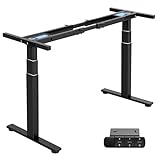
Two-leg frames are common and can be perfectly adequate for loads around 100 to 150 pounds, depending on the design. Three-stage legs provide a wider height range and typically allow a more compact lowered position. Dual-motor frames generally distribute lifting work across both legs, making them preferable for heavier setups. The TOPSKY 3-Stage Dual Motor Standing Desk Frame, listed at a 300-pound capacity, illustrates the kind of specification that appeals to buyers with a large top or multiple displays; confirm whether its 300 pounds is static or dynamic before purchasing.
Pay attention to the crossbar, feet, frame steel, and leveling glides. Longer feet and a rigid crossbar can improve stability, although no specification guarantees that a desk will be wobble-free at its maximum height. A desk carrying 120 pounds at 48 inches may feel steadier than the same desk carrying 120 pounds at 55 inches because the raised column has more leverage.
Comfort and Performance: Check the Useful Numbers
A practical electric desk should usually offer a height range of approximately 27 to 47 inches, measured with or without the tabletop as specified. Taller users may need a maximum height of 48 to 51 inches; shorter users should verify that the minimum height is low enough for seated elbow position. Three-stage columns often provide more usable range than two-stage columns.
Motor speed is commonly around 0.8 to 1.5 inches per second. A faster motor reduces waiting, but speed should not outweigh smoothness, noise, and stability. Some products advertise noise levels near 50 decibels, but manufacturer measurements may use different conditions, so treat those figures as comparisons rather than guarantees.
Look for a control panel with at least two or three memory presets, an anti-collision feature, and overload protection. Anti-collision systems are helpful but not foolproof; keep cables clear and watch the desk during movement. A typical electric standing desk may draw roughly 100 to 300 watts while lifting, with much lower standby consumption. Use a cable tray and leave enough slack for the full height range.
Price Tiers: Pay for Capacity You Will Actually Use
Budget: $100 to $180. Desks in this range often have two motors or a single motor, smaller tops, and stated capacities around 100 to 176 pounds. The Veken 55-inch desk at about $109.99 and the DeskShow 60-by-28-inch desk at about $179.99 represent the type of low-cost options to evaluate. They can suit a laptop, one or two moderate-size monitors, and ordinary accessories, but inspect the warranty and frame dimensions carefully.
Midrange: $180 to $350. This tier commonly includes larger tops, improved controls, dual motors, and stronger frames. The HUANUO 71-by-30-inch desk at about $229.99 offers the kind of spacious surface useful for multiple displays. A midrange desk is often the sweet spot for a home office carrying 80 to 150 pounds.
Premium: $350 to $800 or more. Premium frames may offer three-stage columns, dual or four-motor systems, heavier steel, quieter operation, stronger electronics, and longer warranties. The TOPSKY frame at about $299.99 sits near the upper midrange or entry-premium boundary, depending on whether the tabletop is included. Premium pricing is worthwhile when you need a 200-pound-plus rating, frequent adjustments, a custom top, or extensive warranty coverage.
Warranty: Read the Coverage by Component
A useful warranty separates the frame, motor, control box, and tabletop. Look for at least three years on electrical components and five years on the frame; premium products may offer seven to 10 years on structural parts. A one-year warranty is not automatically a dealbreaker, but it is a reason to demand a lower price and keep the packaging until the desk is fully tested.
Check whether the warranty covers labor, replacement parts, shipping, and failures caused by overloading. Some warranties exclude commercial use or require registration. Also confirm the return window and restocking policy, because a 150-pound desk can be expensive to return.
Delivery and Assembly: Budget Time and Space
Expect a boxed electric desk to weigh approximately 70 to 150 pounds, depending on the top and frame. Large solid-wood configurations can weigh more. Two-person handling is safer for boxes longer than 60 inches. Assembly commonly takes 45 to 120 minutes, and a heavier dual-motor frame may take longer.
Before ordering, measure doorways, stair turns, and the final location. Confirm whether the desk arrives in one box or multiple cartons. During assembly, tighten bolts evenly, avoid overtightening threaded inserts, and test the desk without equipment first. After installation, raise it slowly while checking that power and monitor cables do not catch.
Spec Checklist
| Spec | Budget | Mid | Premium |
|---|---|---|---|
| Typical price | $100–$180 | $180–$350 | $350–$800+ |
| Recommended surface | 48–55 by 24–28 in. | 55–72 by 28–30 in. | 60–84 by 30–36 in. |
| Useful dynamic capacity | 80–120 lb. | 120–180 lb. | 180–300+ lb. |
| Height range | 28–46 in. | 27–48 in. | 25–51 in. |
| Motor setup | Single or basic dual motor | Dual motor | Dual or four motor; often three-stage |
| Motor speed | 0.8–1.0 in./sec. | 1.0–1.3 in./sec. | 1.2–1.5 in./sec. |
| Warranty target | 1–3 years | 3–5 years | 5–10 years on frame |
Red Flags
- A capacity number with no statement explaining whether it is static or dynamic.
- A large tabletop paired with a narrow frame and no recommended top-size range.
- A claimed 300-pound rating from a single small motor without detailed electrical or frame specifications.
- No height range, motor speed, warranty terms, or replacement-parts information.
- A very thin tabletop beneath a monitor-arm clamp with no reinforcement guidance.
- Reviews mentioning uneven lifting, controller errors, excessive wobble, or missing hardware repeatedly.
- A return policy that excludes oversized furniture or charges substantial return freight.
FAQ
How much weight should my standing desk support?
Add the tabletop and every item placed on it, then add at least 25% headroom. For example, a 45-pound top, 35 pounds of monitors and arms, and 15 pounds of accessories equals 95 pounds. A desk with a dynamic rating of at least 120 pounds would provide a more sensible margin than a desk rated exactly at 95 pounds.
Is a 300-pound standing desk capacity enough?
Usually, yes, for a very large home-office setup—but confirm that 300 pounds is the dynamic rating and includes the tabletop. A high static rating does not guarantee smooth lifting. Stability also depends on desk height, top depth, frame width, floor level, and how the load is distributed.
Do I need a dual-motor standing desk?
Choose dual motors when your total load approaches 100 to 150 pounds, when you want a desk wider than 60 inches, or when you will adjust the height several times daily. A single-motor desk can be adequate for a light laptop setup, but it generally offers less lifting reserve and may move more slowly.
Should I buy the frame and tabletop separately?
Buying separately makes sense when you want a solid-wood, extra-deep, or custom-size top. It also lets you select a frame with the exact capacity and height range you need. However, verify the frame’s compatible width, mounting pattern, top thickness, and overhang limits before drilling. A complete desk is simpler; a separate frame is more flexible.
Ready to decide? Our #1 pick for 2026 is the Typical price.
Live price & availability on Amazon.
Related Reviews & Guides



Adjustable Standing Desks With Keyboard Trays: How They Change Your Typing Height

4 Best Anti Fatigue Mats for Standing Desk