Last Updated: September 9, 2026
- Top Pick: WALI Desk File Organizer, 4 Tier Desktop Paper Letter Tray Organizer with Drawer and 2 Pen Holders, Office Desk Accessories & Workspace Organizers for Office, Home Supplies(DO005DH-B), 1 Pack, Black
- Best Value: OPNICE Desk Organizer and Accessories, 2-Tier Computer Monitor Stand Riser with Drawer and 2 Pen Holders, Laptop Stand, Office Desk Accessories for Office Supplies, Black
- Premium Choice: Wood Desk Organizers and Accessories with File Holder & Catalog Racks
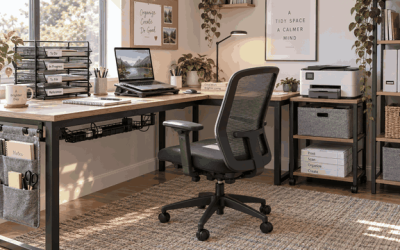
A cluttered desk is not a personality flaw; it is a storage-system mismatch. Most people accumulate three to five distinct categories of paper—mail, invoices, printouts, reference handouts—then reach for the cheapest wire tray that happens to be in stock. The result is a single bin where everything lands flat and nothing surfaces on time. A good desktop organizer solves this by giving each category its own visible zone, so that placing a document is fast and finding it later requires no digging.
What separates a worthwhile organizer from a disposable one comes down to tier count matched to your actual workflow, drawer depth that fits real objects rather than decorative trinkets, and a footprint that respects the depth of your desk. The eight models below range from under ten dollars to just under thirty, and the differences in daily usability between them are larger than the price gaps suggest. This roundup was assembled by comparing published specifications, checking owner feedback for recurring pain points, and weighing each unit’s value at its listed price for 2026.
As an Amazon Associate we earn from qualifying purchases at no extra cost to you.



📄 In This Review
Quick Picks
| Product | Best for | Price |
|---|---|---|
| WALI 4-Tier File Organizer | Heavy daily paper flow | $16.99 |
| OPNICE Monitor Stand Riser | Elevation plus light storage | $19.79 |
| Wood Desk Organizer with File Holder | Warm aesthetic in a study | $19.79 |
| OPNICE 4-Tier File Organizer | Vertical sorting on a small desk | $18.99 |
| Simple Trending 7-Tier | Maximum capacity per unit | $29.89 |
| Amazon Basics Mesh Tray | Lowest-cost starting point | $9.44 |
| gianotter 4-Tier Rose Gold | Color-matched creative setups | $22.49 |
| Amazon Basics Mesh Pen Holder | Dedicated writing-tool caddy | $12.59 |
How We Picked
See also: Can DDR5 Motherboards Use DDR4? Compatibility Guide • Best Gaming Desktops for Smooth PC Gaming
We narrowed the field using four criteria. First, tier count and whether each tier is actually letter-width deep or merely decorative. Second, drawer utility—some drawers are too shallow for a standard stapler or a pack of index cards. Third, footprint-to-function ratio: a unit that claims five zones but occupies the desk real estate of two is a poor trade. Fourth, finish durability based on long-term owner reports about chipping, warping, or loosened joints.
The 8 Best Desktop Organizer in 2026
1. WALI 4-Tier File Organizer
Built for anyone whose incoming paper exceeds what a single tray can absorb before it becomes a pile. Four tiers let you assign zones by urgency—pending, filed, active, archive—while the bottom drawer keeps rubber bands and USB drives out of sight.
- Pro: Four distinct sorting levels prevent documents from merging into an undifferentiated stack.
- Pro: Integrated drawer adds hidden storage without increasing the unit’s footprint.
- Con: Pen holders are shallow; long markers or capped fountain pens may tip out.
Skip this if your primary need is storing large-format prints or books that will not sit upright in letter-width slots.
2. OPNICE Monitor Stand Riser
Designed for the laptop or monitor user who wants to raise their screen to eye level while reclaiming the space underneath for a keyboard or folded documents. The two-tier structure doubles as a modest file tray.
- Pro: Elevates a display to a healthier neck angle, solving two desk problems with one purchase.
- Pro: Drawer and pen holders provide secondary storage at no extra footprint cost.
- Con: Only two file tiers, so heavy paper overflow still requires a companion tray.
Skip this if your monitor already sits on a VESA arm or you have no need for screen elevation.
3. Wood Desk Organizer with File Holder and Catalog Racks
A solid choice for a home study, library corner, or any workspace where a metallic organizer would feel cold. The wood grain and catalog-style angled racks give reference books a visible display position rather than burying them flat.
- Pro: Natural wood finish hides fingerprints and minor surface marks better than painted metal.
- Pro: Catalog racks let frequently consulted books stay upright and reachable.
- Con: Wood joints can loosen over years of loading and unloading heavy paper stacks.
Skip this if your workspace is humid or you need a wipe-clean surface after frequent coffee spills.
4. OPNICE 4-Tier File Organizer
A straightforward vertical sorter for workers who process documents in clear project stages and want all four levels visible at a glance from a seated position. The black powder-coat finish resists surface scratches from metal clip edges.
- Pro: Tall, narrow profile conserves horizontal desk space on workstations under 48 inches wide.
- Pro: Base drawer sits at a natural hand height for quick-access small supplies.
- Con: Top tier becomes awkward to reach for shorter users or on low-profile desks.
Skip this if you primarily store documents flat—blueprints, large photographs, or folded maps that need full surface contact.
5. Simple Trending 7-Tier Desk File Organizer
The highest-capacity single unit in this roundup, built for people juggling five or more simultaneous document streams such as invoices, contracts, receipts, project briefs, and personal correspondence. The metal hanging basket adds a no-drill wall-mount option for overflow.
- Pro: Seven tiers provide more sorting zones than any other model here.
- Pro: Hanging basket doubles as a wall shelf or a desk-side overflow tray.
- Con: At seven levels the unit is notably tall and can feel top-heavy on a shallow desk.
Skip this if you prefer a low-profile setup or your desk is under 18 inches deep, where the height-to-width ratio becomes unstable.
6. Amazon Basics Mesh Desk Organizer
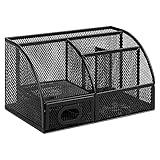
The entry point for a student or minimal-desk worker building an organizing habit without committing to a larger system. At under ten dollars it removes the price objection to buying your first real tray rather than a decorative bowl.
- Pro: Lowest price in this roundup; the pullout drawer alone justifies it for sticky-note and cable storage.
- Pro: Compact 9.25-inch width fits tight cubicle ledges or nightstand surfaces.
- Con: Single-tier tray offers no visual separation between document types.
Skip this if you handle more than two categories of paper daily and need the tiers to prevent cross-contamination of files.
7. gianotter 4-Tier Desk Organizer in Rose Gold
A color-first choice for creative studios, co-working spaces, or anyone whose desk hardware already leans warm-metal. Functionally it matches the standard four-tier-with-drawer layout, but the rose gold finish sets it apart visually.
- Pro: Finish resists chipping better than flat black powder coat in long-term owner reports.
- Pro: Four tiers plus drawer give the same sorting logic as more expensive rivals.
- Con: Rose gold shows fingerprint oils more visibly under direct sunlight than darker coatings.
Skip this if you want a neutral color that blends invisibly with existing black or silver hardware.
8. Amazon Basics Mesh Pen Holder and Desktop Organizer
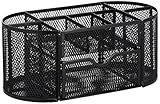
Solves one specific problem well: giving pens, pencils, scissors, and rulers dedicated compartments so they stop migrating across your keyboard. At 9.1 by 5.9 inches it occupies minimal desk area while holding a full writing set upright.
- Pro: Compartmentalized slots keep tools separated and visible rather than mixed in a cup.
- Pro: Small footprint under six inches wide suits cramped laptop desks.
- Con: No paper slots at all, so it addresses only the tools half of desk clutter.
Skip this if loose documents are your primary annoyance and you want one all-in-one unit rather than a dedicated caddy.
Buying Guide
Tier Count and What It Actually Buys You
Two tiers suit anyone sorting by urgency only (today versus later). Four tiers let you separate by project, client, or document type. Seven tiers is practical only if you genuinely run five or more parallel workstreams; beyond that, added tiers collect dust and become visual clutter themselves. Match the number to how many categories you can name in under five seconds.
Drawer Depth and Accessibility
A drawer that fits a standard stapler and a pack of 3-by-5 cards is useful. One that only swallows loose paper clips is decorative. Check interior dimensions when listed, or read owner reviews for the word “stapler”—if multiple people mention it, the drawer is probably adequate.
Footprint-to-Function Ratio
Measure your available desk depth before buying. A 7-tier unit that is only six inches deep works on a 20-inch desk. A wood organizer with catalog racks angled backward may need twelve inches of clearance. The best desktop organizer is the one that fits without forcing you to relocate your monitor.
Our Verdict
For anyone processing multiple document streams daily, the Simple Trending 7-Tier offers the most sorting zones per dollar spent, making it our top pick at $29.89. The budget pick is the Amazon Basics Mesh Tray at $9.44—a no-brainer entry point for a first organizer. However, if your primary frustration is screen height rather than paper pile, the OPNICE Monitor Stand Riser wins because it solves an ergonomic problem no tier count can address.
FAQ
What is the best desktop organizer for a small desk?
A vertical, narrow-profile unit like the OPNICE 4-Tier or the Amazon Basics Mesh Tray maximizes function per inch of width. Avoid wide catalog-style racks unless your desk exceeds 50 inches.
Do wooden organizers last as long as metal ones?
Under normal indoor use, yes, but wood joints are vulnerable to repeated heavy loading and humidity swings. Metal mesh and powder-coated steel units tolerate rougher handling and damp environments without warping.
How many tiers do I actually need?
Count the distinct document categories you touch in a typical week. If the number is two, a single-tier tray suffices. If it is four or five, a multi-tier unit pays for itself in retrieval time.
Can I combine multiple organizers?
Yes. A common setup pairs a file tray like the WALI 4-Tier with a separate pen caddy such as the Amazon Basics Mesh Pen Holder, giving each function its own zone without overloading a single unit.
Related Reviews & Guides



Best DDR4 Graphics Cards and GPUs for Value Builds

Anker Desktop Charger vs USB C Charger Block: Which Should You Buy?