Last Updated: October 18, 2026
If you spend all day on Zoom, Teams, or Google Meet, 60fps sounds like an easy upgrade. Motion looks smoother, hand gestures don’t smear, and screen shares where you move around look more natural. But on budget webcams, 60fps comes with trade-offs that matter more for work than the frame rate number.
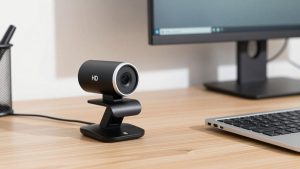
Most cheap webcams that advertise 60fps only do it at 720p, or they drop to 30fps the second light gets dim. Others hit 1080p60 in good light but look noisy, soft, or overexposed in a normal home office. For calls, a stable, well-exposed 1080p30 image often looks better than a flickery 1080p60 image. Buy 60fps for the right reasons: you move a lot on camera, you demo products with your hands, you teach, or you record tutorials and want smoother footage.
📄 In This Review
What 60fps actually gets you on calls
On a video call, 60fps does not make you look sharper. Resolution, lens quality, focus, and exposure do that. What 60fps changes is motion smoothness. At 30fps, fast hand movement breaks up and leaves trails. At 60fps, it stays readable.
That matters if you whiteboard, hold up documents, demonstrate tools, type on a keyboard you want to show, or present while standing. It matters less if you sit still two feet from the camera in a meeting. Most conferencing apps also compress heavily. Zoom and Meet will often cap you below full quality anyway, especially in gallery view or on weak Wi-Fi. You will still see the benefit locally in recordings, but your coworkers may see only part of it.
The other catch: 60fps needs twice as much light as 30fps for the same exposure. Budget sensors are small. In a dim spare bedroom at 7pm, a budget 60fps webcam will either go dark, get grainy, or silently drop back to 30fps to cope. If your office has one overhead light and no window in front of you, plan on adding a cheap desk lamp or ring light. The webcam alone won’t fix it.
What to check before you buy
See also: Best Monitor for MacBook Air: Two USB-C 4K Screens and Six Adapter-Dependent Alternatives • Best Monitor for MacBook Pro: Eight Listings Sorted by Cable, Sharpness and Scaling
Ignore the box headline and check these four details in the specs and reviews. First, at what resolution does it do 60fps? You want true 1080p at 60fps, not 720p60 or 1080p30 / 720p60 split. Second, fixed focus or autofocus? Fixed focus is fine if you sit still, but the sharp zone is usually 2 to 5 feet. Lean in and out and you go soft. Autofocus tracks you better but cheap autofocus can hunt and pulse during calls.
Third, field of view. For a laptop desk, 75 to 90 degrees is the sweet spot. Wider than 95 degrees makes you tiny and shows your whole room. Fourth, microphone and mount. Budget webcam mics are usable for backup, but they pick up keyboard and room echo. If you take calls all day, use earbuds or a USB headset. For mounting, check that the clip actually grips a thin laptop lid and that it has a tripod thread if you want to get it off the monitor on a Mac mini or desktop setup.
Mac users: check macOS compatibility specifically. Most budget UVC webcams work plug-and-play on Mac for video, but the settings app for zoom, focus, and exposure is often Windows-only. That means you get whatever default image the camera boots with. If you use a MacBook, look for a camera with good auto-exposure out of the box and a physical privacy shutter so you don’t depend on software.
The three budget 60fps types worth comparing
Almost every budget 60fps webcam falls into one of these buckets. This is more useful than chasing model numbers, which change constantly in this price range.
| Type | Typical spec | Best for | Trade-off |
|---|---|---|---|
| Basic 1080p60 fixed-focus | 1080p60 in good light, fixed focus, dual mic | Desk workers who sit still, students, second camera for a desktop | Soft if you move; weak in low light; often drops to 30fps when dim |
| Budget 1080p60 with autofocus | 1080p60, autofocus, wider FOV, tripod thread | Teachers, demos, anyone who leans in and holds things up | Autofocus can breathe during calls; colors can run warm or cool |
| 2K sensor running 1080p60 | 1440p30 / 1080p60 modes, larger sensor, better exposure | Small rooms with mixed light, recording tutorials | Costs more; file sizes larger; still needs decent light for true 60fps |
The honest take: for straight meetings, the basic type is fine. If your lighting is decent and you sit at a normal distance, coworkers won’t see a big difference between that and the more expensive options once Zoom compresses the feed. Pay extra for autofocus or a larger sensor only if you move, demo, or record.
Which budget option suits you
Sit-still office worker: Get a basic fixed-focus budget 1080p 60fps webcam and spend the savings on light. Put a soft white light in front of you, not behind you. Keep the camera at eye level, about arm’s length away. Failure mode here is backlight: window behind you turns you into a silhouette and no frame rate fixes that. Close blinds behind you or turn to face the window.
Teacher, trainer, hands-on demo: Get a budget model with real autofocus and look specifically for 1080p 60fps webcam with autofocus. Test the focus distance before an important class. Hold up a book or tool at chest height and watch if it snaps to the object or sticks to your face. Cheap autofocus often prefers faces, so you may need to hold items closer to the lens and pause a second. Also turn off beauty filters and auto-framing if they make the image pump in and out.
Home office with bad light or Mac mini / desktop: Consider the 2K-sensor class that can shoot 1080p60. Search for 2K webcam with 1080p 60fps mode and confirm in the listing that 1080p60 is listed as a real mode, not interpolated. These handle mixed living-room light better and usually have a wider dynamic range. They still need light for clean 60fps. Expect visible grain if you try to run 60fps with only a monitor glowing on your face. If you record, set the recording app to 1080p60 explicitly; otherwise it may default to 30fps and you paid for nothing.
Common failure modes across all three: USB power issues on hubs, especially on older laptops. If the image freezes or flickers at 60fps, plug directly into the laptop, not a cheap dock, and try another USB-A port or USB-C adapter. On Windows, check the camera settings in the app – Teams and OBS sometimes default to 720p or 30fps to save CPU. On Mac, quit other apps using the camera; Photo Booth or Teams running in the background can lock resolution.
Setup matters more than the camera
You can make a $40 camera look like a $120 camera with three changes. First, light your face from the front with a $20 lamp bounced off a wall. Second, set exposure manually if you can. Auto-exposure on budget webcams blows out windows and faces. Lower exposure one notch and raise room light instead. Third, clean the lens and stabilize the mount. A loose clip that vibrates every time you type ruins 60fps smoothness completely.
Audio is the other half of looking professional. Budget webcam mics sound hollow past three feet and pick up fans. If people ask you to repeat yourself, the camera isn’t the problem. A wired earbud mic will beat any budget webcam mic for work calls.
Don’t buy 60fps for low-light performance. If your main complaint is grainy evening calls, buy better light sensitivity or just add light, not more frames. A good 1080p30 image with clean exposure will make you look more competent on a client call than a noisy 1080p60 image.
FAQ
Will my coworkers see 60fps on Zoom or Teams?
Sometimes, but not always. Both apps adjust resolution and frame rate based on bandwidth, CPU, and view layout. You are most likely to see full benefit in 1-on-1 calls, screen recordings, and local OBS recordings. In large gallery meetings, expect compression to hide much of the difference.
Why does my 60fps webcam look worse at night?
At 60fps the sensor has half the time to collect light per frame. In dim rooms the camera raises gain, which adds grain, or drops to 30fps automatically. Add a front light and keep bright windows out of the background. That fixes most budget complaints.
Do these work with MacBooks and M-series Macs?
For video, usually yes over USB with no driver. The limitation is settings: many brands offer focus, zoom, and exposure controls only on Windows. If you need manual tuning on Mac, check recent Mac reviews before buying or plan to use OBS to control the image.
Is 4K worth it over 1080p60 for work?
For most calls, no. 4K helps if you want to crop in or use digital zoom without going soft, but budget 4K sensors often run at 30fps and need even more light. If you move a lot and want smoothness, true 1080p60 is the more useful spec than cheap 4K30.
Related Reviews & Guides


Gaming Desk White (2026 Guide)
Best Monitor Hood: Six Listings Sorted by Frame Width, Fit and What They Actually Block