Last Updated: September 18, 2026
- Top Pick: Under Desk Cable Management Tray No Drill, Metal Mesh Cable Management Under Desk with Clamp Mount, 2 Hole Cable Tray with Wire Management and Cord Organizer for Home Office Standing Desk
- Best Value: Mzmaxy Cable Management, 25'' Cable Management Under Desk, Cable Tray
- Premium Choice: Univivi No Drill Under Desk Cable Management Tray, 36 inch Cable Management
📄 In This Review
The Short Answer
For most home-office desks, an under desk cable tray measuring 24 to 36 inches (61 to 91.4 cm) long, 4 to 6 inches (10.2 to 15.2 cm) wide, and 2 to 4 inches (5.1 to 10.2 cm) deep provides the best balance of capacity and clearance. A 24-inch tray is usually enough for a laptop, monitor, keyboard, and a small power strip. Choose a 36-inch tray when you need to store multiple adapters, a large surge protector, speaker cables, or standing-desk slack.
Before buying, measure the usable underside of the desktop rather than the total desk width. Leave at least 2 inches (5.1 cm) between the tray and each desk leg, drawer pedestal, crossbar, or lifting column. Clamp-on models commonly cost about $14 to $40, while larger or screw-mounted trays may cost $20 to $70. The right size depends less on the number of cables than on the size of your power strip and the amount of slack required for moving equipment.
As an Amazon Associate we earn from qualifying purchases at no extra cost to you.


Standard Sizes
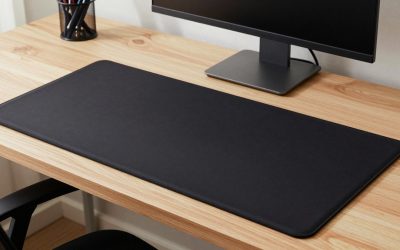
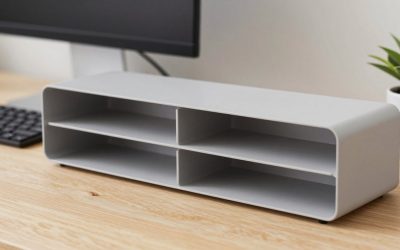
See also: Best Gaming Desk Pads for Full Desk Coverage • Best Desk Organizers Under $30: Match the Organizer to Your Clutter
Under desk cable trays are generally sold by their overall length. The useful interior space can be slightly smaller because of side rails, mounting brackets, mesh, or a rear lip. Check both the outside measurements and the internal opening before ordering.
| Tray size | Typical outside dimensions | Best for | Approximate capacity |
|---|---|---|---|
| Small | 16 x 4 x 2 in (40.6 x 10.2 x 5.1 cm) | Laptop desks, one monitor, and a compact power strip | Power strip, 3 to 5 cables, and one adapter |
| Medium | 24 x 5 x 3 in (61 x 12.7 x 7.6 cm) | One or two monitors and a standard home-office setup | Power strip, 5 to 8 cables, and 2 to 3 adapters |
| Large | 30 x 5.5 x 3.5 in (76.2 x 14 x 8.9 cm) | Dual monitors, desktop computers, and standing desks | Large surge protector, 8 to 12 cables, and several adapters |
| Extra large | 36 x 6 x 4 in (91.4 x 15.2 x 10.2 cm) | Gaming stations, multi-monitor setups, and shared workstations | Oversized power strip, 10 or more cables, and bulky chargers |
A medium 24- or 25-inch tray is the most versatile choice for a single workstation. A 36-inch option offers more room for routing, but it may not fit between desk legs. Some trays list length without including clamp brackets; allow an additional 1 to 2 inches (2.5 to 5.1 cm) at each end when checking clearance.
Width and depth
Tray width describes how far the basket extends from front to back under the desktop. A 4-inch-wide tray works for loose cables and a slim power strip. Choose 5 to 6 inches for a surge protector, power bricks, or a cable box. Depth describes the vertical space available for cables. A 2-inch-deep tray is low-profile, while a 3- to 4-inch-deep tray is better for thick cords and adapters.
Weight capacity
Many clamp-on trays support approximately 10 to 22 pounds (4.5 to 10 kg), depending on the clamp, desktop thickness, and mounting design. A power strip and cables often weigh less than 8 pounds (3.6 kg), but several large laptop adapters can add weight quickly. Do not treat a tray’s capacity as permission to store books, tools, or other heavy objects. For a heavy setup, use a screw-mounted steel tray installed into a suitable desktop.
How to Measure Your Space
- Measure the usable width. Measure between the desk legs, drawer unit, frame, and any lifting columns. Subtract at least 4 inches (10.2 cm) from the result so the tray has about 2 inches (5.1 cm) of side clearance on both ends.
- Check the desktop thickness. Clamp-on trays often fit desktops from about 0.4 to 2.4 inches (1 to 6 cm) thick, but the range varies. Measure the desktop edge, including any bevel or underside trim.
- Measure the underside clearance. Identify crossbars, modesty panels, drawers, and keyboard mechanisms. A tray that is 4 inches (10.2 cm) deep may not fit behind a front apron or below a sit-stand frame.
- Measure the power strip. Record its length, width, height, plug orientation, and cord exit location. A power strip that is 12 inches (30.5 cm) long needs a tray with enough internal length, not merely a 12-inch outside measurement.
- Count bulky adapters. Measure the largest charging brick and allow room for its cord to bend. Add roughly 1 inch (2.5 cm) of height above the tallest adapter so plugs are not pressed against the desktop.
- Plan for movement. For a standing desk, measure the cable path at both the lowest and highest desk positions. Keep at least 12 to 18 inches (30.5 to 45.7 cm) of loose cable below or behind the tray, depending on the desk’s travel.
- Confirm access to outlets. Leave space to reach the power switch and unplug devices. A tray that completely encloses a surge protector can make resetting it inconvenient.
By Room or Use Case
Home office
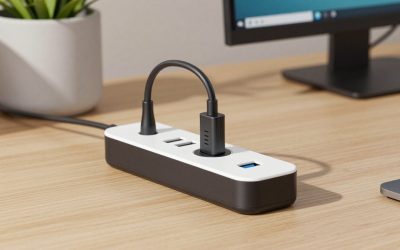
A 24-inch tray is usually sufficient for a laptop, one monitor, a USB hub, and a six-outlet power strip. Choose a 5-inch width if the setup includes a docking station or two charging bricks. A no-drill clamp tray is useful for rented spaces and desks with finished wood surfaces. Prices commonly range from $14 to $30 for this size.
Dual-monitor workstation
Choose a 30- to 36-inch tray, particularly when each monitor has a separate power cable and video cable. A width of at least 5 inches (12.7 cm) prevents the power strip and adapters from stacking too tightly. If your desk is narrower than 48 inches (121.9 cm), verify that a long tray will not interfere with the legs or monitor-arm clamps.
Standing desk
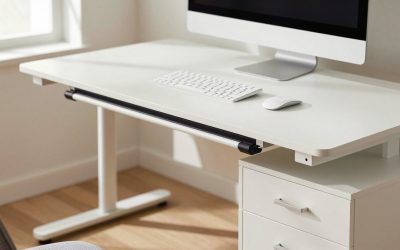
Prioritize cable capacity and clearance over a low-profile design. A 30- or 36-inch tray can hold the power strip near the center of the desk while cables rise to the monitors. Look for rounded edges, a secure clamp, and a tray that remains stable when the desktop moves. The tray should not obstruct the lifting columns or collide with a wall, cabinet, or cable-management spine.
Gaming setup
A large tray measuring about 30 to 36 inches long and 5 to 6 inches wide is appropriate for a gaming PC, monitor, speakers, controller charger, and networking equipment. Allow extra space for thick HDMI, DisplayPort, Ethernet, and power cables. Separate low-voltage signal cables from power cords where practical, and avoid bending premium video cables sharply at the tray opening.
Small desk or student workspace
Use a 16- to 20-inch tray if the desk is less than 40 inches (101.6 cm) wide or has drawers underneath. A compact basket keeps a small power strip and laptop charger off the floor without reducing legroom. Measure carefully around chair clearance; a tray that projects too far forward can contact your knees.
Shared workstation
A 36-inch tray or two separate 18-inch trays can serve two users. One long tray is simpler for a shared surge protector, while two trays allow each person to manage individual chargers. Check the desk’s total load rating if the tray is attached to a lightweight laminate or folding table.
Common Sizing Mistakes
- Buying by desk width alone: A 60-inch desk may have only 42 inches of open underside space because of legs, drawers, or a support frame.
- Ignoring internal dimensions: Exterior measurements include rails and brackets. Compare the usable basket opening with the power strip and largest adapter.
- Choosing a tray that is too shallow: A 2-inch tray may hold thin cords but fail to accommodate a tall surge protector or sideways plugs.
- Forgetting clamp clearance: Rear aprons, beveled edges, and cable grommets can prevent a clamp from sitting flat.
- Leaving no cable slack: A fixed-length cable can pull out when a monitor arm moves or a standing desk rises.
- Overloading a clamp tray: Keep the power strip and adapters within the manufacturer’s stated capacity. Heavy objects can loosen clamps or damage the desktop.
- Blocking controls: Do not place a tray where it covers a power-strip switch, reset button, or outlet access point.
FAQ
What is the best under desk cable tray size?
For most home offices, choose a tray about 24 to 25 inches long, 5 inches wide, and 3 inches deep (61 to 63.5 x 12.7 x 7.6 cm). Move to 30 or 36 inches when you have dual monitors, several adapters, or a standing desk.
How much longer should a cable tray be than the power strip?
Allow at least 2 inches (5.1 cm) of extra internal length beyond the power strip. For example, a 14-inch (35.6 cm) power strip needs roughly 16 inches (40.6 cm) of usable tray length. More space is helpful when plugs exit from both ends.
Will a cable tray fit any desk?
No. Check desktop thickness, underside clearance, leg spacing, and the clamp’s minimum and maximum opening. Clamp trays may not fit desks with thick aprons, glass tops, tapered edges, or very narrow rear ledges. Screw-mounted trays require a desktop that can safely accept fasteners.
Is a 36-inch cable tray too large?
Not necessarily. A 36-inch tray is practical for multi-monitor, gaming, and standing-desk setups, but it needs adequate clearance. Measure the open underside first and keep the tray away from legs, drawers, lifting columns, and the desk’s movement path. For a typical single-monitor workspace, it may provide more capacity than necessary.
Ready to decide? Our #1 pick for 2026 is the Small.
Live price & availability on Amazon.
Related Reviews & Guides



Desk Organizer Tray Drawer Review

6 Best Desk Bookshelf Ikeas 2026