Last Updated: October 18, 2026
If you just need to show up clearly on Zoom, Teams, or Google Meet, you do not need to spend much. A basic PC camera in the $25 to $50 range will usually beat a three-year-old built-in laptop camera, especially in a dim home office. The catch is that “low price” covers a huge range of quality, from perfectly usable to frustratingly blurry.
I have tested a lot of these budget cameras for daily work calls. The difference is rarely resolution on the box. Almost all of them say 1080p. The real difference is lens quality, focus type, and how they handle low light and backlight from a window. Get those wrong and you look washed out or soft no matter what resolution is listed.
📄 In This Review
What a low price actually gets you
Most low-priced PC cameras share the same formula: 1080p sensor, fixed focus, single or dual noise-reducing microphone, and a clip that fits on a laptop lid or external monitor. Plug-and-play over USB-A, no drivers on Windows and Mac. That is enough for head-and-shoulders framing at a desk.
What you do not get at this price is good automatic exposure, fast autofocus, or a wide dynamic range. If you sit with a bright window behind you, a cheap camera will either blow out the window to white and darken your face, or expose for your face and make the background glow. There is no HDR to save it. You also do not get useful digital zoom — it just crops and gets grainy.
Audio is the other trade-off. The built-in mics are fine for quiet rooms, but they pick up keyboard clicks, fan noise, and echo in hard rooms. If you take calls all day, a separate USB headset or even wired earbuds will do more for how professional you sound than a more expensive camera.
The three types of cheap PC cameras
See also: Best Monitor for MacBook Air: Two USB-C 4K Screens and Six Adapter-Dependent Alternatives • Best Monitor for MacBook Pro: Eight Listings Sorted by Cable, Sharpness and Scaling
Ignore brand names for a minute. Almost all sub-$50 cameras fall into one of these three buckets. Pick by how you work, not by megapixels.
| Type | Typical price | Strengths | Weaknesses | Best for |
|---|---|---|---|---|
| Basic 720p / 1080p fixed-focus | $20-$30 | Cheap, light, works on old laptops | Soft image beyond 3-4 feet, weak low light | Students, second computer, occasional calls |
| 1080p fixed-focus with dual mic + privacy shutter | $30-$45 | Sharper at desk distance, better voice pickup, shutter included | No autofocus, struggles with backlight | Home office, customer support, daily standups |
| 1080p autofocus with auto light correction | $45-$65 | Holds focus if you move, better in mixed light | Focus can hunt/pulse, plastic build, mic still average | Teachers, coaches, anyone who stands or whiteboards |
For most desk workers, the middle bucket is the sweet spot. A 1080p webcam with microphone and privacy shutter costs little more than the cheapest option but gives you more consistent sharpness and less fiddling.
When the cheaper option is fine
If your calls are mostly internal — team check-ins, 1:1s, job interviews where audio matters more than video — buy cheap and spend 10 minutes on setup. Put a lamp in front of you, not behind you. Set the camera at eye level with books or a monitor arm. In Zoom or Teams, turn off “touch up appearance” and “HD” if your connection stutters, and lock exposure if your app allows it.
Cheap is also fine for kids’ school laptops and shared family PCs. Image quality will not be perfect, but durability and simplicity matter more there. Look for a metal hinge rather than thin plastic, and a lens cover you will actually use. Small rooms with echo will make any built-in mic sound hollow — sit closer, within 2-3 feet, and turn down speaker volume to prevent feedback.
Mac users in particular often do not need to overspend. Modern MacBooks already handle color well, and macOS will recognize any UVC webcam without drivers. An inexpensive USB webcam for MacBook home office is usually enough unless you need Center Stage-style tracking or want to shoot in 4K for content.
Common failure modes to watch for
Low-priced cameras fail in predictable ways. Focus hunting is the most annoying: the image pulses in and out every few seconds because the contrast autofocus cannot lock in low light. If you sit still at a desk, fixed focus avoids this entirely and looks sharper in practice.
Second is color shift under office LEDs. Faces go green or orange, especially on cheaper sensors. Most meeting apps let you turn off auto white balance or apply a filter, but you cannot fully fix it. Adding a $15 daylight desk lamp in front of you does more than upgrading the camera.
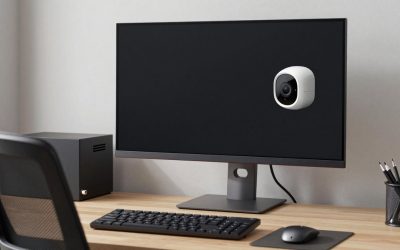
Third is mount wobble. Thin clips slip on curved ultrawide monitors or thick laptop lids. Check that the clip opens wide enough for your screen and has rubber pads. If you use a laptop on a stand, mount the camera on the external monitor instead — otherwise coworkers stare up your nose and see every keystroke shake.
Fourth is USB quirks. Very cheap cameras sometimes ship with short, stiff USB-A cables and no USB-C adapter. If you only have USB-C ports, factor in an adapter. On older office desktops with USB 2.0 hubs, you may get dropped frames at 1080p/30. Plugging directly into the computer instead of a cheap hub usually fixes it.
What to buy for work from home
For a single person at a desk in a quiet room: get a 1080p fixed-focus model with a 75- to 80-degree field of view. That frames head and shoulders without showing the whole messy room. Wider 90-degree lenses are useful only if two people share one camera. A wide angle webcam for home office video calls sounds flexible, but on a cheap sensor the edges get soft and distorted.
For teaching, tutoring, or demos where you move: spend slightly more for autofocus. Fixed focus goes blurry as soon as you lean back to show paperwork. Just be prepared to add light — autofocus needs light to work. A window to your side plus an overhead light is often enough. Avoid sitting with a ceiling fan light directly behind your head.
For laptops that travel: weight and cable matter. Some budget cameras have permanently attached 5-foot cables that tangle in a bag. If you commute, consider a compact model with a fold-flat clip and a short cable, or just use the built-in camera on the road and keep the USB camera docked at home.
Who should not buy the cheapest
Do not buy the absolute cheapest if you present to clients, record training videos, or live-stream. Low-bitrate sensors smear motion and create blocky backgrounds. You will also notice lag when you gesture. In that case, step up to a mid-range 1080p/60 or 2K camera with a larger sensor, or use a mirrorless camera as a webcam if you already own one.
Also skip ultra-cheap if your office is very dark or you work nights. Small sensors need light. No software “low-light correction” can invent detail that is not there — it just brightens noise. A cheap camera plus a decent key light will still beat an expensive camera in the dark.
FAQ
Is 1080p enough for Zoom and Teams?
Yes. Both platforms compress video heavily, usually to 720p or lower for group calls. Sharp 1080p with good light looks better than soft 4K in a dark room. Spend effort on lighting and stable internet first.
Will a cheap PC camera work on Mac and Chromebook?
Usually yes if it says UVC or driver-free. It should show up in FaceTime, Zoom, Meet, and Teams without software. Privacy shutters and mic volume work, but any Windows-only effects app for background blur or filters will not.
Why do I look blurry even though the box says 1080p?
Most often you are outside the fixed focus range, too far away, or in low light. Sit 2 to 4 feet away, add frontal light, and wipe the lens. If the image still pulses, turn off autofocus or auto-exposure in your meeting app if available.
Should I use the webcam mic or a headset?
Use a headset or earbuds for any call longer than 15 minutes or in a noisy room. Webcam mics are 2 to 3 feet away and pick up room echo. They are fine as a backup, but you will sound clearer and less tiring to listen to with a mic near your mouth.
Related Reviews & Guides

Best CPUs for Office Work in 2026: Fast, Quiet Options
Best Webcam for MacBook Pro USB C