Last Updated: September 18, 2026
Choosing between an LED desk lamp and a fluorescent desk lamp is less about picking the newest technology and more about matching the light to your room, routine, and tolerance for maintenance. An LED lamp is usually smaller, cooler, more efficient, and easier to dim. A fluorescent lamp can still make sense when you want broad, evenly distributed light from a larger fixture or already own compatible bulbs and parts.
The real decision is whether you want a compact task light that uses little energy and adapts easily to modern home offices, or a traditional fixture that may provide a familiar, diffuse glow at a potentially low upfront cost. Below is a practical comparison of led desk lamp vs fluorescent desk lamp choices for home use in 2026, including comfort, five-year cost, and the needs of different households.
As an Amazon Associate we earn from qualifying purchases at no extra cost to you.


📄 In This Review
Quick Verdict
For most buyers, an LED desk lamp is the better choice. LEDs commonly use 5 to 12 watts for desk-level task lighting, turn on instantly, last for many years, and are available with dimming, adjustable color temperature, USB charging, and clamp mounts. They also produce relatively little heat compared with older fluorescent fixtures.
Choose a fluorescent desk lamp if you prefer a broad, diffuse light source, need an inexpensive replacement bulb for a fixture you already own, or find a used commercial-style lamp that meets your needs. Fluorescent lamps are not automatically uncomfortable or inefficient, but they tend to be larger, less flexible, and more maintenance-intensive. Look for a modern electronic ballast and a high color-rendering bulb rather than an older flickering fixture.
Side by Side
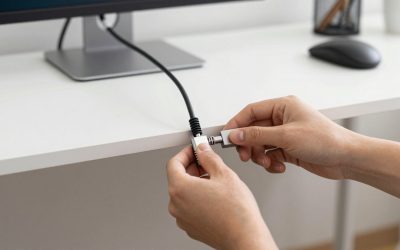
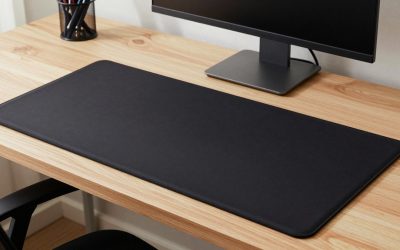
See also: Best Ways to Organize Cables Behind a Desk • Best Gaming Desk Pads for Full Desk Coverage
| Feature | LED desk lamp | Fluorescent desk lamp |
|---|---|---|
| Comfort | Easy to dim; many models offer 3,000K–6,500K settings and low-glare diffusers | Can provide soft, broad light, but older ballasts may hum or visibly flicker |
| Durability | Often rated for about 25,000–50,000 hours; integrated LEDs may not be replaceable | Bulbs commonly last about 7,500–20,000 hours; tubes and ballasts eventually need replacement |
| Price range | About $15–$100 for home desk models; premium architectural lamps can cost more | About $20–$150 for desk fixtures, with replacement tubes often costing $5–$20 |
| Maintenance | Usually limited to dusting; the whole lamp may need replacement if its LED module fails | Requires occasional bulb replacement and possible ballast service |
| Space needed | Many are 4–8 inches wide at the base or use a clamp; arms may reach 15–20 inches | Often needs a 6–10-inch base and a wider 18–24-inch shade or tube housing |
| Look | Minimal, modern designs with thin arms and touch controls are common | More traditional, utilitarian, or office-like in appearance |
| Resale | Feature-rich, clean, working models are generally easier to give away or resell | Demand is narrower, especially for bulky fixtures or lamps with aging ballasts |
| Best for | Home offices, bedrooms, small desks, crafting, reading, and adjustable task lighting | Large work surfaces, diffuse illumination, and owners who already have a compatible fixture |
Where LED Desk Lamp Wins
Energy use is the clearest advantage. A typical LED desk lamp uses 5–12 watts, while a fluorescent desk lamp may use roughly 13–32 watts once the bulb and ballast are considered. The difference is modest for a single lamp, but it adds up when the light operates for several hours every day.
LEDs also offer more control. Basic models may have three brightness levels, while more advanced lamps provide stepless dimming. Adjustable color temperature is useful when one lamp serves multiple purposes: a warm 3,000K setting can feel relaxed for evening reading, while a neutral 4,000K setting is practical for paperwork. A cooler 5,000K–6,500K mode may suit detailed tasks, although it is not automatically better for concentration.
Modern LEDs are easy to fit into limited spaces. A slim base may take up less than 8 inches of desk depth, and a clamp model can attach to a surface without consuming any desktop area. For example, the Airlonv LED Desk Lamp with Clamp, 17" Stepless Dimming Light, Black is listed at $19.92, while the Motumen Led Desk Lamp for Home Office, Eye-Care Desk Light Clamp, Black is listed at $21.98. These kinds of clamp designs are especially useful on narrow desks, shelves, and shared workstations.
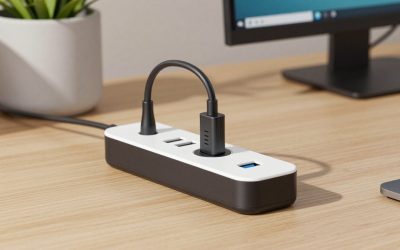
Convenience features are another advantage. Some LED lamps include USB-A or USB-C charging ports, memory settings, touch controls, timers, and flexible necks. The LED Desk Lamp with USB Ports, Touch Desk Lamps for Home Office with 5 Modes is listed at $16.97, placing several useful features in the affordable category. The important buying detail is to check whether the USB port provides charging power only or also supports data; desk lamps almost always provide charging only.
LEDs are also less likely to become a hot, uncomfortable presence beside your hand or monitor. They still generate heat inside their electronics, but a well-designed lamp directs that heat into a metal housing or heat sink rather than into a large, hot bulb surface. Look for a weighted base, stable joints, and a diffuser that hides harsh points of light.
Where Fluorescent Desk Lamp Wins
Fluorescent lighting can be a good fit when you want a broad wash of light instead of a concentrated beam. A long fluorescent tube spreads light across a wider area, which can be helpful for drafting, sewing, model-making, or a large paper-covered workbench. The effect is often softer than an exposed, small LED source.
Fluorescent fixtures can also be economical when purchased secondhand or when you already own one. Replacing a tube may cost less than replacing an integrated LED lamp, particularly if the fixture is sturdy and the ballast is still in good condition. Standardized replacement bulbs also mean you are not tied to a proprietary LED module.
However, inspect an older fluorescent lamp carefully. A slow start, buzzing, darkened tube ends, or repeated flickering can indicate a worn bulb or ballast. Electronic ballasts generally start faster and operate more quietly than old magnetic ballasts, but performance varies by fixture. Fluorescent bulbs contain a small amount of mercury, so they should be recycled through an appropriate household hazardous-waste or lamp-recycling program rather than placed in ordinary trash where local rules prohibit it.
Cost Over 5 Years
Upfront prices overlap, so the lamp’s expected usage matters more than the sticker price alone. Consider a simple example: an LED lamp costing $25 and using 8 watts, compared with a fluorescent lamp costing $35 and using 20 watts. At four hours per day for five years, the LED would consume about 58 kilowatt-hours. The fluorescent would use about 146 kilowatt-hours.
At an assumed electricity rate of $0.18 per kilowatt-hour, that equals approximately $10.50 for the LED and $26.30 for the fluorescent. The energy difference is therefore about $15.80 over five years. Add one $8 fluorescent replacement bulb and the fluorescent option could cost roughly $18 more over the period, before considering ballast replacement. Actual totals depend on local electricity rates, daily hours, bulb life, and whether the lamp is left on unnecessarily.
Do not assume every LED is automatically the cheapest long-term choice. A $90 premium lamp may never recover its extra purchase price through energy savings compared with a $20 fluorescent fixture. Buy premium LED features for their convenience, construction, adjustability, and light quality—not solely for electricity savings.
Which One for Your Home
Small apartment
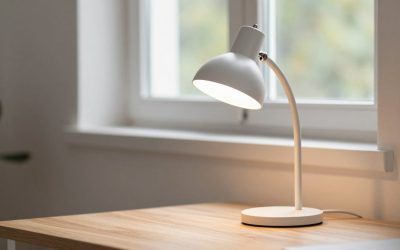
Choose an LED lamp, especially a clamp model or one with a base no wider than about 7 inches. It will preserve desk space, use less power, and can serve as a reading, work, or bedside light. A folding arm or adjustable head makes storage easier when the desk has to serve several purposes.
Family with kids or pets
LED is usually the safer practical choice because many models have cool-touch housings and sturdy, low-profile designs. Prioritize a heavy base, concealed or protected controls, a short exposed cord, and joints that cannot be easily pulled downward. A clamp can reduce the chance of a lamp being knocked over, but verify that the clamp fits the desk thickness securely.
Rental
An LED desk lamp avoids drilling and provides flexibility if the room layout changes. USB ports can reduce cord clutter by charging a phone at the desk, while dimming lets one lamp work in a bedroom or living room without adding a harsh overhead light. Keep the original packaging if you expect to move frequently.
Long-term home
Either technology can work, but LED is the better default for a new purchase. Choose a model with a replaceable power adapter, a strong hinge, a diffuser, and a color temperature that suits your routine. If you already own a reliable fluorescent fixture with inexpensive, readily available tubes, continuing to use it can be more sensible than replacing it solely for the sake of upgrading.
FAQ
Is an LED desk lamp better for your eyes than a fluorescent desk lamp?
Neither technology is automatically better for every person. Comfort depends on brightness, glare, flicker, color quality, and how the lamp is positioned. Choose a dimmable lamp, aim the light at your work rather than your eyes, and avoid a bright source reflected directly in a screen. A high-quality fluorescent fixture with an electronic ballast can be comfortable, while a poorly diffused LED can feel harsh.
Which lamp lasts longer?
LEDs generally last longer on paper, with many desk lamps rated around 25,000–50,000 hours. Those figures describe the light source under stated conditions, not necessarily the life of every switch, power adapter, or hinge. Fluorescent tubes commonly last around 7,500–20,000 hours, and the ballast may fail before the tube reaches its maximum rating.
Do fluorescent desk lamps use more electricity?
Usually, yes. A fluorescent desk fixture often uses about 13–32 watts, while an equivalent LED desk lamp commonly uses 5–12 watts. The actual difference depends on the fixture’s ballast, brightness, and operating schedule. For occasional use, the savings will be small; for a lamp used four or more hours every day, LED’s lower wattage is more meaningful.
What should I look for when buying an LED desk lamp?
Check the lamp’s minimum and maximum brightness, color-temperature range, arm reach, base or clamp dimensions, warranty, and power-adapter length. For detailed work, a color-rendering index of 80 or higher is a reasonable starting point. Also confirm that “eye-care” claims are supported by practical features such as flicker reduction, a diffuser, and adjustable brightness rather than relying on the label alone.
Related Reviews & Guides
6 Best Adjustable Height Standing Desk Electrics 2026
Best Clamp on Desk Lamp for Thick Desks in 2026: Compared and Ranked