Last Updated: October 18, 2026
Under $75 is the sweet spot for work webcams. You don’t get perfect low-light performance or true studio color, but you do get sharp 1080p, usable mics, and reliable plug-and-play USB that beats almost every built-in laptop camera. For Zoom, Teams, Meet, and general home office use, that’s enough.
The trick is not overbuying resolution. A good 1080p sensor with decent autofocus and exposure control will look better than a cheap 2K or 4K camera that struggles with focus hunting and grain. Spend for better lenses and microphones, not bigger numbers on the box.
📄 In This Review
What you actually get under $75
Most options in this range are 1080p at 30fps over USB-A, with a clip mount for a laptop lid or external monitor. Almost all are UVC-compliant, which means no driver install on Windows 10/11 and macOS Ventura, Sonoma, and Sequoia. You plug in, select the camera in Zoom or Teams, and it works.
What separates good from bad here is not megapixels. It’s autofocus behavior, auto-exposure speed when a window is behind you, microphone pickup at 3-4 feet, and how well the mount stays put. Cheap models fail in the same ways: washed-out face when backlit, soft focus if you lean back, tinny audio, and a clip that slowly droops on a thin MacBook Air lid.
If your laptop camera is from the last 3 years and you mostly take calls in a bright room, be honest: you may not need an upgrade. Where an external under $75 helps is if your built-in is 720p, positioned too low, crops badly, or your team has told you you’re blurry or quiet. A $35-$45 camera fixes 80% of that.
The three types worth buying
See also: Best Monitor for MacBook Air: Two USB-C 4K Screens and Six Adapter-Dependent Alternatives • Best Monitor for MacBook Pro: Eight Listings Sorted by Cable, Sharpness and Scaling
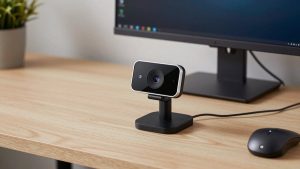
1. Basic 1080p fixed-focus webcam. This is the cheapest option that is still worth it for work. No autofocus motor to hunt, usually a 65-75 degree field of view, single or dual mics. Image is sharp if you sit 2-3 feet away and don’t move much. It’s ideal for a dedicated desk where you sit in the same spot every day.
Trade-off: if you lean back in your chair, stand up to whiteboard, or share the frame with someone else, you will go soft. Fixed focus is set for one distance. Also, low-light performance is basic. In a dim spare bedroom at night, expect grain and a darker image unless you add a $15 desk lamp in front of you.
Buy this if you want the smallest spend for a clearly better-than-laptop picture. A simple budget 1080p webcam for laptop work is fine for daily standups, 1:1s, and customer calls in good light.
2. 1080p autofocus webcam with dual mics and privacy shutter. This is the best pick for most home office workers under $75. You get autofocus that keeps you sharp from about 12 inches to 8 feet, wider 78-90 degree lens options, better noise reduction, and often a physical shutter. Mics are still small electret capsules, but stereo placement helps with clarity.
Trade-off: autofocus can hunt in low light or when you gesture a lot with your hands. Good models lock quickly; bad ones pulse in and out every 10 seconds. Look for reviews that specifically mention Teams or Zoom focus stability, not just photo samples. Also expect a slightly wider face distortion at the edges on 90-degree models – keep yourself centered.
Buy this if you move around, use a sit-stand desk, or take calls in mixed lighting. An autofocus 1080p webcam with dual mics is the workhorse choice for managers, teachers, recruiters, and anyone on camera 3+ hours a day.
3. Budget 2K / QHD webcam. You can find 1440p models under $75 now, usually from value brands. In bright, even light they do resolve more detail – text on a shirt, hair, background bookshelf. Downscaled to 1080p for Zoom, they can look slightly cleaner than native 1080p.
Trade-off: this is where most disappointment happens. Many cheap 2K sensors are noisier in dim rooms, need more USB bandwidth and CPU for full resolution, and Teams will often compress them back to 720p or 1080p anyway. Autofocus and auto white balance are also less predictable than on mature 1080p models. Only buy if you have good front lighting and a relatively recent laptop.
Buy this if you record Loom videos, do demos where sharpness matters, and you control your lighting. Otherwise, a proven 1080p autofocus model will look more consistent day to day.
| Type | Best for | Where it fails | Typical price |
|---|---|---|---|
| 1080p fixed-focus | Same-desk workers, bright rooms, minimal fuss | Soft when you move, grainy at night | $30-$45 |
| 1080p autofocus + dual mic | Most home office, sit-stand, long meeting days | Can focus-hunt in low light, wide lens distorts edges | $45-$70 |
| Budget 2K / QHD | Good lighting, recordings, detail-critical calls | Noisy in dim rooms, often downscaled by apps | $60-$75 |
Mac and laptop notes that matter
On Macs, most sub-$75 webcams work instantly, but you lose Windows-only tuning apps. That means you cannot always turn off auto-focus, lower sharpness, or update firmware. If you use a MacBook with only USB-C, factor in a short USB-C adapter or hub – a surprising number of returns are just cable confusion, not camera failure. Mount weight matters too. Heavier models with glass lenses can tip forward on a MacBook Air lid. Look for a foldable clip with rubber grip and a tripod thread if you use an external monitor.
On Windows laptops, check whether your dock or hub passes enough power. A webcam plugged into an unpowered hub alongside a headset and external SSD will sometimes drop to lower resolution or freeze. Plug directly into the laptop for testing first. In Teams, go to Settings – Devices and confirm it lists 1080p. Teams defaults to power-saving modes that cap at 720p unless you change it.
Field of view is personal. For a small office or laptop 2 feet from your face, 65-78 degrees keeps you natural and hides mess. For a larger desk where you sit 4 feet back, or if you interview with two people in frame, 85-90 degrees helps. Anything advertised over 95 degrees in this price range usually looks stretched and cheap.
Setup matters more than the model
I have tested $40 cameras that looked like $120 cameras after three changes: face a window or put a soft white lamp behind your monitor at eye level, move the camera to eye level within arm’s reach, and turn off overhead-only lighting that creates dark eye sockets. No sensor under $75 can fix strong backlight – if you sit with a bright window behind you, you will be a silhouette regardless of specs.
Audio is the other hidden failure. Built-in webcam mics are fine in a quiet room at 2-3 feet, but they pick up keyboard clatter, HVAC, and echo in hard rooms. If people say you sound distant, move the camera closer rather than boosting mic gain in Windows or macOS, which just adds hiss. For noisy homes, a wired earbud mic will beat any webcam mic at this price.
If you want one upgrade path, buy the mid-range 1080p autofocus type now and add light first. A daylight-balanced desk lamp bounced off a wall does more for under $75 video quality than jumping from 1080p to 2K. If you later need framing flexibility, look at webcams with a standard tripod mount so you can raise them to eye level on a small stand.
FAQ
Is 1080p enough for work in 2026?
Yes for live calls. Zoom, Teams, and Meet compress video heavily, usually to 720p or 1080p, so a stable, well-exposed 1080p feed looks better than an unstable higher-resolution feed. Only go higher if you record locally and have good light.
Why do I look blurry even with a new webcam?
Usually distance, low light, or a dirty lens. Sit within 2-4 feet, add front light, wipe the lens with a microfiber cloth, and check the app is not using a beauty blur or virtual background that softens edges. Test with autofocus locked if your camera app allows it.
Will a cheap webcam work with MacBook and Teams?
Most USB UVC webcams work on macOS without drivers, and Teams will list them under Devices. Use a quality USB-C adapter, plug in before launching Teams, and quit Photo Booth or FaceTime if they are holding the camera.
Should I use the webcam mic or a headset?
Use the webcam mic only in a quiet, carpeted room close to the camera. For open offices, kitchens, kids in the background, or calls over 30 minutes, a headset or USB earbuds will be clearer and less fatiguing for listeners.
Related Reviews & Guides


Best Video Conference Camera for Mac
5 Best Laptop Docking Station Dual Screens 2026