Last Updated: September 18, 2026
Buying a desk lamp can seem simple until the light is too dim, the shade blocks your screen, the base takes up half your workspace, or the touch controls activate every time you reach for a notebook. The most common mistake is choosing by appearance or advertised brightness alone. A lamp that looks attractive in a product photo may have a short arm, a narrow light spread, a glare-producing diffuser, or a cord that is too short for your desk.
The other mistake is assuming that more settings automatically mean better performance. Five color modes are useful only if the lamp stays stable, dims smoothly, and puts light where you need it. Before comparing finishes and features, decide how much space you have, what kind of work you do, and whether you need focused task lighting or a softer bedside glow. This guide explains what to look for in desk lamps in 2026, with practical specifications that make comparison easier.
As an Amazon Associate we earn from qualifying purchases at no extra cost to you.


📄 In This Review
Decide These 3 Things First
- Where will the lamp sit? Measure the usable area beside your keyboard, monitor, or bed. A compact lamp may need a base no wider than 5 to 6 inches, while a clamp lamp can preserve valuable surface space.
- What will you use it for? Reading, drawing, paperwork, video calls, and ambient lighting each require different beam coverage and brightness. A reading lamp needs more directed light than a bedside lamp.
- How much adjustment do you need? Decide whether you want a fixed shade, a swiveling head, a height-adjustable arm, or multiple joints. Every additional joint can improve positioning, but it also creates another place for looseness or sagging.
Once those decisions are clear, compare the following factors in order of importance.
Size and Placement
See also: Best Gaming Desk Pads for Full Desk Coverage • Best Desk Organizers Under $30: Match the Organizer to Your Clutter
Start with the lamp’s footprint, not its maximum height. For a small desk or nightstand, look for a base measuring about 4 to 6 inches wide. A standard home-office desk can usually accommodate a 6- to 8-inch base, while larger architectural lamps may need 8 to 10 inches or a clamp mount.
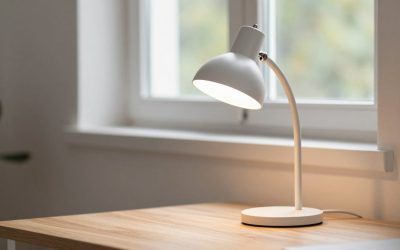
Height matters because the light source should illuminate your work without sitting directly in your line of sight. A useful general range is 14 to 22 inches tall for a desk lamp. Lamps under 14 inches can work on a bedside table or for close reading, but they may cast a small pool of light. Models around 18 to 22 inches provide better coverage for paperwork and keyboards.
Check the arm and shade dimensions as well. A lamp with a 10-inch reach may not extend far enough over a large monitor or drawing surface. For a desk at least 48 inches wide, an adjustable reach of 16 to 24 inches is more flexible. If the lamp sits to the side of a monitor, position it so the shade is slightly above eye level and the beam crosses the work area rather than shining toward your face.
Also account for the cord. A 5- to 6-foot cord is generally easier to route than a 3-foot lead, particularly when the outlet is behind the desk. USB charging ports are convenient, but they should not be the reason you accept a poor light position.
Material and Finish
Material affects stability, heat management, cleaning, and appearance. Steel and aluminum are common choices for task lamps because they are durable and can support adjustable arms. Aluminum is lighter, while steel often feels more substantial. Plastic is perfectly suitable for an affordable lamp, especially when the shade and controls are well designed, but thin plastic can flex at the joints and show scratches more quickly.
Pay attention to the base construction. A weighted metal base is preferable for a tall, articulated lamp. As a rough guide, a compact lamp base may weigh 1 to 2 pounds, while a tall adjustable model benefits from 2.5 to 5 pounds. The lamp should not tip when the arm is extended over the edge of the desk.
Finish is mostly a style decision, but it has practical implications. Matte black and dark painted finishes can show dust, fingerprints, and scratches. Brushed metal tends to hide everyday marks. Glossy finishes are easy to wipe but can create distracting reflections if the lamp is placed near a monitor or glass desktop.
Construction and Adjustability
Good construction is easy to notice in the joints. Move the shade and arm through their full range before tightening anything. The lamp should hold its position without slowly dropping, and the joints should offer resistance without requiring excessive force. A head that rotates at least 90 degrees is useful; a head that swivels 180 degrees or more offers better flexibility for shared desks.
Look for a base with rubber or silicone feet. These prevent sliding and protect wood, laminate, and glass surfaces. A clamp lamp should specify the maximum desk thickness it accepts. Many clamps fit surfaces up to roughly 1.5 to 2.5 inches thick, but that range varies. The clamp should have a broad contact pad rather than a small metal edge.
Controls should be easy to use without looking. A physical switch is dependable and avoids accidental activation. Touch controls are convenient for bedside use, but they can be less predictable if the surface is wet or if the lamp is placed where your hand frequently brushes it. If the lamp has a memory function, it should return to your preferred brightness and color temperature after being switched off.
Comfort and Performance
For most desk work, brightness between 400 and 800 lumens is a practical target. Around 300 to 500 lumens can be sufficient for reading near the lamp, while a large work surface may benefit from 700 to 1,000 lumens. More brightness is not automatically better: an exposed LED or highly focused beam can create glare even when the measured output is modest.
Choose a lamp with a diffuser or a recessed light source to reduce harsh reflections. This is especially important if you use a glossy desk, tablet, or monitor. An adjustable shade is helpful because you can direct light onto paperwork without lighting the screen.
Color temperature affects comfort. Warm light around 2,700 to 3,000K is relaxing and works well beside a bed. Neutral light from about 3,500 to 4,000K is versatile for reading and general office work. Cooler light around 5,000 to 6,500K can look crisp for detailed tasks, but some people find it too stark in the evening. A lamp with a selectable range is useful only if the transitions are smooth and the settings are clearly labeled.
For LED lamps, an advertised lifespan of 25,000 to 50,000 hours is common, but treat it as a manufacturer estimate rather than a guarantee. If color accuracy matters for art, design, or sewing, check the color-rendering index. A CRI of 80 or higher is suitable for ordinary tasks; 90 or higher is preferable when you need colors to appear more naturally.
Price Tiers
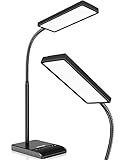
Budget desk lamps generally cost $15 to $30. At this level, expect basic plastic or light metal construction, 300 to 800 lumens, and simple dimming or color modes. The $16.97 LED lamp with USB ports and five modes represents the feature-heavy end of this category, but inspect its base size, diffuser, and charging output before buying.
Midrange lamps usually cost $30 to $75. They tend to offer sturdier arms, better weight distribution, smoother adjustment, and more consistent light. A straightforward industrial metal lamp, such as a model priced around $28.99, can be a good value if you prefer a replaceable bulb and do not need built-in dimming.
Premium lamps cost approximately $75 to $200 or more. You are paying for refined joints, improved optical diffusion, higher-quality controls, stronger warranties, and a more polished finish—not simply extra brightness. For comparison, a $29.99 800-lumen LED model may deliver plenty of light for ordinary home-office reading, while a premium model may justify its price through better adjustability and reduced glare.
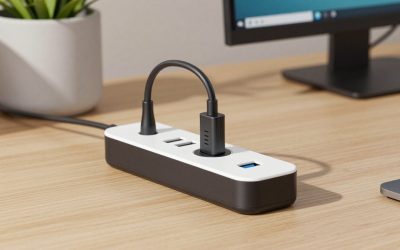
Bedside lamps with USB-A, USB-C, and AC outlets often fall between $20 and $50. A $23.99 touch lamp with charging ports can be practical, but verify the total charging power and whether the AC outlet is safely positioned away from liquids and bedding.
Warranty and Service
A basic lamp should have at least a one-year warranty. For a $75 or higher model, look for two to five years, especially if it has an integrated LED that cannot be replaced. A longer warranty does not prove better quality, but it reduces the risk of being left with a failed light engine or loose arm.
Read what the warranty covers. Some policies exclude power adapters, cosmetic damage, bulbs, or products used commercially. Confirm whether the manufacturer provides replacement parts such as adapters, shades, clamps, or LED modules. A lamp with a replaceable bulb can remain useful longer than a sealed unit, even if its initial light output is lower.
Delivery and Assembly
Most small desk lamps require little assembly, but “tool-free” can still mean attaching an arm, shade, or base. Expect 5 to 20 minutes for a compact lamp and 20 to 45 minutes for a multi-joint model or clamp system. Check whether the package includes screws, an Allen key, spare pads, and the correct power adapter.
Before ordering, check the packed dimensions and shipping weight if you live in an apartment or plan to carry the lamp upstairs. A lamp weighing 2 to 6 pounds is easy to handle; larger architectural models may weigh 8 to 15 pounds. After delivery, inspect the cord, plug, shade, and joints before discarding the packaging. Keep the box until you know the lamp is stable and free of defects.
Spec Checklist
| Spec | Budget | Mid | Premium |
|---|---|---|---|
| Typical price | $15–$30 | $30–$75 | $75–$200+ |
| Brightness | 300–700 lumens | 500–900 lumens | 600–1,000 lumens |
| Color temperature | One or two settings | 2,700–6,000K range | 2,700–6,500K with smooth adjustment |
| Height | 12–18 inches | 16–22 inches | 18–28 inches |
| Base footprint | 4–7 inches | 5–8 inches | 6–10 inches or clamp mount |
| Construction | Plastic or light metal | Steel or aluminum joints | Reinforced metal with precision joints |
| Warranty | At least 1 year | 1–2 years | 2–5 years |
Red Flags
- No lumen rating, wattage, color temperature, or dimensions are provided.
- The listing shows a bright light but does not explain whether the output is adjustable.
- The lamp has several touch modes but no physical backup switch or memory function.
- An articulated arm is tall and thin, yet the base is very light or narrow.
- The product uses an integrated LED without stating the warranty or replacement policy.
- The USB ports list no output rating, making it unclear whether they can charge a phone at a useful speed.
- Reviews repeatedly mention flickering, buzzing, heat, loose joints, or a shade that will not stay positioned.
- The cord is shorter than 4 feet for a lamp intended to sit on a full-size desk.
FAQ
How many lumens should a desk lamp have?
Choose about 400 to 800 lumens for general desk work and reading. Use closer to 800 to 1,000 lumens for a broad work surface, but prioritize diffusion and adjustability to prevent glare.
Is warm or cool light better for working?
Neutral light around 3,500 to 4,000K is the most versatile for office tasks. Warm 2,700 to 3,000K light is more comfortable at night, while cooler light may suit detailed work if it does not feel harsh to your eyes.
Are LED desk lamps worth buying?
Usually. LEDs use relatively little power, produce consistent light, and commonly last longer than replaceable incandescent bulbs. Buy a model with a diffuser, reliable controls, and a clear warranty rather than choosing solely by its advertised lifespan.
Where should a desk lamp be placed?
Place it on the opposite side of your writing hand when possible: on the left for a right-handed user and on the right for a left-handed user. Position the light above eye level and angle it toward the work surface, not directly at your monitor or face.
Ready to decide? Our #1 pick for 2026 is the Typical price.
Live price & availability on Amazon.
Related Reviews & Guides

6 Best Foldables Under Desk Treadmill 2026
How to Choose Integrated Treadmill Desk Workstations: What Actually Matters