Last Updated: September 18, 2026
- Decide These 3 Things First
- Size: Measure the Bundle, Not Just the Cord
- Material: Match Protection to the Room
- Construction: Look at the Opening and the Ends
- Comfort and Performance: Think About Daily Use
- Price Tiers: Pay for the Job, Not the Roll
- Warranty: Check What Is Actually Covered
- Delivery and Assembly: Budget Time as Well as Money
- Spec Checklist
- Red Flags
- FAQ
- Top Pick: Alex Tech 25ft – 1/2 inch Cord Protector Wire Loom Tubing Cable Sleeve Split Sleeving For USB Cable Power Cord Audio Video Cable – Protect Cat From Chewing Cords – Black
- Best Value: Alex Tech 10ft – 1/2 inch Cord Protector Wire Loom Tubing Cable Sleeve Split Sleeving For USB Cable Power Cord Audio Video Cable – Protect Cat From Chewing – Black
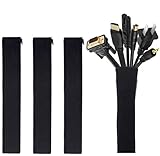
- Premium Choice: JOTO 4 Pack Cable Management Sleeve 19-20 Inches -Black
Cable sleeves look like a small purchase, but the wrong one can create a surprising number of problems. A sleeve that is too narrow will not close around your cords. One that is too loose can slide behind a desk, snag on chair legs, or collect dust. Rigid split loom may discourage a pet from chewing, while a soft fabric sleeve is better for bundling several visible cords. Neither is automatically the right choice for every room.
Buyers also commonly measure only the cable length, not the bundle diameter; confuse protective tubing with a multi-cable management sleeve; or choose a long roll when a short, finished sleeve would be easier to install. The best option depends on what you are covering, where it will sit, and how often you expect to add or remove cables. Here is what to look for in cable sleeves before you buy.
As an Amazon Associate we earn from qualifying purchases at no extra cost to you.


📄 In This Review
- Decide These 3 Things First
- Size: Measure the Bundle, Not Just the Cord
- Material: Match Protection to the Room
- Construction: Look at the Opening and the Ends
- Comfort and Performance: Think About Daily Use
- Price Tiers: Pay for the Job, Not the Roll
- Warranty: Check What Is Actually Covered
- Delivery and Assembly: Budget Time as Well as Money
- Spec Checklist
- Red Flags
- FAQ
Decide These 3 Things First
- What are you covering? A single USB cable, a power cord, a group of desk cables, and wires running along a floor need different designs.
- Do you need protection or concealment? Protective split tubing adds a tougher outer layer. Fabric and braided sleeves mainly organize and hide cables.
- How often will the bundle change? A gaming desk that changes frequently benefits from a zipper, hook-and-loop closure, or split design. A permanent television setup can use a tighter braided sleeve.
Once these choices are clear, compare the details below rather than shopping by appearance alone.
Size: Measure the Bundle, Not Just the Cord
See also: Standing Desk 50 Inch Height: Who Needs It and Why • Standing Desk Height for 5’10”: Your Target Number and How to Dial It In
Diameter is the most important specification. Measure the thickest part of the completed bundle, including plugs or adapters that must pass through the sleeve. For several cables, loosely group them together and measure across the widest point with a ruler or tape measure.
Leave approximately 20% to 30% extra room for easier installation and future additions. For example, a bundle measuring 8 millimeters across should generally use a sleeve with at least 10 millimeters of usable interior space. A 1/4-inch sleeve is about 6.35 millimeters in nominal diameter, so it is suited to a small group of thin USB, audio, or low-voltage wires rather than a thick power-cord bundle.
A 1/2-inch sleeve, about 12.7 millimeters, is more versatile for a few larger cords. It may fit a power cable, HDMI lead, and USB cable together, but do not assume every 1/2-inch product has the same usable opening. Expandable braided sleeves can widen, while rigid loom tubing generally cannot.
Length matters too. Measure the route and add 6 to 12 inches for end finishing. A 10-foot roll can be economical for a single workstation, while a 25-foot roll makes more sense for a media wall, multiple desks, or several rooms. Avoid stuffing a 6-foot route into a 6-foot sleeve; you need slack for bends and connectors.
Material: Match Protection to the Room
PET braided sleeving is lightweight, flexible, and expandable. It is a good choice for combining several cords behind a desk or entertainment center. A 1/4-inch PET sleeve, such as a 100-foot roll, can be useful for many small cable runs, but braided material is not a substitute for heavy-duty abrasion protection.
Plastic split loom is more structured and usually better when you want a barrier around individual cords. The lengthwise split lets you insert cables without disconnecting them. It is particularly useful in homes with pets, around chair legs, or anywhere cords may rub against a sharp cabinet edge. The trade-off is a bulkier appearance and less flexibility around tight corners.
Neoprene or fabric sleeves have a softer, more furniture-friendly look. They are comfortable to handle and can reduce visual clutter on open shelving. Fabric products may collect lint and are not ideal for locations exposed to moisture, heat, or chewing pets unless the manufacturer specifically describes those uses.
Keep electrical safety in mind. A sleeve should not be used to conceal damaged insulation, and it should not trap heat around equipment that requires ventilation. Never bundle cords so tightly that power adapters or transformers cannot dissipate heat.
Construction: Look at the Opening and the Ends
The closure determines whether installation will be quick or frustrating. Split sleeves open along their length and are usually the easiest option for existing cables. Braided sleeves may require feeding cables through from one end, which can mean unplugging equipment or removing connectors. Some braided styles can be cut to length, but the cut ends may unravel unless they are heat-sealed or secured with clips.
Check how the ends are finished. A sleeve with sewn, heat-sealed, or capped edges is less likely to fray than an unfinished roll. For a fabric sleeve, look for a zipper, hook-and-loop closure, or elastic end bands. A zipper is tidy for a fixed bundle; hook-and-loop is more convenient when you add cables regularly.
Also check whether the listed diameter is expanded or compressed. This distinction is especially important with PET sleeving. A product described only as “1/4 inch” may have a different usable range from another product with the same headline measurement. Product dimensions should include a minimum and maximum diameter whenever possible.
Comfort and Performance: Think About Daily Use
In a home office, performance includes more than cable concealment. A sleeve should bend without pushing equipment out of place, stay quiet when it rubs against a desk, and avoid sharp edges that can scratch wood or laminate. Soft fabric and flexible braid generally perform best where the bundle is handled often.
For a standing desk, measure the full up-and-down travel. If the desk moves 24 inches, allow at least 30 to 36 inches of flexible cable path so the sleeve does not pull on plugs at its highest or lowest position. Anchor the bundle with clips rather than letting its entire weight hang from a laptop or monitor port.
For floor-level runs, choose a product that will not become a trip hazard. A sleeve does not automatically make a cable safe to walk over. Keep runs against a wall, under furniture designed for cable clearance, or inside a rated floor cord cover. Avoid placing a thick sleeve beneath a rolling chair.
For pet protection, rigid split loom is typically more appropriate than soft fabric. It can make cords harder to reach and bite, but no sleeve is guaranteed to stop a determined animal. Keep exposed ends away from pets and inspect the installation regularly.
Price Tiers: Pay for the Job, Not the Roll
Budget cable sleeves usually cost about $6 to $12. Examples include a 10-foot, 1/2-inch split sleeve at approximately $8.99 or a compact fabric sleeve kit near $9.99. These are practical for one desk, a television stand, or a small group of charging cables.
Midrange options generally run from $13 to $25. A 25-foot, 1/2-inch split loom priced around $14.99 can cover multiple short runs, while a longer braided roll around $13.99 may be better value when you have many small cables to organize. At this level, compare usable size, closure style, and end finishing rather than assuming a higher price means stronger protection.
Premium systems often cost $25 to $60 or more, especially when they include clips, raceways, labeled sections, custom lengths, or specialized fire and abrasion ratings. They can be worthwhile for a large media console, a carefully designed home office, or a rental-friendly installation that needs a polished finish. For a single charging cable, premium pricing is rarely necessary.
Warranty: Check What Is Actually Covered
Many simple sleeves carry a limited warranty of 30 days to one year, while some have no stated warranty. A warranty may cover manufacturing defects such as a broken zipper or a sleeve that arrives split incorrectly, but it usually does not cover incorrect sizing, fraying after cutting, pet damage, heat exposure, or installation mistakes.
Before purchasing, confirm the return window and whether cut-to-length material can be returned. Keep the packaging until you have tested the sleeve on the full bundle. For a larger order, buy a short sample or the smallest available roll first; this is often more useful than relying on a warranty for a sizing error.
Delivery and Assembly: Budget Time as Well as Money
Finished sleeves and short kits are usually ready to install in 10 to 20 minutes. Measure, unplug the equipment, group the cords, insert them, and secure the ends. A long roll can take 30 to 60 minutes for a single workstation once you include cutting, routing, and cleanup.
Tools vary by construction. Split loom may need only scissors or a utility knife. PET braid may require sharp scissors, heat-shrink tubing, electrical tape, or cable ties to prevent unraveling. If the listing does not include end caps or fastening straps, add roughly $5 to $15 for accessories.
Delivery can affect the choice when you need a room finished quickly. Confirm whether the package contains one continuous roll, several pre-cut pieces, or a multi-pack. A “four-pack” of 19- to 20-inch sleeves may be convenient for separate cable groups but will not replace a continuous sleeve for a long route.
Spec Checklist
| Spec | Budget | Mid | Premium |
|---|---|---|---|
| Typical price | $6–$12 | $13–$25 | $25–$60+ |
| Useful length | 6–20 ft | 20–50 ft | Custom or 50+ ft |
| Common diameter | 1/4–1/2 in. | 1/4–1 in. | Custom, expandable, or multi-size |
| Best material | Fabric or basic split plastic | PET braid or thicker split loom | Specialized braid, abrasion-resistant plastic, or finished fabric |
| Closure | Split or basic hook-and-loop | Zipper, split, or expandable braid | Finished zipper, modular sections, or custom fastening |
| Installation time | 10–20 minutes | 20–45 minutes | 30–60+ minutes |
Red Flags
- No usable diameter range: A single nominal size is not enough for expandable braid or irregular bundles.
- Unclear material: Avoid listings that do not identify whether the sleeve is PET, plastic, neoprene, fabric, or another material.
- Unfinished cut edges: Braided material that frays immediately will be difficult to keep tidy.
- Overstated protection: “Pet proof,” “fireproof,” or “heavy duty” claims should be supported by clear material and rating details.
- Heat-blocking installation: Do not cover ventilation openings or tightly wrap hot power adapters.
- Length confusion: Check whether the stated length applies to each piece or the entire package.
- No return information: This is a concern when size is uncertain or the product is cut to order.
FAQ
What size cable sleeve should I buy?
Measure the outside diameter of your complete bundle, then choose approximately 20% to 30% more usable capacity. For an 8-millimeter bundle, start with about 10 millimeters of interior room. A 1/2-inch sleeve is a flexible general-purpose choice for several medium cords, while 1/4-inch braid is better for smaller groups.
Are cable sleeves safe for power cords?
They can be used with intact power cords when the sleeve does not pinch, crush, or trap excessive heat. Do not cover damaged insulation, overload an electrical circuit, or wrap hot adapters tightly. Follow the sleeve and equipment manufacturers’ instructions, and keep connections accessible.
Is split loom better than braided sleeving?
Split loom is usually better for protection, quick installation, and existing cords that cannot be unplugged. Braided sleeving is often better for a clean, flexible bundle with many cables. Choose split loom for pet-accessible or abrasive areas and braid for a visible home-office or entertainment-center installation.
How do I keep a cable sleeve from sliding?
Secure both ends with cable ties, hook-and-loop straps, clips, or end bands, leaving enough slack for movement. For a standing desk, create a gentle loop that accommodates the full travel range. Do not anchor the sleeve so tightly that it pulls on ports or bends cables sharply.
Ready to decide? Our #1 pick for 2026 is the Typical price.
Live price & availability on Amazon.
Related Reviews & Guides





3 Best Power Strips for Desk: Keep Every Device Charged
Best Powered USB Hubs in 2026: Compared and Ranked