Last Updated: September 29, 2026
- Who Is a 50-Inch Max Height Actually For?
- Ergonomic Posture at Full Extension: What Changes at 50 Inches
- Stability Trade-Offs at Tall Settings
- Decision Matrix: Should You Choose 50 Inches or Save Money With Lower Height?
- Assembly, Moving, and Durability Realities at 50 Inches
- What to Look for If You Do Need 50 Inches
A standing desk 50 inch height is built for taller users — typically 6’2″ to 6’7″ — who need a higher work surface to maintain a neutral wrist and elbow position while standing, and it is otherwise taller than most average-height users will ever need.
If you are under 6’0″, a desk that maxes out at 50 inches gives you no ergonomic advantage over a standard 47 to 48-inch standing desk and often comes with more wobble at full extension. For tall users, remote workers who share a desk, or anyone using a thick anti-fatigue mat and tall shoes, that extra 2 to 3 inches is the difference between hunching and standing comfortably.

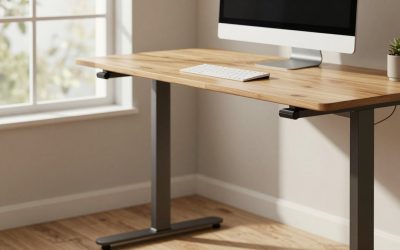
FLEXISPOT E6 MAX 55" x 28" Bamboo Standing Desk, Dual Motor 3-Stage
Included for 'Standing Desk 50 Inch Height: Who Needs It and Why' because the listing specifies Dual Motor 3-Stage, details this guide uses to compare options.
View on Amazon
FLEXISPOT E6 MAX Acacia Solid Wood Dual Motor Standing Desk, 48 x 24
Included for 'Standing Desk 50 Inch Height: Who Needs It and Why' because the listing specifies 48 x 24, details this guide uses to compare options.
View on Amazon📄 In This Review
- Who Is a 50-Inch Max Height Actually For?
- Ergonomic Posture at Full Extension: What Changes at 50 Inches
- Stability Trade-Offs at Tall Settings
- Decision Matrix: Should You Choose 50 Inches or Save Money With Lower Height?
- Assembly, Moving, and Durability Realities at 50 Inches
- What to Look for If You Do Need 50 Inches
Who Is a 50-Inch Max Height Actually For?
Standing desk height is not about your total height, it is about your standing elbow height — the distance from the floor to the bottom of your bent elbow when your arms are at your sides and elbows are at 90 degrees. Your keyboard and work surface should sit just below that point.
Most standing desks with a range of 28 to 47 inches cover users from about 5’0″ to 6’1″. A 50-inch max height extends that coverage for the tallest 5% of users:
| User Height (with shoes) | Approx. Standing Elbow Height | Ideal Desk Height for Typing | Is a 50-Inch Desk Needed? |
|---|---|---|---|
| 5’4″ (163 cm) | 38.5 – 39.5 inches | 38 – 39 inches | No – 47″ desk is more than enough |
| 5’8″ (173 cm) | 41 – 42 inches | 40.5 – 41.5 inches | No |
| 6’0″ (183 cm) | 43.5 – 44.5 inches | 43 – 44 inches | No – 47″ to 48″ is sufficient |
| 6’2″ (188 cm) | 45 – 46 inches | 44.5 – 45.5 inches | Borderline – 50″ gives headroom for mats |
| 6’4″ (193 cm) | 46.5 – 47.5 inches | 46 – 47 inches | Yes – recommended |
| 6’6″ (198 cm) | 48 – 49 inches | 47.5 – 48.5 inches | Yes – essential for neutral posture |
Add about 0.75 to 1.5 inches if you stand on an anti-fatigue mat and another 0.5 to 1 inch for shoes with a thicker sole. A 6’2″ person on a 1-inch mat in sneakers may need 46 to 47 inches of desk height — right at the limit of a 47-inch desk. This is why the 50-inch range is not just for people over 6’4″, but for any tall user who uses a standing setup correctly with a mat.
Three situations where 50 inches makes sense
- You are 6’2″ or taller and stand to work daily. You will use the top 3 inches regularly, not occasionally.
- Shared workstation with a large height gap. For example, partners who are 5’5″ and 6’5″ sharing one home office desk. The wider range (often 24 to 50 inches for a 3-stage frame) accommodates both sitting and standing for both users.
- Tall user with ergonomic accessories that add height. A 1.25-inch thick standing mat, plus a keyboard tray mounted below the desk, plus monitor arms that require the desk to go slightly higher to keep the screen at eye level.
Ergonomic Posture at Full Extension: What Changes at 50 Inches
See also: Best ViewSonic Monitor: Six Listings Sorted by Job, From a Portable 16-Inch to a Curved 1440p Screen • Best AOC Monitor: Eight Listings Ranked by Price, Refresh Ceiling and Panel Type
At 42 to 45 inches, most standing desks feel like a stable kitchen counter. At 49 to 50 inches, the physics change and your posture has to be more precise.
The ideal standing posture is: elbows at 90 to 100 degrees, wrists straight and floating above the keyboard, monitor top at or just below eye level, and weight evenly distributed on both feet. At 50 inches, small errors are magnified:
- Elbow angle collapses quickly if the desk is too low. For a 6’5″ user, a 47-inch desk forces the elbows to bend to about 105 to 115 degrees and the wrists to extend upward to reach the keyboard, which compresses the carpal tunnel over time. The extra 3 inches restores a neutral 90-degree angle.
- Monitor height becomes critical. At 50 inches, the desk surface is already at chest height for an average-height person. For a tall user, the screen needs to be another 8 to 12 inches above the desk. Without a monitor arm with at least 12 to 14 inches of vertical adjustment, you will look down 15 to 20 degrees, adding strain to the neck. Fixed monitor stands that come with the desk are rarely tall enough at this height.
- Foot position matters more. At full height, users tend to lean on the desk edge for stability. This puts pressure on the forearms and shoulders. A proper anti-fatigue mat that is at least 20 x 30 inches and allows micro-movements helps keep you from locking your knees and leaning.
If you are buying a 50-inch desk and you are 5’10” or shorter, you will almost never use the top 3 inches ergonomically. The desk will live at 42 to 44 inches, and you are paying for height you do not use while accepting the stability compromises that come with a taller column.
Stability Trade-Offs at Tall Settings
Every standing desk gets less stable as it goes higher. A 50-inch desk is either a 3-stage frame (three leg segments) or a very long 2-stage frame. That design choice determines how much wobble you get at 48 to 50 inches.
| Frame Design | Typical Height Range | Stability at 48-50 Inches | Weight Capacity | Best For |
|---|---|---|---|---|
| 2-Stage Frame (2 leg segments) | 28 – 47 inches | Not applicable – cannot reach 50″ | Usually 250 – 310 lbs | Users under 6’1″, maximum stability at mid-height |
| 3-Stage Frame (3 leg segments) | 24 – 50 inches | Moderate lateral wobble, especially front-to-back | Usually 270 – 350 lbs | Tall users who need 48″+, sit/stand for all heights |
| 3-Stage with Crossbar / Heavy Steel Base | 24 – 50 inches | Best in class at 50″ – minimized wobble | Usually 300 – 355 lbs | Tall users with dual monitors and heavy desktops |
| 4-Leg / L-Shaped 50″ Frame | 25 – 50 inches | Very stable, but larger footprint | Usually 330 – 400+ lbs | Corner setups, multi-monitor gaming or trading desks |
What to expect at 50 inches on a typical 3-stage desk without a crossbar:
- Lateral wobble increases 30 to 50% compared to 42 inches. You will notice it when typing aggressively, writing by hand, or if you have a monitor arm clamping the edge. The desk does not collapse, but the monitors may shake slightly.
- Weight limits drop in real use. A desk rated for 300 lbs on paper may be tested at its lowest height. At 50 inches, manufacturers often recommend staying under 180 to 220 lbs of distributed load for best stability, even if the motor can lift more. Place heavy items like a desktop PC tower on the floor, not on the desk, when maxed out.
- Construction matters more than at lower heights. A solid wood top (1 to 1.75 inches thick, 50 to 70 lbs) actually dampens vibration better than a lightweight hollow-core or honeycomb top (25 to 35 lbs), but it adds total load. A steel C-frame leg dampens wobble better than a T-frame. Rectangular columns are stiffer than oval columns at the same height.
Decision Matrix: Should You Choose 50 Inches or Save Money With Lower Height?
Use your actual situation, not just your height, to decide.
| Your Situation | Best Choice | Why |
|---|---|---|
| 5’0″ to 6’1″, solo user, no thick mat | Standard 47″ max height (2-stage is fine) | More stable at your working height, usually $100-$250 less than tall-range models |
| 6’2″ to 6’7″, you stand 2+ hours/day | 50″ max height, 3-stage frame | Only way to achieve neutral elbow/wrist angle without hunching |
| Small apartment / 10×12 ft room, desk near wall | 50″ only if you are tall; otherwise 47″ | At 50″, you need 36″ clearance behind for chair movement and 2-3″ from wall to allow for the desk’s slight sway – don’t place tall, unstable loads near windows |
| Renters / frequent movers | 3-stage 50″ if tall; check box weight first | 3-stage desks ship in heavier boxes (90-130 lbs total, split into 2 boxes) vs 70-90 lbs for 2-stage. Disassembly requires an extra 20 minutes for the third column stage |
| Kids, pets, or light use with climbing risk | 47″ with anti-collision sensor | Lower max height reduces tip risk; gyroscopic collision detection is more important than extra height |
| Back pain / need precise sit-stand alternation | 3-stage 24″-50″ with memory presets | Wider range lets you sit lower (24″) for feet-flat posture if you are shorter, and stand truly tall – presets prevent you from guessing height each time |
Assembly, Moving, and Durability Realities at 50 Inches
Product listings rarely explain what living with a tall desk is like.
- Box size and doorway fit: A 50-inch desk top is usually 55 to 60 inches wide and ships in a box 58 x 30 x 6 inches. The frame box is 38 x 20 x 10 inches. Standard interior doorways are 30 to 32 inches wide, so the top box must be carried flat, not on its side. Stairwells under 36 inches wide will be tight.
- Assembly time: Expect 45 to 75 minutes with two people. The 3-stage legs have an extra alignment step and more screws (typically 32 to 40 fasteners vs 24 to 28 for a 2-stage). Most durability failures in the first year are loose leg-to-top bolts, not motor failures — re-tighten after 30 days of use.
- What wears first at max height: The lead screw and plastic glide pads inside the columns wear faster when the desk is run to 50 inches daily. You may hear a slightly louder hum after 18 to 24 months. Keeping the load under 200 lbs and wiping dust from the columns every few months extends life. Motors are generally rated for 10,000 to 20,000 cycles (one cycle is up and down once).
- Room fit in a 10×12 ft room: A 55-inch wide desk at 50 inches tall dominates visually. Leave at least 36 inches of clearance in front for standing and stepping back, and 42 inches if the desk is opposite a bed or dresser. If the room has a ceiling fan or low pendant, check that a monitor on an arm at 60+ inches from the floor will not interfere.
What to Look for If You Do Need 50 Inches
If you have decided the height is necessary, prioritize frame stiffness over desktop size.
- 3-stage frame with rectangular columns and a C-frame base — usually listed as “3-stage dual motor.” Dual motors (one per leg) lift more smoothly at 50 inches than single-motor designs and typically cost $400 to $800 in 2026 market ranges. Single-motor tall desks usually run $300 to $550 but wobble more at the top.
- Adjustable leveling feet and at least 0.75-inch top thickness. At 50 inches, an uneven floor creates noticeable rocking. A 1-inch solid wood or high-density particleboard top with laminate dampens vibration.
- Memory controller with 3 to 4 presets and sit-stand reminder. You do not want to hold a button for 15 seconds to go from 28 to 50 inches every time.
- Cable management that moves with the desk. A fixed cable tray that drags at 50 inches can pull cables taut. Look for a flexible cable spine or chain that extends the full range.
Brands like UPLIFT Desk, FlexiSpot, and Vari commonly offer 50-inch to 51-inch max height models in their 3-stage lines, while basic 2-stage models from the same brands often stop at 47 to 48 inches. Check the spec sheet for “travel range” or “height range” rather than just “max height,” because a desk that goes from 28 to 50 inches is more useful for shared sitting than one that goes from 30 to 50 inches.
Bottom line
Choose a standing desk 50 inch height if you are 6’2″ or taller, share the desk with someone much taller than you, or stand on a thick mat that pushes your required height above 46 inches. Otherwise, a well-built 47 to 48-inch desk will be more stable, lighter, less expensive, and ergonomically perfect at your actual working height.
Related Reviews & Guides


7 Best Webcams: Top Picks Reviewed and Compared (2026)

Large Desk Mat Leather Pad Review