Last Updated: September 29, 2026
For a 5’10” person, your standing desk height is 43 to 44.5 inches to the desktop with bare feet or socks, 44 to 45.5 inches in shoes, measured from the floor to the top of the desk where your keyboard sits.
If you use a keyboard tray, subtract the tray drop – usually 3 to 5 inches – from those numbers. Your seated desk height at 5’10” is typically 28 to 29 inches, and your monitor top should sit at 65.5 to 67 inches from the floor when standing. The 1.5-inch range accounts for your torso-to-leg ratio and whether you stand with elbows at 90 degrees or slightly open at 100 degrees.

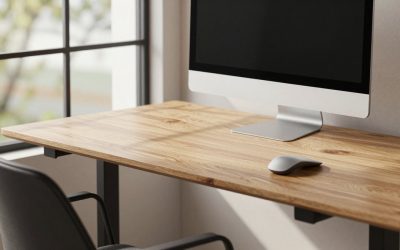
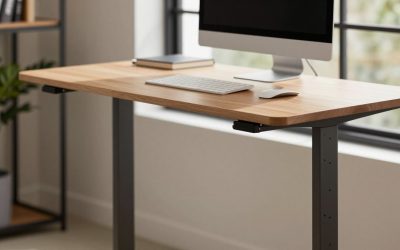
Vari ComfortEdge Electric Standing Desk – 60x30 – Reclaimed Wood/Slate
Included for 'Standing Desk Height for 5'10": Your Target Number and How to Dial It In' because the listing specifies 60x30 and Reclaimed Wood/Slate, details this guide uses to compare options.
View on Amazon
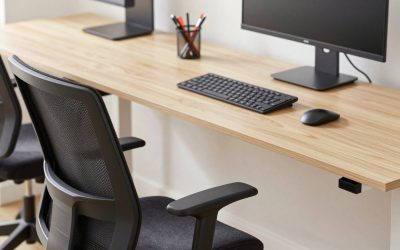
Vari Classic Electric Standing Desk – 72x30 – Butcher Block/Slate
Included for 'Standing Desk Height for 5'10": Your Target Number and How to Dial It In' because the listing specifies 72x30 and Butcher Block/Slate, details this guide uses to compare options.
View on Amazon
Vari Ergo Electric Standing Desk – 54x26 – Reclaimed Wood/Slate
Included for 'Standing Desk Height for 5'10": Your Target Number and How to Dial It In' because the listing specifies 54x26 and Reclaimed Wood/Slate, details this guide uses to compare options.
View on Amazon
Vari Essential Electric Standing Desk – 48x24 – Hazel Wood
Included for 'Standing Desk Height for 5'10": Your Target Number and How to Dial It In' because the listing specifies 48x24 and Hazel Wood, details this guide uses to compare options.
View on Amazon📄 In This Review
Why 43 to 44.5 Inches Works for 5’10”
Standing desk height is determined by elbow height, not total height. At 5’10” (70 inches), most adults have an elbow height of 43 to 44.5 inches from the floor when standing upright with arms relaxed and elbows bent to 90 degrees. That is the height where your forearms can float parallel to the floor without shrugging your shoulders or bending your wrists down.
Two factors shift you within that range:
- Shoe sole thickness: Barefoot or socks keeps you at the low end. Running shoes or dress shoes add 0.75 to 1.25 inches. Thick sneakers or boots add 1.25 to 1.5 inches.
- Torso-to-leg ratio: Two people who are both 5’10” can have elbow heights that differ by over an inch. If you have longer legs and a shorter torso, you will be closer to 43 to 43.75 inches. If you have a longer torso and shorter legs, you will be closer to 44 to 44.5 inches.
To dial it in, stand in the shoes you actually work in, let your arms hang, bend your elbows to 90 degrees, and have someone measure from the floor to the underside of your forearm at the elbow crease. That measurement is your neutral desktop height for typing. Round to the nearest 0.25 inch and use that as your target.
Your Complete Height Stack at 5’10”
See also: Best ViewSonic Monitor: Six Listings Sorted by Job, From a Portable 16-Inch to a Curved 1440p Screen • Best AOC Monitor: Eight Listings Ranked by Price, Refresh Ceiling and Panel Type
Getting the desk right is only one part. Your chair, monitor, and keyboard tray all need to align or you will trade wrist strain for neck strain.
| Measurement Point | At 5’10” (Barefoot/Socks) | At 5’10” (With Shoes, ~1″ Sole) | How to Verify |
|---|---|---|---|
| Standing desktop height (keyboard on desk) | 43 – 44.5 inches | 44 – 45.5 inches | Forearm parallel to floor, elbows ~90-100 degrees, wrists neutral |
| Standing desktop height (with keyboard tray) | 38.5 – 41.5 inches | 39.5 – 42.5 inches | Desktop = elbow height + 3 to 5 inches (tray drop) |
| Seated desktop height | 28 – 29 inches | 28.5 – 29.5 inches | Thighs parallel to floor, feet flat, same 90-degree elbow rule |
| Seated chair height (seat pan) | 17.5 – 19 inches | 18 – 19.5 inches | Knees at ~90 degrees, 2-3 fingers clearance behind knee |
| Monitor top edge from floor (standing) | 65.5 – 67 inches | 66.5 – 68 inches | Top bezel at or just below eye height, screen 20-30 inches from eyes |
| Monitor top edge from floor (seated) | 47 – 49 inches | 47.5 – 49.5 inches | Eyes naturally land 1/3 down from top of screen when looking straight ahead |
Seated height explained
When seated, your elbow height drops to about 25 to 26 inches above the seat pan for most 5’10” users. Add your chair height of 17.5 to 19 inches and you get the 28 to 29 inch seated desktop target. If your desk does not go that low – many budget frames bottom out at 28.5 to 29 inches – you will need to raise your chair slightly and use a footrest to keep your feet from dangling. An ideal footrest height in that case is 3 to 5 inches.
Monitor height explained
For a 5’10” standing user, eye height is typically 65 to 67 inches barefoot. Your monitor top should be at that eye height line, not the center of the screen. With a 27-inch monitor on its stock stand, the top edge sits about 16 to 17.5 inches above the desktop. So if your desktop is at 43.5 inches, the monitor top will land at roughly 60 inches – too low. You will need a monitor arm or riser that lifts it another 5 to 7 inches to reach 65.5 to 67 inches. For a seated position, that same monitor on the desk without adjustment often sits correctly, which is why people who switch between sitting and standing without adjusting the monitor get neck pain while standing.
How a Keyboard Tray Changes Your Numbers
A keyboard tray does not change your elbow height, but it changes where the desk frame needs to be. Most under-desk trays drop the keyboard 3 to 5 inches below the desktop and sit 1 to 2 inches thick themselves.
For a 5’10” user with a 43.5-inch elbow height:
- Without a tray: set desktop to 43.5 inches
- With a 4-inch drop tray: set desktop to 47.5 inches (43.5 + 4). Your keyboard will then be at 43.5 inches, and your desktop is free for monitors and writing at a higher, more ergonomic viewing height.
There is a trade-off. A tray requires 5.5 to 6.5 inches of clearance under the desktop, plus knee clearance. If your seated desktop is 28.5 inches and you add a 1.5-inch thick tray mechanism, usable clearance under the tray becomes about 26.5 to 27 inches. That is tight for thicker legs or if you like to cross your legs. Check that your frame leaves at least 24 inches of clear knee depth from the front edge to any crossbar or cable tray.
Calibrating for Your Body in 60 Seconds
Use this quick method instead of guessing from a chart:
- Stand in your typical work shoes against a wall. Place a hardcover book under your forearm as if it were your desk, with your elbow at 90 degrees and your upper arm vertical.
- Have someone measure from the floor to the top of the book. That is your standing keyboard height.
- Raise or lower your desk to that number. Rest your hands on the keyboard. Your wrists should be straight, not flexed up or down, and your shoulders should be relaxed.
- Open your elbow to about 100 degrees – the angle most people actually type at. The desk should feel 0.5 to 1 inch low at 90 degrees; that is correct. You do not want to be reaching up.
- Check your monitor. Close your eyes, look straight ahead, open them. You should be looking at the address bar area, not the center of the screen. Adjust the arm accordingly.
If you feel pressure on the pinky side of your palms, the desk is too high. If you feel your shoulders shrugging or your wrists bending downward to reach the keys, it is too high. If your wrists are bending upward, it is too low.
What About 5’8″? How the Numbers Shift
For a 5’8″ user, elbow height averages 41.5 to 43 inches barefoot, so the standing desktop target is 1.5 to 2 inches lower than for 5’10”.
- Standing desk height for 5’8″ barefoot/socks: 41.5 to 43 inches
- With shoes: 42.5 to 44 inches
- Seated desk height for 5’8″: 27 to 28.25 inches, with a seat pan around 16.5 to 18 inches
- Monitor top standing (5’8″): 63.5 to 65 inches from the floor
The practical difference is important when buying. Many two-stage standing desks have a minimum height of 28 to 29.5 inches. At 5’8″, that minimum can be too tall for correct seated ergonomics, forcing you to raise your chair and add a footrest. At 5’10”, that same minimum usually works fine without modifications. If you are 5’8″ and plan to sit for long periods, look for a frame that goes down to 27.5 inches or lower, or budget for an under-desk keyboard tray to get your seated typing height down.
Fit, Clearance, and Frame Specs That Matter More Than They Look
Height range is only useful if the desk actually fits your space and holds your gear at that height.
- Room fit: A standard 60 x 30 inch desk needs a 80 x 50 inch floor footprint once you account for chair roll-back (30 to 36 inches behind the desk) and side clearance (20 to 24 inches to walk past). In a 10×12 ft room, that still leaves space for a bookcase or filing cabinet on the opposite wall with 36 to 42 inches of walkway.
- Height range to look for at 5’10”: Choose a frame that covers 27 to 47 inches. That covers your 28-inch seated need and your 45.5-inch standing need in shoes with margin for an anti-fatigue mat (0.5 to 0.75 inch thick, which effectively raises you and requires the desk to go 0.5 to 0.75 inch higher).
- Weight limits: Frames usually list 180 to 300 lbs of lifting capacity. That is lifting capacity in motion, not static holding capacity. Keep your actual load at 60 to 70% of that rating for smooth, long-term operation. A dual-monitor setup with arms, a desktop computer, and accessories often totals 80 to 130 lbs without you leaning on it.
- Stability at height: At 43 to 45 inches, a desk is near the top of its range. Two-stage legs (two segments) wobble more at that height than three-stage legs. If you are 5’10” and sensitive to monitor shake while typing, a three-stage frame or a frame with a crossbar will be noticeably steadier above 42 inches.
- Assembly and moving realities: Desktop-plus-frame boxes typically weigh 70 to 110 lbs combined, with the desktop box up to 60 inches long. You need a 29 to 32 inch doorway clearance to carry the desktop flat. The first thing to wear on most desks is the edge banding where your wrists rest, followed by the hand control and then the motor – not the steel legs.
Electric frames in the usual $300 to $600 range will cover this height range reliably. Frames under that range often use a single motor and slower lift speed (0.8 to 1.1 inches per second) and may struggle near their max height with a full load. Dual-motor frames usually lift at 1.2 to 1.6 inches per second and handle the 43 to 46 inch zone with less strain.
Common Mistakes to Avoid at 5’10”
- Setting the desk to 47 or 48 inches because it feels like a bar counter. That is 3 to 4 inches too high and forces wrist extension.
- Leaving the monitor on the desktop while standing. Your neck flexes down 15 to 20 degrees all day, which causes upper back and neck fatigue.
- Forgetting the mat. An anti-fatigue mat compresses 0.25 to 0.5 inch under weight. If you set your height without it and then add it, your elbows will be slightly low. Set your height while standing on the mat you will use.
- Locking elbows at exactly 90 degrees. A 90 to 100 degree opening with forearms slightly downhill to the keyboard is more sustainable than a rigid right angle.
FAQ
Do I need a different height for typing vs. writing?
Yes, slightly. Typing is best with elbows at 90 to 100 degrees as described. Handwriting is more comfortable with the desktop 1 to 1.5 inches higher than typing height, so your forearm has support without hunching. If you write a lot, set the desk at your typing height and use a slight keyboard tray tilt or a writing pad to make up the difference.
What if I am 5’10” but my partner is 5’8″ and we share the desk?
Program two memory presets. Preset 1 at 43.5 inches for the 5’10” user, Preset 2 at 42 inches for the 5’8″ user barefoot. The 1.5-inch difference feels larger than it sounds. If only one preset is available, split the difference at 42.75 inches and the taller person can use a slightly thicker mat.
Does desk thickness affect the measurement?
Yes. All heights here are to the top surface where your hands rest. A 1-inch thick solid wood top and a 0.75-inch laminate top create a 0.25-inch difference at the same frame height. Always measure to the worksurface, not to the frame.
Related Reviews & Guides

Best Drafting Chairs in 2026: Compared and Ranked

Ergonomic Kneeling Chair