Last Updated: October 17, 2026
- Why Screens Strain Your Eyes
- Best Ways to Reduce Eye Strain From Screens at Your Desk
- Monitor Settings for Eye Strain
- Reduce Eye Strain at the Computer With Better Lighting
- Laptops, Tablets and Multi-Monitor Desks
- Do Blue Light Glasses Work?
- Gear That Helps
- When to See an Eye Doctor
- Frequently Asked Questions
The best ways to reduce eye strain from screens are to take regular focus breaks (the 20-20-20 rule), place your monitor about an arm’s length away and slightly below eye level, match screen brightness to the room, cut glare, and make text larger so you stop squinting. Blinking more and keeping your eyes moist matter more than blue light, which major eye care groups do not consider the main cause of digital eye strain.
This guide covers how to reduce eye strain at the computer with desk layout changes, the monitor settings for eye strain that make the biggest difference, what the evidence says about blue light glasses, and when symptoms mean you should see an eye doctor.

Stylish Blue Light Blocking Glasses for Women or Men - Ease Computer and Digital Eye Strain, Dry Eyes, Headaches and Blurry Vision - Instantly Blocks Glare from Computers and Phone Screens w/Case
Included for 'Best Ways to Reduce Eye Strain From Screens at Your Desk' because the listing specifies Ease Computer and Digital Eye Strain and Dry Eyes, details this guide uses to compare options.
View on Amazon
F FORITO 2-Pack 15.6 Inch Anti Blue Light Laptop Screen Protector, Eye Protection Anti Glare Matte Computer Screen Cover for 15.6" Laptop with 16:9 Aspect Ratio, Reduce Eye Strain and Touch Sensitive
Included for 'Best Ways to Reduce Eye Strain From Screens at Your Desk' because the listing specifies Reduce Eye Strain and Touch Sensitive, details this guide uses to compare options.
View on Amazon
2 Pcs 14 Inch (1920x1200P) Laptop Blue Light Screen Protector, Reduce Eye Strain Anti Glare Blue Light Blocking Screen Protector for 14’’ with 16:10 Resolution HP/Dell/Acer/Asus/Samsung/Lenovo
Included for 'Best Ways to Reduce Eye Strain From Screens at Your Desk' as a relevant option in this category; details come from the product listing.
View on Amazon
Clear Blue Light Glasses for Women and Men, Computer and Screen Glasses | Eases Digital Eye Strain from Phones and Tablets, Stylish Unisex Frame, Anti Fatigue Blocking Lens, Durable Case Included
Included for 'Best Ways to Reduce Eye Strain From Screens at Your Desk' because the listing specifies Computer and Screen Glasses and Eases Digital Eye Strain from Phones and Tablets, details this guide uses to compare options.
View on AmazonKey takeaways
- Every 20 minutes, look at something about 20 feet away for at least 20 seconds; the American Academy of Ophthalmology recommends this habit.
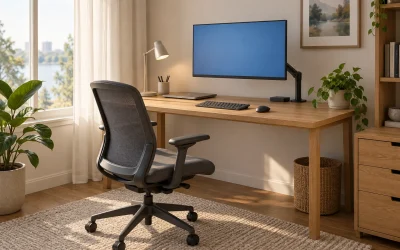
- Put the screen roughly 20 to 30 inches away, with the top at or slightly below eye level.
- Set brightness so the screen looks like a sheet of paper in the room, not a light source.
- Increase text size and contrast before you lean in to read.
- Blue light glasses have weak evidence for relieving eye strain; fix distance, glare and breaks first.
📄 In This Review
- Why Screens Strain Your Eyes
- Best Ways to Reduce Eye Strain From Screens at Your Desk
- Monitor Settings for Eye Strain
- Reduce Eye Strain at the Computer With Better Lighting
- Laptops, Tablets and Multi-Monitor Desks
- Do Blue Light Glasses Work?
- Gear That Helps
- When to See an Eye Doctor
- Frequently Asked Questions
Quick answer: For most people in 2026, the best ways to reduce eye strain from screens at your desk is the Brightness — our #1 rated choice. See the full ranked comparison, alternatives and buying advice below.
Why Screens Strain Your Eyes
Digital eye strain, also called computer vision syndrome, comes from several things happening at once. Your eye muscles hold a near focus for long periods. You blink less when concentrating on a screen, so your eyes dry out. Glare and high contrast between a bright screen and a dim room add work for your pupils. Small text pushes you to lean in, which affects both your eyes and your neck. Uncorrected vision, even a mild prescription, makes all of this worse.
Common symptoms include tired or burning eyes, blurred vision late in the day, dryness, headaches and neck or shoulder pain. These are typically temporary and ease with rest, but if they persist, an eye exam is the right next step.
Best Ways to Reduce Eye Strain From Screens at Your Desk
See also: Selecting an Ergonomic Office Keyboard: What Matters • Best Resteck Neck and Back Massager and Rivals: 6 Desk Picks
These steps are ordered from the biggest, cheapest wins to the finer adjustments.
- Follow the 20-20-20 rule. Every 20 minutes, look at something about 20 feet away for 20 seconds. Why: it relaxes the focusing muscles that stay tense during close work. Set a timer or use a break-reminder app until it becomes habit.
- Move the monitor back. Place it about an arm’s length away, roughly 20 to 30 inches for a typical desktop screen. Why: a slightly longer focus distance reduces focusing effort.
- Lower the screen slightly. The top line of text should be at or a little below eye level, so your gaze tilts down about 15 to 20 degrees to the center. Why: looking slightly down narrows the eye opening, which reduces tear evaporation and dryness.
- Match brightness to the room. If the screen glows like a lamp, it is too bright; if it looks gray and dim, it is too dark. Why: large brightness differences make your pupils keep adjusting.
- Remove glare. Place the monitor perpendicular to windows, close blinds when the sun hits the screen, and use a matte screen or anti-glare filter on glossy displays. Why: reflections lower contrast and make you squint.
- Increase text size. Use Windows display scaling or macOS display settings so body text is comfortable from your normal seated position. Why: if you lean in, your distance and posture both suffer.
- Blink deliberately. Every few minutes, close your eyes fully for a second or two. Why: concentration cuts your blink rate, and partial blinks do not spread tears properly.
- Improve the air. Point fans and heating vents away from your face and consider a humidifier in dry winter months. Why: moving, dry air speeds tear evaporation.
- Book an eye exam. Tell the eye doctor how many hours you spend on screens and how far your monitor sits. Why: a small uncorrected prescription or focusing issue is a frequent hidden cause.
Monitor Settings for Eye Strain
Most monitors ship far brighter and cooler than needed for indoor work. A few minutes in the on-screen menu can make them much easier to look at.
| Setting | Suggested starting point | Why it helps |
|---|---|---|
| Brightness | Lower until white areas look like paper in the room; many calibration guides use about 120 nits for typical offices | Reduces contrast with surroundings and glare |
| Contrast | Default or slightly reduced; keep text crisp | Too high makes white areas harsh |
| Color temperature | About 6500K by day; warmer (night light) in the evening | Warmer light feels gentler in dim rooms |
| Text scaling | 125-150% on high-resolution laptops and 27-inch 4K screens | Prevents leaning in and squinting |
| Refresh rate | Highest supported (often 60-165Hz) | Smoother scrolling is easier to track |
| Flicker | Prefer monitors marketed as flicker-free (DC dimming) | Some people are sensitive to PWM flicker at low brightness |
| Dark mode | Personal preference; use light mode in bright rooms | Dark text on light backgrounds is often easier to read in well-lit spaces |
Where to find these settings
- Windows 11: Settings > System > Display for brightness, scale and Night light. Refresh rate is under Advanced display.
- macOS: System Settings > Displays for brightness, resolution scaling and Night Shift.
- Monitor menu: The physical buttons control the panel’s own brightness, contrast and color modes; many monitors include a low blue light or reading mode.
Reduce Eye Strain at the Computer With Better Lighting
Room lighting is as important as the screen itself. The aim is even, soft light without bright spots in your field of view.
- Avoid working in the dark. A bright screen in a dark room creates the strongest contrast your eyes can face at a desk.
- Use indirect light. Lamps that bounce light off walls or ceilings create fewer reflections than bare bulbs.
- Add a monitor light bar. It lights the desk without shining on the screen, which is helpful for paper notes beside your monitor.
- Keep windows to the side. A window behind the screen makes you squint; a window behind you reflects on it.
Laptops, Tablets and Multi-Monitor Desks
Different setups create different strain patterns, so a few targeted fixes help.
- Laptops: The screen sits low and close, which encourages hunching and squinting. Raise it on a stand to eye level and add an external keyboard and mouse, or connect a larger external monitor for long sessions.
- Tablets and phones: People tend to hold them closer than a monitor, often 12 inches or less. Increase text size, hold the device a little farther away, and take more frequent distance breaks.
- Two monitors: Keep both at the same height and distance. If one is your main screen, center it in front of you and angle the second one beside it so you turn your head rather than twisting your eyes far to the side.
- Ultrawide monitors: A curved ultrawide keeps the edges at a more even distance from your eyes; with flat ultrawides, sit a bit farther back so you can scan the whole width without turning your head constantly.
- Glossy laptop screens: These reflect lamps and windows easily. Tilt the screen to remove reflections, or add a matte filter if you work in bright rooms.
Do Blue Light Glasses Work?
Blue light glasses are widely marketed for eye strain, but the evidence is weak. The American Academy of Ophthalmology does not recommend blue light glasses for computer use, and a 2023 Cochrane review of clinical trials found that blue-light filtering lenses may make little or no difference to eye strain symptoms in the short term.
Screens emit far less blue light than sunlight, and the symptoms of digital eye strain are better explained by focus fatigue, reduced blinking and glare. Blue light in the evening may affect sleep for some people, so using your device’s night mode or reducing screen use before bed is a reasonable step. If you like how tinted lenses feel, they are not harmful, but they should not replace breaks, good distance and an up-to-date prescription. If you wear glasses, ask your eye doctor about lenses designed for computer distances, which often help more than a blue-light coating.
| Fix | Effort | Cost | Strength of support |
|---|---|---|---|
| 20-20-20 breaks | Low | Free | Recommended by major eye care organizations |
| Correct monitor distance and height | Low | Free to low | Widely recommended in ergonomic guidance |
| Brightness, glare and text size | Low | Free | Widely recommended |
| Updated prescription or computer glasses | Medium | Medium | Strong when a vision problem exists |
| Humidifier and redirected airflow | Low | Low | Helpful for dryness in dry rooms |
| Blue light glasses | Low | Low to medium | Weak; reviews show little short-term benefit |
Gear That Helps
BenQ ScreenBar Pro
Asymmetric light that avoids screen glare · motion sensor · adjustable brightness and color temperature. Lights the desk without reflecting off your monitor. Upper-mid tier.
Quntis Computer Monitor Lamp
Monitor-mounted LED bar · auto-dimming · adjustable color temperature. A lower-cost way to balance desk lighting with your screen. Budget tier.
HUANUO FlowLift Single Monitor Mount
Fits 13-32 inch screens · height, depth and tilt adjustment · clamp or grommet. Makes it easy to push the screen to arm’s length and set the right height. Budget tier.
When to See an Eye Doctor
Screen-related eye strain usually fades after rest. Make an appointment with an optometrist or ophthalmologist if you notice blurred vision that does not clear after breaks, frequent headaches, double vision, eye pain, light sensitivity, or redness that lasts. These can point to a vision problem or eye condition that needs a professional assessment, and only an eye care professional can recommend drops or treatments for your specific situation.
Frequently Asked Questions
What is the fastest way to reduce eye strain from screens?
Look away at something about 20 feet away for 20 seconds, blink fully several times, and lower your screen brightness to match the room. These steps relieve focusing fatigue and dryness within minutes.
How far should my monitor be to reduce eye strain?
About an arm’s length, roughly 20 to 30 inches for most desktop monitors, with the top of the screen at or slightly below eye level. Larger screens can sit a little farther away if text stays readable.
Do blue light glasses help with eye strain?
Current evidence suggests they make little or no short-term difference to eye strain. The American Academy of Ophthalmology does not recommend them for computer use; breaks, distance and glare control are more effective.
Is dark mode better for your eyes?
Not universally. Dark mode can feel more comfortable in dim rooms, but dark text on a light background is often easier to read in well-lit spaces. Choose whichever lets you read without squinting.
What monitor settings are best for eye strain?
Lower brightness to match the room, keep contrast moderate, use a warmer color temperature in the evening, raise text scaling so you do not lean in, and choose a flicker-free monitor if you are sensitive to flicker.
Can screen time permanently damage your eyes?
Digital eye strain symptoms are generally temporary and improve with rest. If symptoms persist, or you notice changes in your vision, see an eye care professional to rule out other causes.
Ready to decide? Our #1 pick for 2026 is the Brightness.
Live price & availability on Amazon.
Related Reviews & Guides



Quick Picks: Best Adjustable Aluminum Laptop Stands
8 Best Quiet Desk Fans for Home Office Use in 2026