Last Updated: September 18, 2026
If your wrist hurts after a day at the computer, buying the tallest or most expensive mouse is not automatically the answer. Many shoppers choose based on appearance, DPI, or a familiar brand name, then discover that the mouse is too large, too narrow, too heavy, or awkward with their existing desk setup.
The better approach is to treat an ergonomic mouse as a fit-and-workflow purchase. Your hand size, grip, pointing habits, operating system, and tolerance for charging matter more than a long list of buttons. A vertical design can reduce the amount your forearm rotates, but it can still be uncomfortable if your thumb rests at an unnatural angle. A low-cost wireless mouse can be excellent value, while a premium model may justify its price with quieter clicks, better software, or more reliable switching between devices.
As an Amazon Associate we earn from qualifying purchases at no extra cost to you.


This guide explains how to choose an ergonomic mouse in 2026 without getting distracted by specifications that have little effect on everyday comfort.
📄 In This Review
Decide These 3 Things First
- Choose your hand and grip. Most ergonomic mice are right-handed, and many are designed for a relaxed palm grip rather than fingertip control. Measure your hand from the crease at your wrist to the tip of your middle finger. Hands under about 6.75 inches usually need a compact or small-to-medium shell; 6.75 to 7.75 inches generally suits medium models; hands over 7.75 inches often need a larger body.
- Choose your connection. Bluetooth is convenient for laptops and tablets, while a 2.4GHz USB receiver typically offers simple plug-and-play performance. If you use multiple computers, look for a mouse that supports two or three devices. Confirm that your computer has the required USB port or Bluetooth version before buying.
- Choose your movement style. A vertical mouse places your hand in a handshake-like position. A contoured horizontal mouse is less of an adjustment and may suit users who switch between a mouse and a graphics tablet. If you have never used a vertical design, allow at least several work sessions for your accuracy to adapt.
Size and Shape
See also: Standing Desk 50 Inch Height: Who Needs It and Why • Standing Desk Height for 5’10”: Your Target Number and How to Dial It In
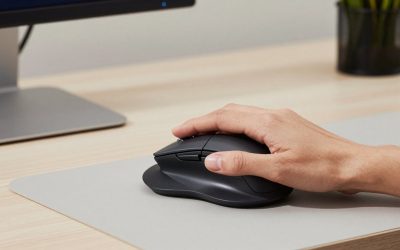
Fit is the most decisive factor. Your palm should rest on the shell without your fingers reaching beyond the primary buttons. The front edge should not force your fingertips to curl sharply, and the rear of the mouse should support the broad part of your palm.
As a general guide, look for a mouse about 4.0 to 5.0 inches long and 2.5 to 3.2 inches wide. Small models may weigh less than 3 ounces and measure close to 4 inches long. Full-size vertical mice can approach 5 inches long, 3.2 inches wide, and 4 ounces or more. These dimensions are not universal standards, so compare them with a mouse you already find comfortable.
Height matters especially with vertical designs. A model around 3.0 to 4.5 inches high can keep your thumb and fingers separated, but a very tall shell may feel unstable for small hands. Look for a thumb rest that supports the thumb without making it reach upward. Left-handed users should confirm that a product is genuinely ambidextrous; many “ergonomic” shapes are right-hand-only.
Material and Surface Finish
The best surface is one you can hold without squeezing. Most ergonomic mice use ABS plastic, rubberized side grips, or a combination of the two. Textured plastic is usually durable and less likely to become sticky over time. Soft-touch coatings can feel comfortable initially, but some wear or become tacky after years of exposure to skin oils, heat, and cleaning products.
For everyday office use, prioritize a slightly matte finish over glossy plastic. Glossy shells show fingerprints and can feel slippery during long sessions. Side grips with shallow texture are easier to clean than deep rubber ridges. If your hands tend to sweat, avoid a completely smooth rubber coating and look for ventilation or a more tactile side panel.
Also check the coating around the thumb rest and palm area. These are high-contact zones. A mouse that feels comfortable for five minutes may become irritating after six hours if a seam, logo, or sharp edge sits under your palm.
Construction and Controls
Construction quality is visible in the details: buttons should sit evenly, the scroll wheel should turn without side-to-side wobble, and the shell should not creak when gently pressed. A mouse in the 3- to 4-ounce range usually feels substantial without becoming tiring to reposition. Heavier models can feel planted, but they may be less comfortable for users who make frequent sweeping movements.
Two primary buttons and a clickable scroll wheel are enough for most office work. Forward and back buttons are useful for browsing and file navigation, but their position matters more than their number. You should be able to reach them with a small thumb movement rather than lifting your hand.
Adjustable DPI is useful when you move between a large monitor and a laptop display. For regular productivity, a range of roughly 800 to 2,400 DPI is sufficient; gaming-oriented figures such as 4,800 DPI or higher are not automatically more ergonomic. A DPI button placed beneath the mouse is less convenient than one you can reach without changing your grip.
Pay attention to the scroll wheel. A rubberized wheel with distinct steps is preferable for spreadsheets and documents. Free-spinning or hyper-fast scrolling can be useful for long pages, but it may be unnecessary if your work involves precise selection.
Comfort and Performance
An ergonomic mouse should reduce effort, not demand a new kind of effort. During use, your wrist should remain relatively straight, your forearm should rest on the desk or armrest, and your shoulder should stay relaxed. The mouse should glide with light pressure; if you must grip it tightly to control the pointer, the shape or surface is wrong for you.
Wireless performance should be stable across your normal workspace. A 2.4GHz receiver generally works well within about 30 feet in an unobstructed area, though desks, metal surfaces, and crowded USB environments can reduce that distance. Bluetooth avoids a receiver but may require pairing steps and can be affected by the computer’s power-saving behavior.
Battery life varies widely. Basic wireless mice using one AA or AAA battery may run for several months to more than a year, depending on usage and sleep settings. Rechargeable models often provide approximately 30 to 90 days per charge, but the advertised figure depends on lighting, polling behavior, and software settings. A USB-C charging port is preferable to a proprietary cable.
Click noise also affects comfort in shared spaces. Quiet switches are helpful in offices, libraries, and bedrooms, but they can have a softer or less tactile feel. Test the click response if possible, especially if you rely on precise button feedback.
Price Tiers
Budget ergonomic mice typically cost about $15 to $30. This category includes simple 2.4GHz wireless and entry-level vertical models, such as products priced near $19.98 or $20.85. Expect basic plastic construction, two or three buttons, and fewer customization options. These are good starting points if you are testing whether a vertical shape suits you.
Mid-range models generally cost $35 to $75. The Logitech Lift, for example, sits in this general range depending on color and retailer pricing, with listed prices around $64.49 to $69.95 in the examples considered here. This tier commonly adds improved shaping, quieter switches, Bluetooth, receiver connectivity, device switching, and better software support.
Premium ergonomic mice cost about $80 to $150 or more. You are paying for refined materials, higher-quality switches, advanced scrolling, multi-device controls, longer software support, or specialized designs. Do not pay this premium unless those features solve a specific problem. A well-fitting $25 mouse is more useful than an expensive model that is too large.
Warranty and Long-Term Support
Look for at least a one-year limited warranty, which is common for mainstream computer accessories. Two or three years is more reassuring for a mouse intended for daily professional use. Read what the warranty covers: accidental damage, cosmetic wear, battery degradation, and normal switch wear are often excluded.
Software support matters if you want to remap buttons or save profiles. Confirm that the manufacturer supports your operating system and that basic functions work without installing an app. A mouse that requires software for scrolling or device switching may be frustrating on a work computer where downloads are restricted.
Also check whether replacement receivers are available. Losing a tiny USB receiver can make a budget mouse unusable unless the brand offers a replacement or the receiver can be paired again.
Delivery and Assembly
Most ergonomic mice require no assembly beyond inserting a battery, plugging in a receiver, or completing Bluetooth pairing. Delivery is still worth checking because return policies are especially important when fit cannot be judged from a photograph. Favor sellers offering at least 30 days for returns, and keep the packaging until you have used the mouse for several full workdays.
Before ordering, confirm the box includes the receiver, batteries, charging cable, and any adapter you need. A USB-A receiver may require a hub or adapter on a laptop with only USB-C ports. For a multi-device mouse, check whether the product switches with a physical button or through software; the former is usually easier to set up.
Spec Checklist
| Spec | Budget | Mid | Premium |
|---|---|---|---|
| Typical price | $15–$30 | $35–$75 | $80–$150+ |
| Length | 3.9–4.7 in. | 4.1–5.0 in. | 4.2–5.2 in. |
| Weight | 2.5–4 oz. | 3–5 oz. | 3.5–6 oz. |
| Connection | 2.4GHz receiver or basic Bluetooth | 2.4GHz and/or Bluetooth | Bluetooth, receiver, and multi-device support |
| DPI range | 800–1,600 | 800–3,200 | 800–4,000+ |
| Battery expectation | Several months to 12+ months | 30–90 days rechargeable or 6–18 months disposable | 30–120 days rechargeable |
| Warranty | At least 1 year | 1–2 years | 2–3 years |
Red Flags
- Only generic dimensions: A listing that gives no length, width, height, or weight makes fit difficult to judge.
- “Ergonomic” with no shape description: The term does not tell you whether the mouse is vertical, contoured, ambidextrous, or right-handed.
- Huge DPI numbers as the main selling point: A 10,000-DPI sensor does not improve wrist posture or guarantee office accuracy.
- No return information: Shape is personal, so a vague return policy is a meaningful risk.
- Unclear receiver details: Check whether the receiver is included, replaceable, and compatible with your available ports.
- Very low price with extensive features: Be cautious when a mouse promises Bluetooth, three-device switching, silent buttons, rechargeable power, and premium materials for an unusually low price without a clear warranty.
FAQ
Is a vertical mouse better for wrist pain?
It may help some users by reducing forearm rotation, but it is not a medical treatment. Fit, posture, breaks, and desk height matter just as much. Stop using any mouse that causes sharp pain, numbness, or tingling and seek professional advice.
How do I measure my hand for an ergonomic mouse?
Measure from the wrist crease to the tip of your middle finger. Compare that measurement with the manufacturer’s size guidance, then check the mouse’s actual length and height. If you are between sizes, the smaller option is often easier to control, while the larger option may provide more palm support.
Is Bluetooth or a USB receiver better?
Bluetooth is convenient for laptops and frees a USB port. A 2.4GHz receiver is usually simpler for desktop use and may offer more consistent plug-and-play performance. A mouse supporting both gives you the most flexibility, especially if you switch between computers.
How long should I try a new ergonomic mouse?
Give it at least three to five workdays, provided it causes no pain. Vertical designs can feel awkward at first because pointer control changes. Use the return window as your safety net, and evaluate comfort after a full work session rather than after a few minutes in a store.
Ready to decide? Our #1 pick for 2026 is the Typical price.
Live price & availability on Amazon.
Related Reviews & Guides




8 Best Gaming Chairs for Desk: Top Picks for 2026

Quick Picks: Best LED Desk Lamps for Home Office at a Glance