Last Updated: September 18, 2026
- Top Pick: WALI Desk File Organizer, 4 Tier Desktop Paper Letter Tray Organizer with Drawer and 2 Pen Holders, Office Desk Accessories & Workspace Organizers for Office, Home Supplies(DO005DH-B), 1 Pack, Black
- Best Value: gianotter Metal Mesh Desk Organizers and Accessories with File Holder
- Premium Choice: OPNICE Desk Organizer and Accessories, 2-Tier Computer Monitor Stand Riser with Drawer and 2 Pen Holders, Laptop Stand, Office Desk Accessories for Office Supplies, Black
📄 In This Review
The Short Answer
For most home workspaces, a desk organizer measuring about 12 to 16 inches wide, 6 to 10 inches deep, and 6 to 12 inches tall is the best starting point. That size usually holds pens, notebooks, sticky notes, chargers, mail, and a few everyday accessories without taking over your desktop.
Choose a smaller organizer—roughly 8 to 12 inches wide—if you have a compact desk, work from a narrow console, or mainly need pen and cable storage. Choose a larger unit, about 16 to 24 inches wide and 10 to 14 inches deep, if you regularly handle letter-size papers, folders, files, or craft supplies.
As an Amazon Associate we earn from qualifying purchases at no extra cost to you.

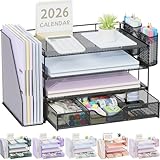


The right answer to “what size desk organizer do I need” depends on three things: the space available, what you need to store, and how often you use each item. Measure first, then select the smallest organizer that holds your essentials comfortably. Leaving some open desk space is usually more useful than filling every inch with storage.
Standard Sizes
See also: Best Gaming Desk Pads for Full Desk Coverage • Best Desk Organizers Under $30: Match the Organizer to Your Clutter
Desk organizers are sold in several practical formats. The measurements below are typical exterior dimensions, not universal standards, so check the product listing before buying. One inch equals 2.54 centimeters.
| Organizer type | Typical dimensions (inches) | Approximate dimensions (cm) | Best for |
|---|---|---|---|
| Compact pen and accessory caddy | 8–12 W × 4–7 D × 4–7 H | 20–30 W × 10–18 D × 10–18 H | Pens, scissors, clips, sticky notes, and cables |
| Standard desktop organizer | 12–16 W × 6–10 D × 6–12 H | 30–41 W × 15–25 D × 15–30 H | Everyday office supplies and small notebooks |
| Paper tray organizer | 10–14 W × 9–13 D × 8–14 H | 25–36 W × 23–33 D × 20–36 H | Letter paper, mail, invoices, and documents |
| Multi-tier file organizer | 12–17 W × 9–14 D × 12–16 H | 30–43 W × 23–36 D × 30–41 H | Files, folders, active paperwork, and mail sorting |
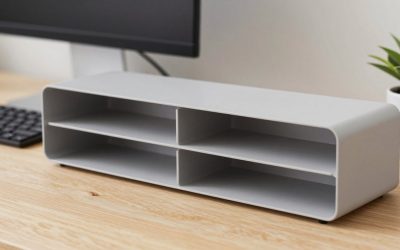
| Monitor stand organizer | 20–24 W × 8–10 D × 3–6 H | 51–61 W × 20–25 D × 8–15 H | Raising a monitor while storing a keyboard or supplies |
| Large desktop storage station | 16–24 W × 10–14 D × 12–18 H | 41–61 W × 25–36 D × 30–46 H | Busy workstations, shared desks, and craft materials |
For paper storage, confirm the interior width. US letter paper measures 8.5 by 11 inches (21.6 by 27.9 cm), and a loaded folder needs extra clearance. A tray that barely fits a sheet may be frustrating to use, especially when papers are stacked or slightly curled. Allow at least 0.5 inch of extra width and depth around the items you retrieve often.
Compact mesh caddies and small tray units commonly cost about $10 to $20. Larger multi-tier organizers generally range from $20 to $35, while monitor-stand organizers and heavier storage stations often cost $20 to $45. For example, basic four-tier paper organizers are commonly near the lower end of that range, while seven-tier units with baskets and pen compartments tend to cost more. Price varies with materials, drawers, finish, and assembly.
How to Measure Your Space
- Clear the intended area. Remove your current supplies and measure the actual usable desktop, shelf, or cabinet surface. Do not measure only the empty space around your monitor or lamp.
- Measure width from side to side. Record the maximum width in inches and centimeters. Leave at least 1 inch of clearance on one side if you need to remove drawers or access a side compartment.
- Measure depth from front to back. Account for the desk edge, keyboard, mouse, monitor base, and any cable grommet. An organizer that is too deep can make your working position feel cramped.
- Check the height. Measure from the desktop to the lowest obstruction, such as a shelf, window ledge, cabinet, or the bottom edge of a monitor. Leave 1 to 2 inches of visual and functional clearance above an open-top organizer.
- Map the reach zone. Items used several times a day should be within roughly 12 to 18 inches of your seated position. Less-used files can go behind or beside your monitor.
- Measure your supplies as a group. Stack notebooks, folders, or envelopes and measure their combined width. For pens and tools, measure the longest item; scissors and rulers often determine the necessary compartment length.
- Allow capacity for growth. Buy about 15% to 25% more usable capacity than you need today. A completely full organizer is difficult to sort and encourages piles beside it.
- Check weight and stability. A loaded paper organizer can weigh several pounds. Look for a broad base, nonslip feet, and a stated load rating when available. A monitor riser should support the combined weight of the monitor and stand accessories; many basic models are rated around 20 to 40 pounds, but verify the manufacturer’s limit.
By Room or Use Case
Home office
A 12- to 16-inch-wide organizer is usually enough for a home office. Select one with separate compartments for writing tools, charging cables, sticky notes, and incoming paperwork. If you handle printed documents every day, a four- to seven-tier paper organizer measuring approximately 12 to 17 inches wide and 9 to 14 inches deep will be more useful than a small caddy.
Small apartment or bedroom desk
Prioritize vertical storage. A unit about 8 to 12 inches wide and 4 to 7 inches deep can hold daily supplies while preserving space for a laptop. Two- or three-tier designs make better use of height than a wide tray. Avoid organizers taller than your sightline if the desk is in a bedroom or multipurpose room, since they can make the area feel crowded.
Student desk
Students often need a flexible combination of pens, index cards, notebooks, and loose papers. A 10- to 14-inch-wide organizer with a drawer or two open tiers is a practical middle ground. Make sure the largest compartment accepts notebooks at least 9 by 11 inches, and choose a lightweight model if the organizer will move between a dorm room, classroom, and library.
Mail and household command center
For a kitchen counter or entryway, choose a file organizer rather than a pen caddy. A width of 12 to 16 inches and depth of 9 to 13 inches accommodates incoming mail, bills, school papers, and letter-size folders. Labeling three or four sections—such as “to do,” “to file,” and “outgoing”—can prevent the organizer from becoming a paper pile.
Craft, sewing, or hobby station
Hobby supplies need more depth and stronger compartments. Look for 16 to 24 inches of width and at least 10 inches of depth if you store rolls of tape, cutting tools, thread, or bottles. Check compartment height carefully: short trays may hold stationery but not glue bottles or tall markers. For electronics or charging accessories, keep cables separated and avoid blocking ventilation around powered equipment.
Monitor and laptop workstation
A monitor riser typically needs 20 to 24 inches of width to support a screen securely, with 8 to 10 inches of depth. Leave room underneath for a keyboard that is commonly about 17 to 18 inches wide. Confirm the riser’s maximum load and its height before buying. A stand that raises the screen by 3 to 6 inches can also create space for a drawer or notebook, but it should not obstruct airflow from a laptop or docking station.
Common Sizing Mistakes
- Measuring only width: Depth and height can be the real problem, especially on shallow desks or beneath shelves.
- Ignoring paper dimensions: Letter-size documents need more room than A4 or half-sheet notes. Check interior, not just exterior, measurements.
- Buying by compartment count alone: Ten tiny sections may hold less than four usable compartments.
- Overlooking access space: Drawers and pull-out trays need room to open. Add at least 2 to 4 inches in front of the organizer when measuring.
- Choosing a top-heavy design: Tall organizers filled with paper can tip when a lower drawer is opened. Prefer a wide base or wall-mounted solution for heavy storage.
- Forgetting the keyboard and mouse: A deep organizer can push your keyboard forward and reduce comfortable elbow room.
- Using one organizer for everything: Separate high-use desktop supplies from archived files. This keeps the daily organizer smaller and easier to maintain.
FAQ
What is the best desk organizer size for a small desk?
Choose one about 8 to 12 inches wide, 4 to 7 inches deep, and 4 to 10 inches high. A vertical caddy or narrow two-tier unit can hold the essentials without competing with your laptop, keyboard, and mouse.
How big should a desk organizer be for papers?
For letter-size documents, look for approximately 10 to 14 inches of exterior width and 9 to 13 inches of depth. A multi-tier file organizer around 12 to 17 inches wide is better if you sort papers into several categories.
Should my desk organizer be taller than my monitor?
Usually, no. A low organizer keeps your sightline open and makes the desk feel less cluttered. If you use a vertical file unit, place it to the side of the monitor and keep its height below or near the top of the display.
How much extra space should I leave in an organizer?
Plan for about 15% to 25% unused capacity. This gives you room to add supplies and makes it easier to remove items without lifting an entire stack. For drawers and trays, leave enough space to grip the contents rather than packing them tightly.
Ready to decide? Our #1 pick for 2026 is the Compact pen and accessory caddy.
Live price & availability on Amazon.
Related Reviews & Guides


Best Desk Accessories in 2026: Compared and Ranked
6 Best Adjustable Standing Office Desks 2026