Last Updated: September 29, 2026
Screen glare is the washed-out patch or bright reflection that appears on your monitor from a light source somewhere in the room. It lowers contrast, makes you squint, and pushes you to crank screen brightness, all of which add to eye fatigue. Most glare comes from light hitting the screen at the wrong angle, and much of it can be solved by rearranging and choosing lights properly rather than buying a new monitor. This guide explains how to identify and fix glare using desk and room lighting.
📄 In This Review
Quick answer: Our top pick in 2026 is the Window behind you — our #1 rated choice. See the full ranked comparison, alternatives and buying advice below.
Find the source first
Sit in your normal position and turn the monitor off. The dark screen acts as a mirror. Every bright spot you see is a glare source. Note whether it is a window, a ceiling light, a desk lamp or a bright wall.
| Glare source | What you see | Best fix |
|---|---|---|
| Window behind you | Bright rectangle across the screen | Rotate desk so window is to the side; add blinds or curtains |
| Overhead light behind or above | Bright spot near the top of the screen | Tilt screen down slightly; dim or diffuse the overhead light; use indirect lighting |
| Desk lamp | Bright reflection on part of the screen | Move lamp to the side, lower the head, angle away from screen |
| Bright wall or surface | Overall washed-out look | Reduce light on that surface; use matte finishes |
| Window in front, beyond the screen | No reflection, but eye strain from contrast | Use blinds to reduce brightness behind the screen |
Position the desk and monitor
See also: Best Roku Streaming Deals Reviewed • Olipop Flavors Ranked: Best Tastes from Worst to Best
Windows to the side
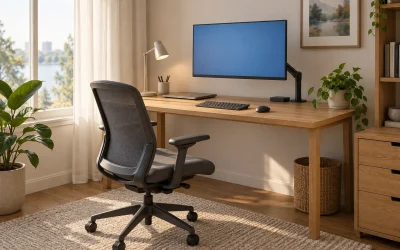
The ideal arrangement places windows perpendicular to your screen, so daylight enters from the side. With a window behind you, daylight reflects straight off the screen; with a window in front, the bright background forces your eyes to cope with extreme contrast.
Tilt and height
Tilting the monitor slightly downward, around 5-15 degrees, often moves ceiling-light reflections out of your line of sight. Monitor arms make fine-tuning easy.
Use desk lighting that avoids reflections
Monitor light bars
Monitor light bars use asymmetric optics to throw light forward onto the desk and away from the screen. They are one of the most effective ways to add task light without creating glare, especially on small desks.
Lamp placement
Place a desk lamp to the side of the monitor, not behind or directly above it, with the head low and angled toward the desk surface. Right-handed users typically place it on the left so the writing hand does not cast a shadow. Choose lamps with shaded or diffused heads so the LEDs are not visible.
Indirect ambient light
Uplighters and wall-washing lamps bounce light off ceilings and walls, creating soft ambient light that produces few reflections. They pair well with a light bar for the desk.
Balance screen and room brightness
Glare feels worse when the screen and room are very different in brightness. Working with a bright screen in a dark room, or a dim screen in a bright room, both increase eye strain. Aim for moderate room lighting and a screen brightness that roughly matches it. Bias lighting behind the monitor can soften the contrast with a dark wall in the evening.
Other tools
- Matte screens: matte or anti-glare monitor coatings diffuse reflections better than glossy panels.
- Anti-glare filters: add-on filters can help on glossy screens, though they may slightly reduce clarity.
- Monitor hoods: side and top shields block stray light, popular in photo editing setups.
- Blinds and sheer curtains: diffuse daylight without darkening the room.
FAQ
Can a desk lamp cause screen glare?
Yes, if it is placed behind or above the screen, or angled toward it. Move it to the side, lower the head and point it at the desk surface. A monitor light bar avoids the issue by design.
Is a matte screen enough to eliminate glare?
A matte coating reduces sharp reflections but does not eliminate glare from strong light sources. Fixing light placement is still the most effective step.
Bottom line
To reduce screen glare, find the source with the monitor off, move windows to the side, tilt the screen slightly downward, and use desk lighting that points at the desk rather than the screen. A monitor light bar or a side-positioned shaded lamp, combined with soft ambient light, eliminates most glare without buying a new monitor.
Ready to decide? Our #1 pick for 2026 is the Window behind you.
Live price & availability on Amazon.
Related Reviews & Guides
How to Clean a Mesh Office Chair
Best standing desk for treadmill desk pairing