Last Updated: September 29, 2026
Accounting work has a rhythm most desk setups ignore. For eleven months of the year it is steady spreadsheet, reconciliation and client correspondence work; then tax season or year-end close arrives and the same desk has to support 10–12 hour days of dense numbers, stacks of source documents and constant cross-checking between screens. A home office for an accountant should be designed for the peak, not the average, and it should treat data security as seriously as ergonomics.
📄 In This Review
Quick answer: Our top pick in 2026 is the Two 24-inch 1080p — our #1 rated choice. See the full ranked comparison, alternatives and buying advice below.
Screens built for spreadsheets
Wide spreadsheets and side-by-side comparisons are the core of the job. Two monitors are the minimum; many accountants benefit from a wide main display for the workbook plus a second screen for the source document, bank portal or client email.
| Layout | Approximate cost | What it does well |
|---|---|---|
| Two 24-inch 1080p | $220–$350 | Budget, adequate for most workbooks |
| Two 27-inch 1440p | $400–$700 | More visible columns and rows, sharper figures |
| 34-inch ultrawide plus laptop screen | $350–$700 | Very wide sheets without a bezel in the middle |
| 27-inch main plus portrait 24-inch | $350–$600 | Long PDFs and statements displayed full page |
A portrait monitor is particularly useful for accountants because bank statements, invoices and tax forms are portrait documents. Viewing a full page at readable size without scrolling speeds up cross-checking noticeably.
Numeric input
See also: Best Roku Streaming Deals Reviewed • Olipop Flavors Ranked: Best Tastes from Worst to Best
Keep a proper number pad
Accountants enter more numbers than almost any other profession, so a numeric keypad is non-negotiable. The question is where it sits. A full-size keyboard pushes the mouse far to the right, stretching the shoulder all day. A tenkeyless keyboard with a separate numeric keypad lets you place the keypad on the left or between keyboard and mouse, keeping the mouse closer. Many experienced users key numbers left-handed with a left-side keypad and hold the mouse with the right.
Mouse with a scroll that suits sheets
A mouse with a horizontal scroll wheel or tilt wheel makes moving across wide spreadsheets much faster. Some models let you switch the main wheel between free-spinning and ratcheted modes, which helps with both long statements and precise row selection.
Paper handling
Even in largely digital practices, source documents keep arriving. A compact duplex document scanner with an automatic feeder, typically $250–$500 for business-grade models, turns a stack of receipts into searchable PDFs in minutes. Choose one that scans straight to a secure folder or your practice management software. Add a document holder or copy stand next to the monitor so paper documents sit at eye level while you key figures, which prevents the constant head-dip that causes neck strain.
Deep desk, good task light
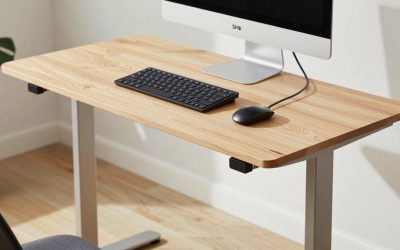
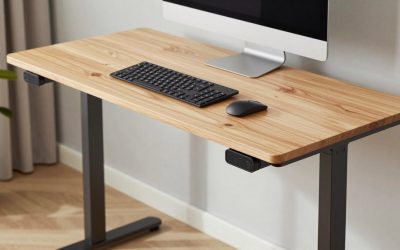
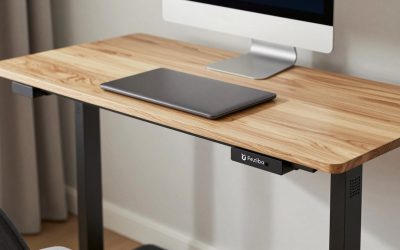
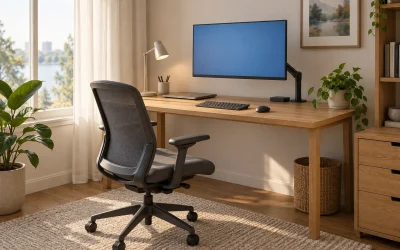
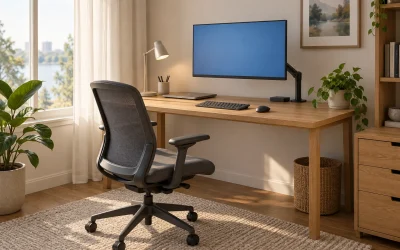
A desk 75–80 cm deep leaves room for a document in front of the keyboard as well as the monitors. Pair it with a task lamp that throws 500 lux or more onto paper without reflecting on the screens.
Security and confidentiality
Client financial data is sensitive, and professional bodies and regulators expect it to be protected. Use a lockable filing cabinet for paper records and a cross-cut shredder for disposal. Position monitors so they are not visible from a window or doorway, or add a privacy filter. Keep the work computer separate from family use, with full-disk encryption and automatic screen locking. A UPS protects against losing work during a power cut and gives you time to save during filing deadlines.
Ergonomics for peak season
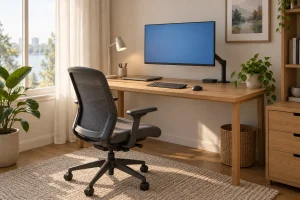
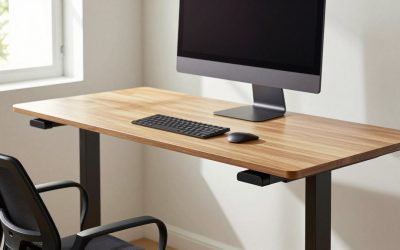
During busy periods, the hours climb and the posture tends to collapse. A fully adjustable chair with adjustable armrests supports the forearms during long keying sessions. A sit-stand desk lets you take calls or review documents standing. Set reminders to stand and look away from the screens every 30–45 minutes; the 20-20-20 rule (every 20 minutes, look 20 feet away for 20 seconds) is a simple habit for reducing eye fatigue.
FAQ
Is an ultrawide better than two monitors for accounting?
An ultrawide shows very wide sheets without a centre bezel, while two monitors are better for side-by-side separate applications and portrait documents. Many accountants prefer two monitors with one rotated to portrait.
Do I need a separate number pad if my laptop has one?
If you work at a desk with external monitors, yes. Laptop keypads are cramped and force you to type with the screen too low.
Bottom line
An accountant’s home office should be built for peak season: two screens with one in portrait, a tenkeyless keyboard with a flexible numeric keypad, a fast duplex scanner, a deep desk with good task light, and strong physical and digital security for client data.
Ready to decide? Our #1 pick for 2026 is the Two 24-inch 1080p.
Live price & availability on Amazon.
Related Reviews & Guides
Uplift V3 vs Herman Miller Nevi
How to mount a webcam on a monitor arm