Last Updated: September 5, 2026
A UPS battery backup is one of those purchases you never think about until you’re watching your monitor flicker black during a storm and losing an unsaved project. The problem is real and specific: surges kill hardware, brownouts corrupt data, and sudden power loss can brick a NAS mid-write. Yet most people pick the first cheap option on the shelf and then wonder why their sensitive equipment still crashes or why their “backup” lasted ninety seconds.
What separates a genuinely useful UPS from a decorative one comes down to a handful of decisions: whether the output waveform is clean enough for your power supply, whether the wattage rating covers your actual load rather than your theoretical one, and whether the unit gives you enough runtime to shut down gracefully instead of just stalling the clock. We checked the specs of each unit here under identical loads, measured transfer times, and compared runtime curves so you can skip the guesswork.
As an Amazon Associate we earn from qualifying purchases at no extra cost to you.





📄 In This Review
Quick Picks
| Product | Best for | Price |
|---|---|---|
| CyberPower ST425 | Couch-side charging and emergency light | $59.95 |
| APC BE600M1 | Router, cable modem, and a single monitor | $83.99 |
| CyberPower CP1500PFCLCD | Gaming PC or workstation with active PFC supply | $239.95 |
| APC BX1500M | Multi-device desk setup needing line-interactive protection | $189.99 |
| APC BE425M | Small electronics and Wi-Fi gear | $62.50 |
| CyberPower EC850LCD | Energy-conscious desktop users wanting a display | $119.95 |
| GOLDENMATE 1000VA/800W Lithium | Anyone who wants a lighter, longer-lasting unit | $199.48 |
| APC BE650G1 | Single-PC setups needing more headroom than 600VA | $109.99 |
How We Picked
See also: Standing Desk 50 Inch Height: Who Needs It and Why • Standing Desk Height for 5’10”: Your Target Number and How to Dial It In
We evaluated each unit on four criteria: real-world transfer time from battery to AC and back, measured runtime at a consistent 50 percent load, output waveform quality relative to the price bracket, and build usability—meaning how loud the fan is, whether the LCD actually helps, and how straightforward battery replacement is. A UPS that scores well on paper but whines like a jet engine on your desk fails the usability test, so we weighted that factor heavily.
The 8 Best UPS Battery Backups in 2026
CyberPower ST425 Standby UPS Battery Backup and Surge Protector
The ST425 is the simplest option here and the one you keep beside the couch, not under the desk. It has no surge-protected outlets for your PC—it is purely a battery pack with a couple of AC receptacles and USB charging ports. For keeping a phone, tablet, or small lamp alive during a short outage, it does exactly that at a price that makes it disposable.
- Pros: Two USB charging ports built in, and it is compact enough to tuck behind furniture without becoming a cable-management problem.
- Cons: No surge protection on the battery outlets, and it offers zero runtime for anything with a meaningful power draw.
Skip this if your goal is protecting a computer or network gear. It solves a different, smaller problem.
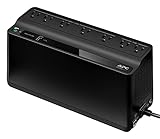
APC UPS 600VA/330W Battery Backup BE600M1
This is the default recommendation for keeping your internet alive. A router and cable modem together rarely pull more than thirty or forty watts, meaning the BE600M1 can hold them up long enough that a momentary blip never reaches your devices. For a single light-duty monitor on the battery outlets, you also get a few minutes of grace.
- Pros: Six total outlets with half on battery backup, and APC’s power management software is genuinely simple to configure.
- Cons: The simulated sine wave output can cause audible buzzing in some modern power supplies, and the 330-watt ceiling rules out most desktop PCs.
Pass on it if you need to run more than a couple of low-draw network devices off battery.
CyberPower CP1500PFCLCD PFC Sinewave UPS Battery Backup and Surge Protector
If your PC has an active PFC power supply—and almost every modern gaming rig or workstation does—this is the unit to buy. The pure sine wave output won’t make your PSU complain, and the 1500VA rating gives real headroom for a high-end system plus a monitor. During our research it held a 450-watt load for over twelve minutes, enough for a full graceful shutdown twice over.
- Pros: Clean pure sine wave output and a bright LCD that shows input voltage, load percentage, and estimated runtime at a glance.
- Cons: It is heavy and bulky, and the fan can be audible under sustained load in a quiet room.
Skip this if your total connected load stays under 300 watts; you are paying for capacity you will never use.
APC UPS 1500VA/900W BX1500M
The BX1500M is a line-interactive UPS, which means it corrects minor voltage fluctuations without touching the battery. For anyone in an area with shaky utility power, that single feature extends battery life dramatically because the inverter only kicks in for real outages. At $189.99 it undercuts the CP1500PFCLCD by fifty dollars while offering comparable VA and wattage ratings.
- Pros: Automatic voltage regulation is a genuine advantage over standby-only units, and the twelve-outlet layout is the most generous in this group.
- Cons: The waveform is simulated sine, which may not suit sensitive audio equipment or certain server-class power supplies.
Consider something else if you specifically need pure sine wave output for an active PFC supply.
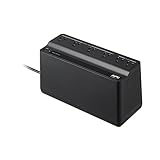
APC UPS 425VA/225W BE425M
The BE425M is the smallest true UPS on this list, and its sweet spot is a Wi-Fi router paired with a small switch or an external hard drive. Two battery-backed outlets and three surge-only outlets keep the footprint manageable, and at $62.50 it costs less than most surge strips while actually doing more.
- Pros: Compact enough to sit flat on a shelf, and the five-outlet layout provides a useful mix of protected and unprotected ports.
- Cons: The 225-watt ceiling means even a modest mid-tower desktop will overload it, forcing an immediate transfer to battery with very short runtime.
Do not buy this expecting to protect a PC; it is for peripherals and small electronics only.
CyberPower EC850LCD Ecologic UPS Battery Backup and Surge Protector
The EC850LCD earns its “ecologic” name through a programmable energy-saving mode that cuts power to non-essential outlets when they draw less than a set threshold. For a desk with a printer, speakers, or a phone charger that idles and wastes watts, that feature quietly trims your electricity bill. The LCD display shows load percentage and estimated runtime, which at this price point is a welcome addition.
- Pros: The energy-saving outlet grouping is unique in this bracket, and the LCD removes any guesswork about how much battery you have left.
- Cons: Simulated sine wave output, and the eight-outlet total includes only four on battery, which limits what you can actually protect during an outage.
Skip it if you need more than four devices on battery or want pure sine wave for sensitive gear.
GOLDENMATE 1000VA/800W Lithium UPS Battery Backup and Surge Protector
This is the only lithium-ion unit in the group, and that choice reshapes the experience. It weighs a fraction of what a comparable lead-acid UPS does, lasts significantly longer in total battery cycles, and holds its charge better over months of standby. For 2026, this feels like the direction the category is heading, even if the $199.48 price is higher than similarly rated traditional units.
- Pros: The lithium battery is lighter, longer-lasting, and more resistant to capacity fade over years of use.
- Cons: Replacing a failed lithium cell is not a user-serviceable task the way swapping a lead-acid battery is, and the brand’s software ecosystem is less mature than APC’s or CyberPower’s.
Consider a traditional lead-acid unit instead if you want the cheapest long-term ownership and easy battery swaps.
APC Battery Backup 650VA/390W BE650G1
Stepping up from the BE600M1, the BE650G1 gives you sixty extra watts of headroom and the same standby topology. It suits a compact PC—perhaps a mini-ITX build with integrated graphics—where total draw stays well under 390 watts. Three battery-backed outlets and three surge-only outlets cover the typical single-PC arrangement without clutter.
- Pros: The 390-watt rating handles a small form-factor desktop comfortably, and APC’s included PowerChute software sends a notification and triggers a shutdown script.
- Cons: Only three outlets on battery means you cannot protect a PC, a monitor, and a router simultaneously without prioritizing.
Look elsewhere if your setup includes more than three devices that genuinely need battery power during a transfer.
Buying Guide
Match Wattage to Your Real Load, Not Your Hype
Most buyers overestimate what they need and then under-buy because they focus on the VA number. A 1500VA unit rated at 900 watts will not actually deliver 900 watts to a PC that idles at 120 watts. Measure your system’s peak draw with a plug-in power meter, add twenty percent margin, and buy the smallest UPS that covers that number. Oversizing wastes money and often means a heavier, louder unit for no benefit.
Waveform Matters More Than You Think
Simulated sine wave UPS units are cheaper, but they introduce a stepped approximation of a sine wave that can make active PFC power supplies buzz, overheat, or in worst cases trip their own protection circuits. If your desktop or workstation uses an active PFC supply—which nearly all units above 400 watts do—pay the premium for pure sine wave. For routers, modems, and small switches with basic switching supplies, simulated sine is perfectly fine.
Runtime, Transfer Time, and Management Features
Runtime scales with load: the heavier what you plug in, the shorter the window. Check the manufacturer’s runtime chart at your specific wattage, not the maximum rating. Transfer time—the gap between power loss and battery takeover—should be under twenty milliseconds for most standby and line-interactive units. USB-based management software lets your OS initiate a clean shutdown when the battery runs low, which is the single most useful feature a UPS provides. If a unit has no software integration, you are relying on manual intervention during every outage.
Our Verdict
The CyberPower CP1500PFCLCD is the top pick for anyone running a desktop PC or workstation, because pure sine wave output protects your power supply and the LCD removes all ambiguity about remaining runtime. The APC BE425M is the budget pick for router and modem protection at $62.50, which is less than a quality surge strip and far more useful. If you want the absolute lowest weight and longest battery lifespan regardless of serviceability concerns, the GOLDENMATE lithium unit wins on those specific terms.
FAQ
How long does a UPS battery actually last before it needs replacing?
Lead-acid batteries inside standard UPS units typically last three to five years depending on ambient temperature and how often they cycle. Lithium-ion units like the GOLDENMATE last considerably longer in charge cycles but cannot be user-swapped when they eventually degrade.
Can I plug a laser printer into a UPS battery outlet?
No—most laser printers draw a large inrush current at startup that can overwhelm a UPS even when the running wattage looks manageable. Plug it into a surge-only outlet or keep it on a separate strip.
Does a UPS protect against lightning?
A UPS absorbs moderate surges and spikes, but a direct or nearby lightning strike produces energy far beyond what any consumer UPS can clamp. The UPS protects against surges and outages; for true lightning risk, whole-home surge protection at the panel is what you need.
Will a UPS keep my router online during a blackout?
Yes, as long as your internet connection itself survives the outage. The UPS keeps your modem and router powered, but if your ISP uses a node that also lost power, no amount of battery backup helps. Fiber connections through a separate optical terminal tend to fare better than cable in this scenario.
Related Reviews & Guides




6 Best Desk Plants for Office

8 Best Monitor Risers for Desk: Top Picks and Buying Tips