Last Updated: September 29, 2026
A compact desk changes the chair equation. The chair has to slide under the desktop, clear any drawer or keyboard tray, turn without scraping the wall, and still support you for hours. Oversized executive and gaming chairs routinely fail at least one of those tests. This guide gives you the measurements to check, sensible target dimensions, and the trade-offs that come with shrinking a chair to fit a small workspace.
📄 In This Review
Quick answer: Our top pick in 2026 is the Overall width — our #1 rated choice. See the full ranked comparison, alternatives and buying advice below.
The five measurements that decide fit
Desk underside clearance
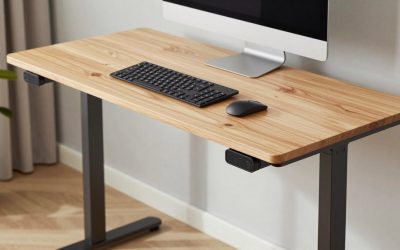
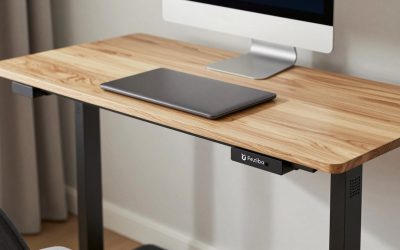
Measure from the floor to the lowest point under the desk where your legs and the chair arms go, which may be a drawer, apron or crossbar rather than the desktop itself. Many compact writing desks have 24 to 26 inches of clearance; standard desks sit around 27 to 28 inches.

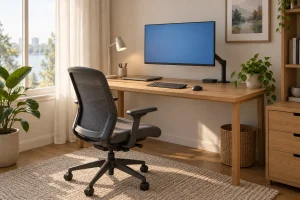
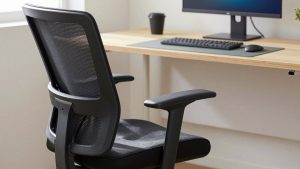
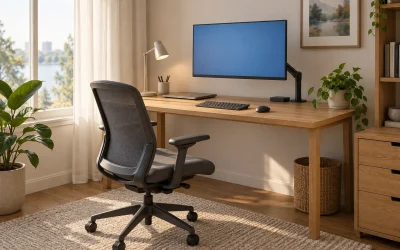
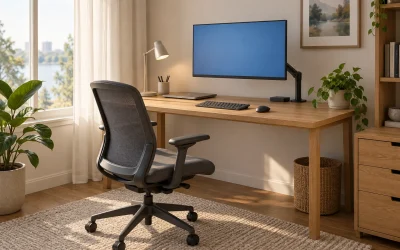
HUANUO Ergonomic Office Chair with 3D Armrests and Lumbar Support
Included for 'Office Chair Dimensions for Small Desks' as a relevant option in this category; details come from the product listing.
View on AmazonArmrest height at your working seat height
Set your seat so your feet are flat and knees near 90 degrees, then note how high the armrests sit. If they are taller than the desk clearance, the chair cannot tuck in, and you end up sitting farther from the keyboard. Height-adjustable arms that drop to 7 inches above the seat, or flip-up arms, solve most conflicts.
Overall chair width
Measure the widest point, usually armrest to armrest. Compact desks often have 20 to 24 inches between legs or drawer pedestals. The chair base spins beneath, but the arms must pass between the legs.
Base diameter
A five-star base is typically 24 to 28 inches across. In a nook or a spare-room corner, a 24 to 25 inch base leaves room to swivel without clipping skirting boards.
Room depth behind the desk
Allow the chair depth plus 12 to 18 inches to push back and stand up. A chair that is 25 inches deep needs about 37 to 43 inches from desk edge to wall.
Target dimensions for small desks
See also: Best Roku Streaming Deals Reviewed • Olipop Flavors Ranked: Best Tastes from Worst to Best
| Dimension | Typical full-size chair | Small-desk target | Why it matters |
|---|---|---|---|
| Overall width | 26 to 30 in | 22 to 25 in | Passes between desk legs or pedestals |
| Overall depth | 25 to 28 in | 22 to 25 in | Less push-back space needed |
| Base diameter | 26 to 28 in | 23 to 25 in | Swivels in tight corners |
| Arm height range | Fixed or 3 in travel | 4 in travel or flip-up | Clears desk apron |
| Seat width | 20 to 22 in | 18.5 to 20 in | Narrower overall footprint |
| Back height | High-back with headrest | Mid-back | Less visual bulk, clears shelves |
What you give up with a smaller chair
Narrower seats can feel restrictive for broader hips; check that the usable seat width is at least 2 inches wider than your hip width when seated. Mid-back chairs end around the shoulder blades, which is fine for upright work but less comfortable for reclining. Armless chairs are the ultimate space saver but remove forearm support, so they work best when the desk surface itself sits at elbow height and supports your forearms.
Weight capacity can also drop. Many compact task chairs are rated for 220 to 250 lb rather than 275 to 300 lb. If you are near that limit, choose a full-width seat with flip-up arms instead of a fully downsized chair.
Smart choices for common small-desk setups
Bedroom writing desk with a centre drawer
The drawer often cuts clearance to 23 to 24 inches. An armless or flip-arm chair with a seat that drops to 16 inches works best. Consider removing the drawer if it is barely used; that alone can recover 3 to 4 inches.
Floating or wall-mounted desk
There are no legs to squeeze between, so width matters less, but depth is often shallow at 18 to 20 inches, so you sit closer to the wall. A compact 23 to 24 inch base and mid-back profile keep the room from feeling crowded.
Corner desk in a studio
The inside corner leaves generous knee space but little room behind. Choose a chair with a 24 inch base and smooth hard-floor casters so it rolls rather than drags on a rug.
Checklist before you order
- Desk clearance minus 1 inch should exceed armrest height at your seat setting.
- Chair width should be at least 1 inch narrower than the gap between desk legs.
- Seat height range should let your feet sit flat with thighs level.
- Base diameter plus 6 inches should fit your swivel zone.
- Confirm the return policy; fit problems are the top reason chairs go back.
FAQ
Are armless chairs a good idea for small desks?
They are the most space-efficient option and let you pull fully under the desk. They work well if your desk height matches your elbow height so forearms rest on the surface. If you type with elbows hanging, choose flip-up or low adjustable arms instead.
What seat height works with a 28 inch desk?
For most adults, a seat height between 17 and 20 inches pairs with a 28 to 29 inch desk. Shorter users may need a lower seat plus a footrest to keep elbows level with the keyboard.
Bottom line
For a small desk, measure clearance, leg gap and room depth first, then shop for a chair around 22 to 25 inches wide with a 24 inch base and adjustable or flip-up arms. Downsizing costs you some recline comfort and seat width, so size down only as far as your space requires, and keep the core adjustments of height, lumbar and depth.
Ready to decide? Our #1 pick for 2026 is the Overall width.
Live price & availability on Amazon.