Last Updated: September 29, 2026
Logitech’s MX Keys and MX Mechanical are two answers to the same question: what does a productivity keyboard for a multi-device desk look like? One is a low-profile scissor-switch board with a famously comfortable typing feel; the other brings mechanical switches to the same ecosystem. This review compares the two, explains the shared MX features that make them so sticky, and helps you decide which layout and switch fits your desk.
📄 In This Review
The shared MX ecosystem
Both keyboards live in Logitech’s MX productivity line, which means they share the features that matter most for daily work: multi-device pairing across three channels, USB-C charging, Logi Options+ customization, and Flow, which lets one keyboard and mouse move between multiple computers. You can type on your work laptop, tap a button, and keep typing on a personal desktop—the same board, no re-pairing.
Multi-device and connectivity
| Feature | MX Keys / Keys S | MX Mechanical |
|---|---|---|
| Switch type | Low-profile scissor | Low-profile mechanical (tactile/linear/clicky) |
| Device channels | 3 (Bluetooth + Bolt receiver) | 3 (Bluetooth + Bolt receiver) |
| Backlight | Smart, proximity-activated | Smart, per-key, multiple effects |
| Charging | USB-C | USB-C |
| Battery (backlight on) | ~10 days | ~15 days |
| Battery (backlight off) | Up to ~5 months | Up to ~10 months |
| Sizes | Full + Mini (TKL) | Full + Mini (TKL) |
Typing feel
See also: Best Roku Streaming Deals Reviewed • Olipop Flavors Ranked: Best Tastes from Worst to Best
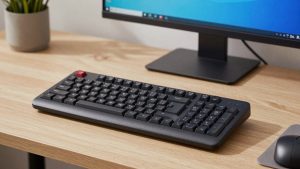
The MX Keys uses spherically dished scissor keys that cradle the fingertips; it is quiet, low-effort, and one of the most comfortable flat keyboards for people who came from laptops. The MX Mechanical offers low-profile mechanical switches—usually tactile brown-style, with linear and clicky options—so you get travel and a defined actuation without the tall stack height of full-size mechanical boards.
Which switch to pick
On the MX Mechanical, tactile switches suit most office users who want feedback without noise; linear switches are smoother and quieter for shared spaces; clicky switches are loud and satisfying but poor for calls and open offices. If you are unsure and mostly type documents and email, the MX Keys scissor feel is the safer, quieter default.
Layout and ergonomics
| Consideration | Full-size | Mini / TKL |
|---|---|---|
| Numpad | Yes | No |
| Mouse ergonomics | Mouse sits farther right | Mouse closer, less shoulder reach |
| Data entry | Ideal | Awkward |
| Desk footprint | Larger | Compact |
The Mini (TKL) versions drop the number pad, which pulls your mouse hand closer to your body and reduces shoulder reach—an underrated ergonomic win for people who do not crunch numbers all day. If you live in spreadsheets, the full-size layout with a dedicated numpad is worth the extra width. Both boards have a fixed, slight incline; neither offers steep tenting for aggressive ergonomic angles.
Software and customization
Logi Options+ ties it together. You can remap the F-key row to app-specific actions, tune backlight behavior, and set up Flow. Smart Actions let a single keypress trigger a sequence—open apps, set volume, launch a meeting layout. The proximity-activated backlight lights up as your hands approach and dims when you leave, which is part of why battery life stretches into weeks or months.
Where they compromise
Neither keyboard is hot-swappable, so you cannot change switch feel later. The low-profile mechanical switches, while excellent, have fewer aftermarket keycap options than standard-profile boards. And for pure gaming, dedicated gaming keyboards offer faster polling and features these productivity boards deliberately skip. Both boards also use a fixed incline with only a modest riser, so if you want steep negative tilt or split-hand tenting for aggressive ergonomics, neither MX model delivers it—they are refined flat boards, not ergonomic split keyboards.
Battery behavior deserves a note too: the proximity-sensing backlight is the single biggest factor in runtime. Leave it on in a dim room and it drains in a week or two; turn it off or work in bright ambient light and both boards stretch for months on a charge. USB-C means a quick top-up gets you going again, and you can keep typing while charging.
FAQ
MX Keys or MX Mechanical—which should I get?
Choose MX Keys if you want the quietest, most laptop-like flat typing and the lowest fuss. Choose MX Mechanical if you miss the travel and feedback of mechanical switches but still want a slim board with the full MX feature set. Both share multi-device pairing, USB-C, and Flow, so the decision really comes down to switch feel and noise.
Can one keyboard control two computers?
Yes. Both boards pair to three devices and switch with dedicated keys, and with Logi Flow plus an MX mouse you can move the cursor across machines and even copy-paste between them. This is the core reason the MX line is popular with people running a work laptop and a personal desktop side by side.
Bottom line
The MX Keys and MX Mechanical are the same great productivity platform in two feels: quiet dished scissor keys or low-profile mechanical travel. Both give you three-device switching, USB-C charging, weeks-to-months of battery, and deep Logi Options+ customization. Pick MX Keys for silent comfort, MX Mechanical for tactile feedback, and choose the Mini layout if pulling your mouse closer matters more than having a numpad.